Currently viewing: Growth – Southern Africa / Next: Quality – Southern Africa
 Growth – Southern Africa
We paused our investment in southern Africa's growth due to COVID-19. Instead, our focus shifted to a cash preservation strategy in the short term, until such time where we have better clarity on the longer-term impact of COVID-19. We are confident that we will be well-positioned to achieve our long-term growth objectives.
Our 2020 priorities |
||
|
||
|
||
|
||
|
||
|
||
|
||
|
||
|
||
|
||
|
ACHIEVED
PARTIALLY ACHIEVED
ONGOING OR NOT ACHIEVED
DELAYED DUE TO COVID-19
This financial year comprised two distinct periods. Firstly, our growth strategy performed against expectations before the COVID-19 outbreak. We grew our PPDs in a flat market by 2% at the end of February, mainly due to a focus on driving our key referrer channels, our continued doctor recruitment and the improved occupancy within our new mental health facility.
However, from March 2020, our focus shifted away from our growth initiatives to meet the unique challenges posed by COVID-19. A number of growth projects were put on hold and capex was curtailed as the business focused on cash preservation. The pandemic had a significant impact, with the business experiencing a decline in elective cases and non-COVID-19 medical cases.
The southern African business experienced 39.3% occupancy in April 2020 due to the national level 5 lockdown and the absence of elective cases. However, occupancy levels started to improve as elective cases returned in May and, despite a decline during June and July, the number of COVID-19 cases increased and, with it, occupancy levels reached just over 66% in July. Occupancies declined again during August and September as the increase in medically necessary procedures was slower than the drop off in COVID-19 cases.
Revenue during April 2020 was approximately 40% below April 2019, but continued to improve month-on-month – during July 2020, revenue was 11% below July 2019 and, in September 2020, approximately 5% below September 2019.
Although normalised EBITDA during April 2020 was at a breakeven point, the southern Africa operations subsequently contributed positively to normalised EBITDA over the remaining half of the year.
We expect to see a recovery in the number of elective surgical and medical cases over the first half of 2021, subject to how the COVID-19 pandemic plays out over this period. Cash preservation will remain a focus going forward, and we will:
| Indicator | Year-on- year trend |
2020 | 2019 | 2018 | ||||
| PPDs1,2 |  |
1 914 159 | 2 269 756 | 2 251 600 | ||||
|---|---|---|---|---|---|---|---|---|
| Occupancy3 (%) | |
58.4 | 69.7 | 69.7 | ||||
| Length of stay (LOS) (days)4 |  |
4.08 | 3.76 | 3.72 | ||||
| Number of healthcare facilities |  |
66 | 66 | 66 | ||||
| Number of registered beds | |
9 151 | 9 136 | 9 055 | ||||
| Number of acute facilities | |
49 | 49 | 50 | ||||
| Number of dedicated acute rehabilitation facilities | |
7 | 7 | 7 | ||||
| Number of dedicated mental health facilities | |
9 | 9 | 8 | ||||
| Number of renal dialysis facilities | |
29 | 26 | 26 | ||||
| Number of specialised maternity units | |
1 | 1 | 1 | ||||
| Number of oncology units | |
5 | 5 | 5 |
| 1 | PPDs refer to a unit of time during which the services of the institution or facility are used by a patient. |
| 2 | This indicator is externally assured.  |
| 3 | The number of beds in SA facilities utilised by patients. |
| 4 | The average amount of time spent in hospital per patient visit. |
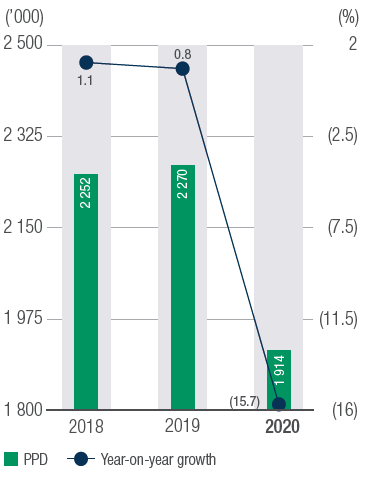
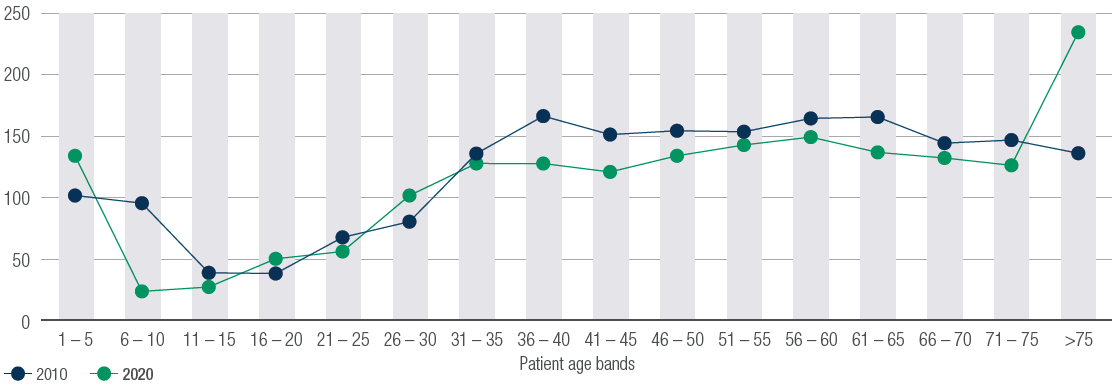
We experienced pleasing PPD growth before the COVID-19 outbreak, with a February year-to-date increase of 2% compared with a PPD decline of 0.1% in 2019. Theatre minutes increased by 2.0%, and the number of cathlab cases increased by 7.1%. However, COVID-19 and the resultant lockdowns negatively impacted elective surgical cases, driving down theatre minutes. In addition, the reluctance of people to visit a hospital during the COVID-19 crisis – even for serious conditions – negatively impacted several areas of our business, including cathlab facilities, where cases were down on prior year. Overall PPDs declined by 15.7% from 2019.
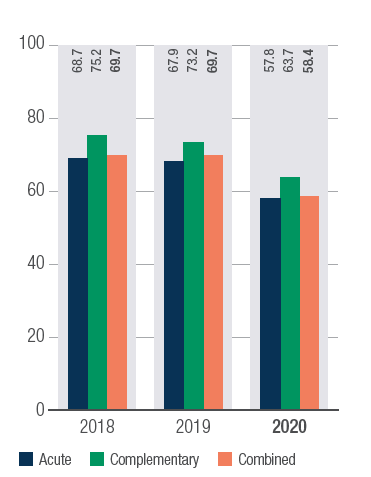
As a result of the decline in PPDs, our overall occupancy levels decreased from 69.7% in 2019 to 58.4% in 2020. COVID-19 impacted the occupancy mix within our acute hospitals, with ICU and high-care occupancy levels remaining high at 65.3% (2019: 68.0%). General ward occupancy was impacted more severely, with occupancies of 49.7% (2019: 60.7%).
Within the complementary services division, our mental health facilities were significantly impacted by the pandemic and resultant lockdowns. The business started to see a steady recovery in occupancy since June 2020. The acute rehabilitation facilities were negatively affected by reduced demand for surgery and trauma-related events, but continued operating at satisfactory occupancy levels.
We suspended all expansion initiatives as part of our cash preservation strategy in response to COVID-19, placing all planned brownfield expansions on hold.
Our oncology business was negatively impacted by COVID-19, and we saw a reduction in the number of new patients treated during the year. This trend was not unique to Life Healthcare, and the number of check-ups and cancer screenings declined worldwide. The number of oncology patients increased from August onwards, but we remain concerned about the long-term impacts of delayed oncology diagnosis on our patients.
Pleasingly, our renal dialysis facilities increased to 29 during the year. Acute dialysis declined year-on-year due to COVID-19 and a reduced number of patients were admitted to ICU. However, chronic treatments continued to grow throughout the year.
Life Esidimeni
We partner with the South African government through Life Esidimeni to provide patient-centred, compassionate services to the most vulnerable South Africans. Our centres focus on recovery and rehabilitation, as well as clinical treatment and care, and we are a third-party primary healthcare provider for the Department of Correctional Services.
Life Esidimeni reacted quickly to the COVID-19 threat introducing appropriate Covid-19 protocols and guidelines, ensuring employees and patients had sufficient PPE and working closely with the acute hospital business, the NICD, doctors and government. Despite these challenges revenue increased by 8.4% over the prior year, driven by a 1.9% decrease in PPD volumes and improved tariffs. EBITDA margins were negatively impacted due to the increased costs of managing Covid-19 including, additional PPE and screening costs, setting up COVID-19 isolation wards and increased agency costs due to employees in isolation and quarantine.
We continued to strengthen our relationships with existing clients during the year, and all contracts were renewed except for the Eastern Cape Frail Care centre, which is still under court order. We received additional requests from the DOH to accommodate more patients, with additional mental health beds from the Gauteng DOH. Occupancies in mental health and frail care centres remain high.
Going forward, we will focus on growing existing contracts within Life Esidimeni and focus on new business developments. Specifically, we will endeavour to expand our Life Esidimeni footprint to KwaZulu-Natal, the Free State and the North West.
Life EHS
Life EHS is South Africa's leading provider of contracted on-site occupational, primary healthcare and wellness services to large employer groups. We focused on strengthening our relationships with customers and maximising efficiencies this year by exiting non-performing contracts. We are pleased that overall revenue increased by 5.9% despite a loss in contracts and the impacts of COVID-19. This was mainly driven by price negotiations concluded before the COVID-19 outbreak, operational consolidation and integration, the sale of COVID-19-related products - including the launch of the innovative Life RISK Solution to over 35 000 employees, and the management of 15 isolation and quarantine facilities - and new contracts won in the wellness space.
Life EHS launched several new service offerings during the year, including offerings relating to COVID-19, such as:
We expect the revenue from these new offerings to offset any losses caused by the pandemic. Going forward, we will further support the growth of Life EHS by:
| Indicator | Year-on- year trend |
2020 | 2019 | 2018 | ||||
| Number of Life EHS clinics (Life Occupational Health) | |
281 | 310 | 301 | ||||
|---|---|---|---|---|---|---|---|---|
| Number of lives covered through Life EHS occupational health | |
226 378 | 210 589 | 211 086 | ||||
| Number of lives covered by Life EHS (employee wellness) | |
379 680 | 383 082 | 367 670 |
New business in our employee wellness offering continued to grow during the year. The number of lives under administration decreased by 0.9% (2019: 4.2% increase). We will continue enhancing our network of affiliates and will leverage our existing care centres to improve our virtual service offerings.
MyLife Healthcare Centre (MyLife)
MyLife continued to offer high-quality primary healthcare provided by nurses and supported by doctors through virtual consultations. This year, we focused on growing our clinic footprint, piloting several different service modalities and price points, as well as implementing various marketing strategies.
| Geographical location and indicator | Year-on-year trend | 2020 | 2019 | |||
| Number of MyLife clinics | |
6 | 2 | |||
|---|---|---|---|---|---|---|
| Number of patient consultations | |
5 492 | 4 199 |
We relocated our flagship clinic at Campus Square to Life Brenthurst Hospital during the year, successfully migrating our patient base. We also launched six clinics across Gauteng, the Western Cape and Mpumalanga.
Our patient volumes are steadily increasing, from 4 199 in 2019 to 5 492 in 2020. However, remaining well below what we expected. We launched a marketing campaign in response, which gained significant traction until the government-imposed lockdown.
Due to the pandemic, many of our product development and system enhancements were delayed, while we focused on development products that would support our employees and patients during this critical time. A free COVID-19 symptom tracker and Direct2Patient virtual consultations ensured that our employees and patients were as well protected as possible.
With nursing employees significantly impacted, our clinic operating hours were reduced, although all clinics remained open and operational throughout the pandemic. We maintained a customer satisfaction score of 95% and enhanced our intellectual capacity, and we intend to remain flexible during this uncertain time while continuing with our growth strategy.
Our 2021 priorities |
|
|
|
|
|
|
|
|
|
|