Currently viewing: Our response to COVID-19 / Next: How we create value
The COVID-19 pandemic created an extraordinary situation medically, socially and economically during 2020, and had a significant impact on the Group. Geographically, our operations are diverse, and the timing of the spread of the virus and the associated responses of different governments has been varied.
Life Healthcare established a response framework and adopted an integrated approach to combating the pandemic within our various geographies. Strong teamwork, across functions and close collaboration with doctors, suppliers and external stakeholders played a key role in allowing the Group to effectively respond to the challenges of the difficult operating environment.
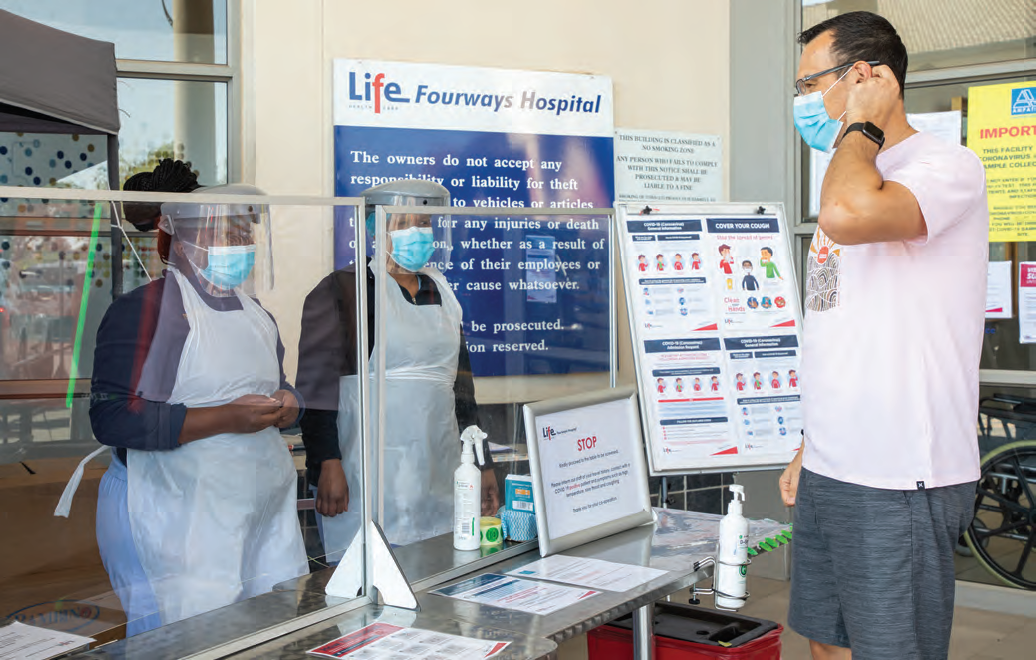
The safety and wellbeing of our employees, our doctors and our patients remain our key priority. We have taken a multi-faceted approach to dealing with risks to our business and quickly adopted a level of agility required in times of crises.
Various protocols and measures that have been introduced have now become embedded into the organisation and will remain in place in perpetuity.
Our continued focus will be on ensuring flexibility in responding to a pent-up demand or potential second wave impact across the business, with delivery of clinical excellence and ongoing safeguarding of our financial position.
We implemented specific operational, staffing and clinical interventions in response to COVID-19 in all our facilities, guided by the National and Provincial Departments of Health (DoH), the National Institute of Communicable Diseases (NICD), the World Health Organization (WHO), including input from various medical societies and experts.
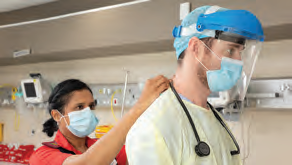
Providing adequate personal protective equipment (PPE) for our frontline employees, doctors and allied professionals working at our hospitals has been a key priority. To secure stock, we expanded our supply lines and collaborated on various industry initiatives, including the Business for South Africa (B4SA) initiative.
As at the end of the financial year, Life Healthcare had admitted approximately 11 000 patients with COVID-19. The peak number of admissions was 1 658 in the latter part of July 2020 and by the end of September 2020, the total number of admissions had dropped below 300. The average age of admitted patients was 54 years. In total, 15% of admitted patients succumbed to the disease, a case fatality rate for hospitalised patients similar to that of the private hospital sector in general. More than 2 800 personnel in our hospitals became infected, with nearly 2 000 of these being nurses and 139 being doctors. Tragically, 19 employees have passed away from COVID-19.
|

|
The outbreak of COVID-19 highlighted the importance of engagements between the public and private sectors in South Africa. Guided by our belief that healthcare providers have a moral obligation to partner with government, we were ready to assist the South African government in various ways to treat public sector patients in our facilities. New channels of communication opened up with government at both national and provincial level. We actively approached provincial legislatures' portfolio committees to keep them abreast of measures taken in their respective provinces, including information on bed availability, with the information and our willingness to collaborate being favourably received. Extensive discussions were held on the arrangements to manage the transfer of patients between public and private sector, should the need arise - with varying degrees of success in different provinces. The pandemic also presented a unique opportunity to collaborate with our doctors, such as:
|
 For more information on how COVID-19 affected our operational performance, refer to our southern Africa performance
At the outset of the pandemic, our international teams established response frameworks according to the various government measures and healthcare policies. This allowed our teams to ensure that all country-specific government measures and policy guidelines were followed, while also considering the Group's overarching guidelines. By adapting our operational procedures to best reflect the situation in each country where we operate, we were able to effectively partner with government and national health providers to support their pandemic responses.
Throughout the pandemic, our first priority was to protect the health and safety of our employees and patients. Due to the nature of our operations, employees were impacted differently based on their roles. Therefore, each business introduced a flexible approach in responding to COVID-19 to ensure the safety and well-being of each employee. We expect that the measures we have introduced over the past year will remain in place for the foreseeable future.
Internationally across geographies, fewer than 200 international employees have become infected, with no deaths.
|
In the UK, Alliance Medical reached an agreement with the National Health Service (NHS) to secure average payments for the national PET-CT contract from April to June 2020. This enabled us to continue providing this essential service to our patients, while also protecting both revenues and employment. Similar average revenue agreements contracts are being discussed with individual NHS trusts. We also secured an additional contract with the NHS to provide CT scanners and employees to support the government's COVID-19 response. International teams utilised government support schemes where available and appropriate, which included deferred insurance contributions and tax opportunities, preferential business loans and employment protection funds. |
For more information on how COVID-19 affected our operational performance, refer to our international performance section.
| Group | Southern Africa |
International | |||
| Revenue | R2 710 million | R2 273 million | R428 million | ||
|---|---|---|---|---|---|
| EBITDA | R2 077 million | R1 786 million | R291 million |
|
We immediately introduced measures to safeguard our financial stability as volumes declined during the COVID-19 crisis, including:
|
Charitable donations
|
Our executive committee decided to suspend their short-term incentive and, along with our non-executive directors, voluntarily donated up to 30% of their salaries for six months to funds that we established to benefit Life Healthcare employees and contractors impacted by the pandemic. During the COVID-19 period, we provided 770 employees who could not isolate or quarantine at home with Companyfunded
accommodation. Additionally, the Employee Assistance Fund paid out R5.8 million in support of 1 435 employees
during these unprecedented times. The Company also paid out a gratuity bonus totalling R45 million to 14 947 employees.
We have donated R1.5 million towards a food relief project that will provide approximately 4 000 food parcels to communities
across Gauteng, the Western Cape, Eastern Cape, North-West, Mpumalanga, Limpopo, KwaZulu-Natal and the Free State.
Each food parcel feeds a family of four for one month. We additionally donated approximately 2 000 cloth masks for students
and employees at the SANCB Optima College, and 750 cloth masks to the volunteer employees at SA Depression and
Anxiety Group – an NGO with a focus on mental health. We also provided funding to families for the funerals of employees
who tragically lost their lives as a result of |
What we could have done differently
COVID-19 provides Life Healthcare with a learning opportunity unprecedented in our lifetime. As a result, we are documenting our learnings in a handbook which will prepare us better for future infectious epidemics which might emerge within, or be imported into, the countries within which we operate, as well as improve on the speed of operational decision making.
We do think we did many things right and will build on those but our improvements come from identifying shortcomings and responding to them.
In spite of their known financial constraints, the aggressive recruitment of nurses by the public sector, took the private sector by surprise. With high-paying short-term contracts of a year, the public sector attracted a significant number of nurses from the private sector, often to field hospitals that were underutilised. Short-term retention schemes for our staff need to be considered early on when there is such a high demand for a healthcare human resource.
We did introduce a campaign to ensure that the non-pharmaceutical interventions (handwashing, cleaning of surfaces, maskwearing and social distancing) became part of everyday behaviour. It is essential that in any disease outbreak we support and educate our staff to protect themselves using measures aligned to the mode of transmission of the disease within communities as well as in the clinical setting.
An early learning to which Life Healthcare did respond promptly was the importance of psychosocial support to personnel who were suddenly quarantined or isolated due to infection with, or high-risk exposure to, this new disease. Fear of the unknown, the uncertainty of the course of the disease and the isolation from family and community had serious consequences practically and emotionally for the individuals concerned.
Collaboration with the public sector (national and provincial health departments in seven provinces in which Life Healthcare operates) proved time-consuming. Each province had to be approached individually by different hospital groups. Similar to a national agreement on pricing, there needs to be a national service level agreement for the referral of patients between the public and private sectors.
Outlook
The business is preparing for a potential COVID-19 second wave, but we are confident that the lessons learned will enable us to respond effectively to future COVID-19 or similar related challenges.