Currently viewing: Sustainability – Southern Africa / Next: International footprint
 Sustainability – Southern Africa
We prioritise the pursuit of social, environmental and financial stability across the Group. Our commitment to sustainability is supported by an engaged workforce, constructive engagement with our stakeholders and a conscientious approach to using natural resources. Our sustainability also depends on our compliance with the requirements of our regulatory universe.
Our 2020 priorities |
||
|
||
|
||
|
||
|
||
|
||
|
||
|
ACHIEVED
PARTIALLY ACHIEVED
ONGOING OR NOT ACHIEVED
DELAYED DUE TO COVID-19
This year, new and nimble ways of working and innovation became an everyday requisite, which our employees responded to admirably. Life EHS provided the platform for the Group's ecosystem to respond to the various stressors of the pandemic. Through this platform, we offered trauma debriefings, psychosocial support for our doctors, additional coaching for our leadership teams, proactive outreach support, and care for vulnerable employees. We also deployed a digital, integrated risk management solution.
We established COVID-19 committees at all our hospitals to manage clinical and operational matters. A key focus area was to ensure adequate PPE was secured to protect our employees and doctors. Furthermore, we implemented several measures in response to the outbreak, including:
Overall, we managed to contain our employee turnover level of critical resources across the Group, notwithstanding aggressive recruitment campaigns by the government. We continued to increase specialist capacity in the clinical pharmacy space. Our pharmacists are at the forefront of the pandemic, and we had to ensure continuity of supply in an environment where procurement required perseverance, flexibility and creativity. Nursing shortages due to illness meant pharmacists were sometimes called on to assist with the reconstitution of medicine in COVID-19 wards.
Our priority this year was to protect our employees while ensuring we had sufficient availability of clinical employees to meet our patients’ needs. We achieved this by implementing a holistic employee management strategy to address the safety, well-being, retention, mobility, accommodation and contracting-in of critical skills. This strategy also enabled us to draft COVID-19-related HR policies.
 Please refer to our response to COVID-19 for more information on our response to COVID-19.
We aim to employ highly engaged individuals to deliver our vision to be a global, people-centred, diversified healthcare organisation. We remain committed to driving transformation by recruiting the right people with the right skills and, once employed, we offer them development programmes that feed our internal succession pool while further establishing an industry presence.
| Category | 2020 | 2019 | 2018 | |
| Administrative employees | 3 091 | 3 176 | 3 006 | |
|---|---|---|---|---|
| Nursing personnel | 9 379 | 9 657 | 9 438 | |
| Pharmacy employees | 389 | 371 | 349 | |
| Rehabilitation employees | 316 | 281 | 249 | |
| Services employees | 1 627 | 1 629 | 1 412 | |
| Other | 258 | 271 | 271 | |
| Total permanent | 15 060 | 15 385 | 14 725 | |
| Temporary personnel1 | 862 | 991 | 1 116 | |
| Total employees | 15 922 | 16 376 | 15 841 |
| 1 | Includes sessional and hourly paid employees and excludes agency employees |
Employee health and safety
It is paramount for our employees to be healthy and feel safe in the workplace where they are our direct line to our patients. The outbreak of COVID-19 further highlighted the importance of protecting our employees.
We have always been motivated to cultivate a culture of safety within our facilities, and encourage our employees to actively partake in health and safety practices. We comply with all relevant legislation, and new employees complete mandatory induction sessions on quality, health and safety, and the environment. During the year, the National DOH conducted an occupational health and safety inspection as part of its COVID-19 management initiatives.
We report on all employee incidents to identify trends and key risk areas.
| Indicator | Year-on- year trend |
2020 target |
2020 | 2019 | 2018 | ||
| Employee adverse events(per 200 000 labour hours) |  |
3.45 | 4.061 | 4.11 | 4.09 |
|---|
| 1 | This does not include employee COVI infections, should employee COVID infections be included this would increase to 12.63. |
The decrease is due to a reduction in the sharps, falling and mobility injuries in 2020, compared to 2019.
COVID-19 occupational diseases contributed significantly to the overall employee adverse events, with a total of 1 626 reported occupational-related
COVID infections.
Our employee wellness provider (EWP), Life EHS, offers comprehensive services to employees and managers, which are well trusted and well utilised, with a usage rate of 16% against an industry benchmark of 9%. The EWP is designed to support and optimise workplace performance in the business.
Life Healthcare has recognised the importance of taking care of the entire ecosystem and the Life EHS services have been extended to doctors, nursing agency staff and contractors.
This year, the COVID-19 pandemic has shifted the type of support and services offered. Since April, more than 2 200 employees were provided with containment and emotional support as part of group trauma interventions. Furthermore, we offered life coaching to management teams, focusing primarily on building resilience, time management and prioritising during a very uncertain and turbulent time.
The Life EHS COVID-19 tracking app - was built and developed to identify and manage COVID-19 positive employees, and Life EHS provided psychosocial support to employees in isolation and quarantine. Life EHS also provided occupational health support to ensure our facilities complied with best practice and regulatory requirements during COVID-19.
Over the coming months, the EWP will provide more proactive solutions for employees, with a focus on building resilience and finding practical solutions in managing mental health concerns.
Employee retention
Our efforts over the past few years to embed effective HR strategies proved to be successful, as evidenced by an increased ability to attract and retain talent. However, we lost a substantial number of key nurses to government during the COVID-19 surge.
Notwithstanding the aforementioned losses, we are pleased that our voluntary employee turnover rate has remained stable at 10.8% from 10.5% in 2019. We welcomed a significant decline in the turnover of pharmacists, registered nurses and case managers. We believe this achievement in the current competitive labour market is a testament to our attractive EVP.
Training and development
We continue believing that a significant part of our key skills will be sourced from within the Group. Therefore, we significantly focus on the personal development of our top talent to develop a pipeline that will address future needs. Our management fundamentals programme focuses on building leadership capability and managerial excellence, aimed at preparing emerging leaders for transitioning into a first-line management role. We rescheduled some initiatives due to COVID-19 but despite the difficulties of the year, 165 African and Coloured male employees completed a management principles learnership programme.
Life Healthcare also operates the Life College of Learning - a higher education institution offering one of the top three private nursing qualifications in the country. This initiative contributes to the national pool of essential skills and serves as an important tool in retaining and developing employees for the southern Africa business.
| Category of nurses in training | 2020 | 2019 | 2018 | |
| Higher certificate: Auxiliary nurse | 11 | – | – | |
|---|---|---|---|---|
| Diploma in general nursing | 42 | – | – | |
| Bridging programme leading to registration as a nurse | 515 | 724 | 836 | |
| Specialist nurses (ICU, high care and theatre) | 161 | 101 | 101 | |
| Total number of nurses registered in training | 729 | 825 | 937 |
| Student-level education | 2020 | 2019 | 2018 | |
| Basic | 568 | 724 | 836 | |
|---|---|---|---|---|
| Post-basic diplomas | 161 | 101 | 101 | |
| Operating department assistant1 | 9 | 21 | 40 | |
| Midwifery | 25 | 31 | 31 | |
| Short learning programme | 39 | 128 | 67 | |
| Total | 802 | 1 005 | 1 075 |
| 1 | Three-year operating department assistant diploma in health sciences. |
90.8% (2019: 91.2%) of the total registered students are female and 92.3% (2019: 92.7%) are ACI candidates.
We focus on developing and retaining scarce pharmaceutical skills in a competitive local environment. Therefore, we develop online continuing professional education (CPE) modules throughout the year to upskill pharmacy employees on relevant topics, both business and clinical-related. The number of training interventions planned for the year was unfortunately significantly affected due to the pandemic. The provision of CPE modules further supports our standardisation and rationalisation processes to reduce the cost of care, and facilitates the mandatory completion of CPE for pharmacists now required by the South African Pharmacy Council.
Our pharmacists' internship and pharmacists' assistant programmes also faced challenges brought on by COVID-19. Due to the lockdown imposed by the government, pharmacists' assistant assessments were put on hold, as were the industry training visits for interns. The remainder of these programmes, as well as pre-registration examination, are however continuing in novel and challenging circumstances.
Talent and succession management
Due to the specialised nature of the environment in which we operate, the loss of key employees over a short period could severely impact the Group's performance. We have succession plans in place across Life Healthcare, which are reviewed annually by the Human Resources and Remuneration Committee. A substantial part of the financial year was devoted to the COVID-19 HR policy formulation, however, this did not advance longer-term strategic goals. Furthermore, we needed to re-schedule several succession management initiatives during the year because of the COVID-19 outbreak.
Social distancing and lockdown regulations impacted important strategic initiatives pertaining to leadership development. For example, our Gordon Institute of Business Science (GIBS) Middle Management and Senior Management development programmes were extended into Q1 2021, impacting the
37 managers who were enrolled in these programmes. We will continue investing in our employees to create resilient and responsible leaders despite the setbacks of the year.
Diversity, transformation and B-BBEE
We are committed to meaningful transformation within the Group to reflect the demographics of southern Africa. We believe this is crucial to building a culture of inclusivity and trust within our business.
We embraced the new B-BBEE code that came into effect in December 2019. Changes to the code will impact our B-BBEE rating negativity, particularly skills development. We focused our attention on training during the year. We suspended several strategic initiatives because of COVID-19, including management development, employee training and areas identified for improvement through our employee engagement survey. We will resume these initiatives during the next financial year, if possible. We are also exploring various mechanisms to deliver online training to employees.
As we close out the second year of our three-year plan, we exceeded our employment equity targets for top, senior and junior management levels. We fell just short of meeting our targets for middle management representation; this will receive focused attention during the next year.
| Category | 2020 | 2019 | 2018 | |
| Top management | 43.8 | 41.2 | 39.0 | |
|---|---|---|---|---|
| Senior management | 45.8 | 40.8 | 38.0 | |
| Middle management | 44.0 | 41.9 | 40.0 | |
| Junior management | 65.5 | 63.9 | 61.0 | |
| Total ACI employees | 76.4 | 75.8 | 74.0 |
We have an integrated approach to empowerment aligned with the pillars of the amended Codes of Good Practice. We focus on preferential procurement from designated groups of exempted micro-enterprises (EMEs), qualifying small enterprises (QSEs) and 51% black-owned companies.
| B-BBEE scorecard | Available points |
2020 score |
2019 score |
||
| Ownership and management control | 25.0 | 18.2 | 10.7 | ||
|---|---|---|---|---|---|
| Management control (Board participation) | 9.0 | 5.0 | 6.9 | ||
| Enterprise and supplier development (ESD) | 44.01 | 34.0 | 33.6 | ||
| Employment equity | 10.0 | 4.5 | 4.3 | ||
| Skills development | 25.01 | 15.3 | 20.8 | ||
| Socio-economic development (SED) | 5.0 | 5.0 | 5.0 | ||
| Total score | 118.01 | 82.0 | 81.3 | ||
| B-BBEE level | 4 | 4 |
| 1 | Available points changed from December 2019: ESD increased from 40 to 60 points and skills development increased from 30 to 25 points, bringing the total available points up from 109 to 118 points. |
We increased procurement of level 1 to level 3 vendors and, overall, continue maintaining the minimum of 3% net profit after tax (NPAT) spend to ESD beneficiaries. We improved representation across all management categories. Based on the excellent results from our past management principles leadership programme, we intend to continue offering the national qualifications framework (NQF) level 5 programme, and add a new cohort of the NQF 6 business analysis programme for students who completed level 5. The one-year learnership programme for visually impaired students of the South African National Council for the Blind Optima College was extended by six months to accommodate lockdown and related COVID-19 restrictions. We will review an additional sponsorship of 120 students in April 2021. The COVID-19 pandemic posed challenges in training delivery mechanisms, considering employee safety and precautionary measures in place. We maintained a minimum spend of 1% NPAT for SED.
Nurses
Nurses across the Group are at the forefront of fighting COVID-19, playing a valuable role during this challenging year. Their contributions are critical to Life Healthcare's purpose. Therefore, it is imperative for us to attract and retain registered nurses with the necessary skills to deliver quality care.
Registered and specialised nurse turnover reduced from 16.4% in 2019 to 16.3% in 2020, with the turnover of qualified registered nurses working in specialised units decreasing by 1.4%. This was mainly due to the support for employees during the pandemic and competitive packages offered by Life Healthcare. However, general registered nurse turnover increased due to premium short-term contract packages offered by government. We foresee that these employees will return to Life Healthcare once the crisis of the pandemic has abated. To aid flexible staffing, we endeavour to achieve a total monthly agency utilisation of less than 25%. Overall patient occupancies were severely impacted by COVID-19, but our average agency utilisation decreased to 22.0% (2019: 26.3%).
Pharmacists
Our pharmacists significantly contribute to the Group's commercial success and support the delivery of cost-effective care through efficient procurement and inventory management, as well as optimising pharmaceutical product utilisation. Furthermore, they play a supporting role in guiding and evaluating patient treatment and, when appropriate, intervening to improve quality care and patient outcomes. This was especially relevant in the context of COVID-19, where we had to work with numerous different clinical and experimental treatment protocols.
Our pharmacy personnel play an essential part in providing sustainable pharmaceutical services in a challenging healthcare setting where change is constant. The annual turnover rate of pharmacists and pharmacists' assistants decreased to just over 8%, down from 12.9% in 2019, driven mainly by several strategic interventions to create an engaged and motivated workforce. Over the years, we have steadily increased our intake of pharmacists' assistants in training to improve the ratio within our dispensary teams. This year, we also increased our clinical pharmacist master's personnel in regional management roles to build the clinical pharmacy function within our hospitals.
Our pharmacy department conducts several training sessions throughout the year, where we engage with new pharmacy managers and high-potential senior pharmacists and inventory managers. During these sessions, we provide them with the necessary information to fulfil their job requirements optimally and support their development plans. All managers are required to have a succession plan in place, as well as independent development plans for their employees based on each individual's needs and aspirations within Life Healthcare.
We look forward to the finalisation of the pharmacy technician qualification and scope of practice, which will allow effective integration of these mid-level workers and further strengthen the pharmacist support base.
We encourage our pharmacists to participate in industry workshops and conferences to present on relevant topics to their wider community, allowing their work and achievements to receive recognition.
Doctors
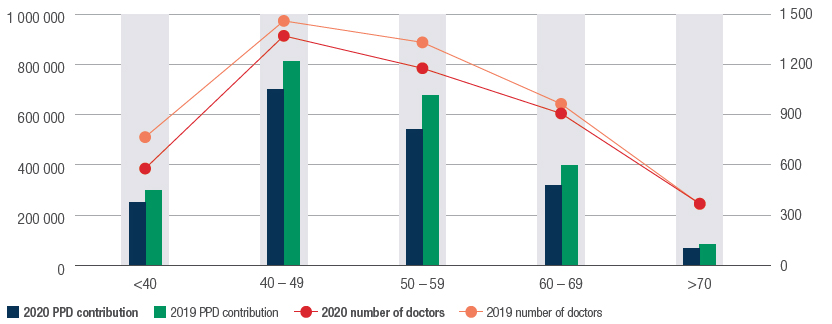
We have a team of appropriately trained and qualified specialists who deliver high-quality care to our patients. Over the years we have built strong relationships with our doctors, and we continue leveraging our good reputation to build a portfolio of excellent specialists. By doing this, we can offer accessible and inclusive healthcare for the communities surrounding our facilities.
All doctors with admission privileges at our facilities must have suitable malpractice insurance policies in place. We continue monitoring this through our online portal, which was launched during 2019. More than 80% of our doctors are registered on this portal, which has substantially improved control in managing doctors' insurance renewals.
We engage with medical associations and tertiary institutions to train specific specialists in scarce disciplines based on our facilities' needs to ensure we cultivate a pipeline of specialists. In recent years, we funded the training of specialists in cardiology, neurology, neurosurgery, nephrology and pulmonology. This initiative was expanded to a wider range of specialities, with 17 specialists in training for the coming year.
This year, we continued to implement projects supporting our commitments to sustainability and improving efficiencies. We upgraded the metering system infrastructure during the first quarter of the financial year, resulting in significant improvement in the accuracy of our water and electricity consumption.
We use an ISO 14001-approved environmental management system (EMS) across the Group. In addition, our environmental sustainability is driven by our environment and climate change forum. The forum is also responsible for the following:
| Quality metrics | Year-on- year trend |
2020 | 2019 | 2018 | ||
| Electricity usage (kWh)2 |  |
155 600 509 | 151 177 1641 | 142 934 448 | ||
|---|---|---|---|---|---|---|
| Water usage (kℓ) | |
997 867 | 913 0901 | 1 089 999 | ||
| Scope 2 carbon emissions reduction (CO2) (%) | |
5.5 | 3.8 | 7.9 | ||
| HCRW (kg/PPD)3 | |
2.01 | 1.93 | 1.88 |
| 1 | We have restated our 2019 figures due to the introduction of improved infrastructure, which has allowed for more accurate reporting. |
| 2 | These figures are based on best estimates using available information. |
| 3 | Indicator is externally assured. |
Total electricity consumption increased by 2.9% due to the impact of COVID-19. However, the extent of the impact was mitigated by the implementation of best practices across the Group. During the year, we continued with the rollout of solar PV panels at our hospitals, despite the challenges presented by COVID-19. We commissioned panels at four hospitals, with the remaining seven hospitals to be to be commissioned during the first quarter of the
2021 financial year. This brings the total number of hospitals currently with solar harvesting plants in the Group to 12. Overall, solar harvesting contributes an estimated 16% towards our total energy consumption on the installed sites, and 4.3% on the total group consumption. This has achieved and exceeded the targeted 2% reduction in consumption from the electricity grid.
Total water consumption increased by 9.3% this year due to the impact of COVID-19, however, the extent of the impact was mitigated by best practices implemented across the Group.
We saw an increase in kl/PPD and kWh/PPD due to low activities in some hospitals coupled with changes to our infrastructure to reduce the chance of COVID-19 transmissions.
Our containerisation project was rolled out to 10 facilities during the year bringing the total facilities to 20, resulting in a 3.7% decrease in disposable cloth used - which, previously, would have ended up in landfill sites. In December 2019, we completed the rollout of our large volume parenteral project to our acute hospitals. Our hospitals can, on average, redirect 10 tonnes of waste from landfill sites to accredited HCRW treatment facilities per month.
Roll out three additional solar PV panels
Ensure Group sustainability by driving DOMINO initiatives
Embed transformation initiatives throughout Life Healthcare