
INTEGRATED REPORT 2019
Corporate governance overview
Chairman:
Mustaq Brey
The entrenchment of good governance principles sets the tone for the organisation as a whole. Strong corporate governance reinforces our ability to deliver long-term sustainable results and generate value for our shareholders and stakeholders.
Statement on corporate governance
It is a greatly challenging time for most corporates, both in South Africa and globally – especially in the context of economic uncertainty and governance failures. During times like these, there are heightened expectations from our stakeholders for more prudent and effective leadership to safeguard value creation and promote the sustainable growth of Life Healthcare. It is within this framework that the board exercised its fiduciary duties for the year under review.
Adhering to the highest levels of ethical standards remains at the top of our agenda, together with the assessment and management of Group-wide risks, as well as the focused review and oversight over the performance and affairs of the Group.
The board remains Life Healthcare's overall custodian of sound corporate governance. We continue to ensure that we grow and evolve in this role through ongoing review and improvement of our processes and policies. The board is satisfied that it has fulfilled its responsibilities in accordance with its charter and with all other applicable legislation for the year under review.
OUR GROUP GOVERNANCE FRAMEWORK
The Group’s Governance Framework has been formulated to ensure effective and sustainable delivery of the overall strategy. The Governance Framework is intended to provide a structure within which the business is properly managed and the interests of its stakeholders are protected. The executive management committees established within the Group are fully mandated by the board to oversee the operational aspects of the business within the parameters of a board-approved delegation of authority.

Our governance approach
Role of the board
Life Healthcare has a unitary board of directors that is supported in delivering its mandate through various board committees and a formal charter that clearly defines its role and responsibilities.
The board sets the overall strategic objectives of the Group, determines investment policy and performance criteria, and delegates the detailed planning and implementation of policies to management within the appropriate risk parameters. The board monitors compliance with policies and performance against objectives by holding management accountable for its activities through quarterly performance reporting and budget updates.
The board considers matters of strategic direction, significant acquisitions and disposals, and approves major capital expenditure, financial statements and other material matters. Board members are encouraged to debate and challenge matters in an atmosphere of mutual respect and co-operation. While retaining overall accountability, the board has delegated authority to the Group Chief Executive Officer (CEO) to manage the day-to-day affairs of the Group, who is, in turn, supported by the Group executive committee.
The following policies were finalised and approved by the board and its committees during the year under review:
- A global code of conduct
- The Group risk management strategy and framework
- A Group clinical governance framework
BOARD COMMITTEES
| Audit committee | |||||
Role The committee is constituted as a statutory committee in terms of section 94 of the Companies Act. It has an independent role and is accountable to the board and shareholders. The overall functions of the committee are to:
|
Composition Chairman Members |
||||
Key focus areas for the year under review
The committee is satisfied that it executed its duties in accordance with its terms of reference during the financial year. |
|||||
| Risk committee | |||||
Role The overall functions of the committee are to assist the board in ensuring that:
|
Composition Chairman Members |
||||
Key focus areas for the year under review
The committee is satisfied that it executed its duties in accordance with its terms of reference during the financial year. |
|||||
| Investment committee | |||||
Role The overall functions of the committee are as follows:
|
Composition Chairman Members |
||||
Key focus areas for the year under review
The committee is satisfied that it executed its duties in accordance with its terms of reference during the financial year. |
|||||
| Remuneration and human resources committee | |||||
Role The overall functions of the committee are to assist the board in ensuring that:
|
Composition Chairman Members |
||||
Key focus areas for the year under review
The committee is satisfied that it executed its duties in accordance with its terms of reference during the financial year. |
|||||
| Social, ethics and transformation committee | |||||
Role The social, ethics and transformation committee is constituted as a statutory committee in terms of section 72(4)(a) of the Companies Act, 71 of 2008 (as amended) (Companies Act). Its main purpose is to ensure that:
For more information refer to the social, ethics and transformation committee’s report. |
Composition Chairman Members |
||||
Key focus areas for the year under review
The committee is satisfied that it executed its duties in accordance with its terms of reference during the financial year. |
|||||
| Clinical governance, quality and safety committee | |||||
Role The overall functions of the committee are to assist the board in:
|
Composition Chairman Members |
||||
Key focus areas for the year under review
The committee is satisfied that it executed its duties in accordance with its terms of reference during the financial year. |
|||||
| Nominations and governance committee | |||||
Role During the year under review, the committee expanded its mandate to include the fulfilment of governance imperatives. The naming of the committee was amended to reflect these added responsibilities. The overall functions of the committee are to assist the board in:
|
Composition Chairman Members |
||||
Key focus areas for the year under review
The committee is satisfied that it executed its duties in accordance with its terms of reference during the financial year. |
|||||
GOVERNANCE AS A DRIVER FOR VALUE CREATION
Board composition and tenure
As at 30 September 2019
| MEMBERS | DATE APPOINTED | TENURE | ||||
| MA Brey1* | 10 June 2010 | 9 years | ||||
| GC Solomon2* | 10 June 2010 | 9 years | ||||
| MP Ngatane3* | 10 June 2010 | 9 years | ||||
| P Golesworthy | 10 June 2010 | 9 years | ||||
| JK Netshitenzhe | 30 November 2010 | 9 years | ||||
| RT Vice | 1 January 2014 | 5 years | ||||
| ME Jacobs | 1 January 2014 | 5 years | ||||
| M Sello | 3 July 2017 | 2 years | ||||
| A Mothupi | 3 July 2017 | 2 years | ||||
| PP van der Westhuizen | 1 June 2013 | 6 years | ||||
| SB Viranna | 1 February 2018 | 1.5 years | ||||
| 1 | Mr Brey joined the board in November 2003, while the Company was under private ownership, seven years prior to listing. |
| 2 | Mr Solomon joined the board in March 2005, while the Company was under private ownership, five years prior to listing. |
| 3 | Dr Ngatane joined the board in July 2007, while the Company was under private ownership, three years prior to listing. |
| * | Messrs Brey, Solomon and Ngatane’s tenure is calculated with effect from the date of listing, being 10 June 2010. The board is nevertheless satisfied that these directors continue to display objective, unfettered judgement in the execution of their role, despite their long association with the Company prior to listing. |
| Brief biographies of all directors outlining their qualifications and skills are included on https://lifehealthcare.group |
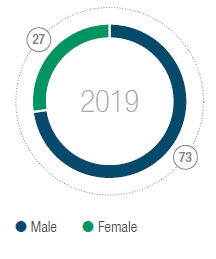
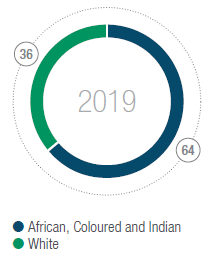
| Gender diversity (%) | FemaleEquity diversity (%) | SKILLS AND EXPERIENCE | ||
 |
 |
|
Power, control, support, and appointments
Mr MA Brey, a non-executive director, is the Chairman of the board. In accordance with King IV, PJ Golesworthy is the lead independent non-executive director. His roles include acting as a sounding board for the Chairman, chairing board meetings in the absence of the Chairman, and leading the performance appraisal of the Chairman.
Dr SB Viranna is the Group CEO. The roles of Chairman and Group CEO are separate, and there is a clearly outlined division of responsibilities.
Effective control is exercised through the Group CEO, who is accountable to the board through regular reports. Senior executives may attend board meetings as and when necessary to apprise the directors of important events, and to develop and implement strategy. This encourages communication and co-operation between the directors and executive management.
The board ensures that no individual has unfettered powers of decision making and authority, and that shareholder interests are protected at all times. The board considered whether there is an appropriate balance of knowledge, expertise and collective experience among the non-executive directors. In doing so the board is satisfied that the non-executive directors have the required skills and experience to have objective judgement on matters of strategy, operational performance, resources, transformation, diversity and employment equity, standards of conduct, evaluation of results and economic, and social and environmental policies.
At the Group’s expense, directors are entitled to seek independent professional advice to further their duties. All directors have access to the Group Company Secretary, who is responsible for ensuring Group compliance with applicable legislation and procedures. In compliance with JSE Listings Requirements, non-executive directors do not participate in any share incentive or option scheme of the Group.
Delegation of authority
Life Healthcare has an international, capital intensive business. The strategy, operating and investment budget and plans are approved by the board. To control trading activities, it is the board’s philosophy that authority and responsibility be delegated to the lowest prudent level, and management is expected to always act in accordance with the Group values, both formally and informally.
The Group delegation of authority includes fundamental elements such as:
- Authority matrix for the board, Group Chief Executive Officer and management in the different territories
- Corporate, finance and human resource matters reserved for the board
- Processes for the approval or amendment of the Group’s business plan and annual budget
The delegation of authority was revised during the year to provide for the authority levels in all the territories.
Directors’ attendance at board and committee meetings
The board meets quarterly and on an ad hoc basis to consider specific matters as needed. The board and management meet annually to review the Group’s strategy and agree on future focus areas. Where directors are unable to attend board meetings for any reason, every effort is made to communicate their comments regarding the agenda and general items.
| Board | Meeting | Audit | Investment | Nominations and governance |
Remune- ration and human resources |
Risk | Social, ethics and transfor- mation |
Clinical governance quality and safety |
Board strategy session |
|||||||||
| Members | ||||||||||||||||||
| MA Brey | 4/4 | 6/6 | 3/3 | 1 | ||||||||||||||
| PJ Golesworthy | 4/4 | 5/5 | 6/6 | 3/3 | 3/3 | 3/3 | 1 | |||||||||||
| ME Jacobs | 4/4 | 3/3 | 3/3 | 1 | ||||||||||||||
| AM Mothupi | 4/4 | 5/5 | 3/3 | 3/3 | 1 | |||||||||||||
| JK Netshitenzhe | 4/4 | 3/3 | 1 | |||||||||||||||
| MP Ngatane | 4/4 | 3/3 | 3/3 | 3/3 | 1 | |||||||||||||
| M Sello | 3/4 | 5/6 | 3/3 | 1 | ||||||||||||||
| GC Solomon | 4/4 | 5/5 | 6/6 | 6/6 | 1 | |||||||||||||
| PP van der Westhuizen | 4/4 | 6/6 | 2/3 | 1 | ||||||||||||||
| RT Vice | 4/4 | 5/5 | 6/6 | 6/6 | 1 | |||||||||||||
| SB Viranna | 4/4 | 5/6 | 3/3 | 3/3 | 3/3 | 1 |
Code of ethics
In living our values, the Group has earned a reputation for fairness and ethical behaviour in all its business dealings and processes.
The board is responsible for ensuring that management embeds a culture of ethical conduct throughout Life Healthcare, and sets the values by which the Group abides. A global code of conduct (code) was implemented during the year under review. Guidance for appropriate behaviour throughout the Group is based on the code.
The code sets out policies and procedures to be followed in all aspects of professional, clinical and business dealings, and establishes a set of standards. It guides employees in their behaviour towards supporting healthcare professionals, patients, customers, suppliers, shareholders, co-workers, and the communities in which the Group operates. The code also extends to safety, health, security, conflicts of interest, environmental matters and human rights. While common sense, good judgement and conscience apply in managing a difficult or uncertain situation, the code assists in detailing the standards and priorities within the Group. New employees are familiarised with the code as part of their induction.
A confidential guidance and support hotline, operated by an international auditing firm, provides an independent facility for employees and suppliers to report fraud or any form of malpractice. A policy of non-retaliation protects and encourages people wishing to share their concerns. The Group maintains a zero-tolerance approach to fraud. Executives and line management are responsible for implementing procedures against fraud and corruption. In tandem with the code, individuals from Life Healthcare sit on the South African Nursing Council, as well as the professional conduct committee that monitors professional misconduct within the South African nursing profession. Professional employees across the Group are encouraged to become members of their respective professional associations.
Tip-offs anonymous
Employees, doctors and suppliers can report suspected irregularities anonymously to an independent service provider. Reported incidents are independently assessed and, where relevant, independently investigated. These incidents are also reported to the audit, and social, ethics and transformation committees. Of all the tip-offs received in the year, the majority were deemed to be unfounded and only 12 (22%) matters remain under investigation across the Group.
Internal controls
We maintain accounting records, and developed systems designed to provide reasonable assurance as to the integrity and reliability of the financial statements. The board delegates responsibility for the adequacy and operation of these systems to the Group CEO. These records and systems are designed to safeguard assets and minimise fraud. The systems of internal control are based on established organisational structures, such as written policies and procedures, which include budgeting and forecasting disciplines and the comparison of actual results against these budgets and forecasts. The Group has a key operational process checklist, and has assigned responsibilities for controls in the processes to relevant employees.
Compliance is tested by internal and external audit reviews.
Induction and training of directors
It is important that directors are kept up to date with their duties, as well as changes in the Group. On appointment, new directors are briefed on their fiduciary duties and responsibilities by executive management. The nominations committee approved an induction policy which includes the requisite reading material and the required exposure to the business. The policy is reviewed annually by the nominations and governance committee. In addition, new directors receive information on JSE Listings Requirements, King IV, the Companies Act and obligations they have to comply with. The Group Company Secretary assists the Chairman with the induction of directors. Directors are informed of relevant new legislation and changing commercial risks that affect the Group. Directors have full and unrestricted access to management and information when required and are entitled to seek independent professional advice in support of their duties at the Group’s expense.
Independence
The Group’s nominations and governance committee is responsible for assessing the independence of the Group’s directors on an annual basis. Independence is determined according to the Companies Act, JSE Listings Requirements and the recommendations in King IV, which takes into account, among others, the number of years a director has served on the board.
The board was satisfied that all its independent non-executive directors met its independence criteria for the 2019 financial year.
| NON-EXECUTIVE DIRECTOR | DIRECTORS’ EXTERNAL INTERESTS | |
| Mustaq Brey | Mr Brey owns shares in the Company, the value of which is material to his personal wealth and he can therefore not be considered independent. However, the nominations and governance committee and board is satisfied that Mustaq displays objective, unfettered judgement in decision making and that his objectivity has not been compromised by virtue of his shareholding. |
BOARD SUCCESSIONBoard succession planning has been high on the nomination and governance committee’s agenda for the year under review. The committee deliberated upon and recommended to the board, a succession strategy for the short to medium term until 2025. In keeping with the board’s view that succession planning must follow as seamless a process as possible, a process is under way to execute on the following board-approved imperatives:
The board, upon recommendation from the nomination and governance committee, has also approved an internally accepted tenure of 12 years for members. The rationale is premised on a board view that directors with a longer tenure have an enhanced appreciation for the operational challenges facing the Company and the industry at large, and provide invaluable insight into board deliberations. |
Conflict of interests
Directors are required to avoid a situation where they may have a direct or indirect interest that conflicts with the Group’s interests. Directors disclose conflicts of interest at every meeting in terms of section 75 of the Companies Act. Directors present an updated list of their directorships and interests to the Group Company Secretary annually, and the comprehensive list is tabled at the board meeting in July.
Appointments, rotation and diversity
Any new appointment to the board involves a formal and transparent process and is a matter of consideration for the full board, assisted by the nominations and governance committee.
Appointments and diversity
The board diversity policy applies to the appointment of new directors and has been taken into account for purposes of succession planning for the board. The nominations and governance committee will make the board appointment recommendations on merit and will consider candidates against objective criteria with due regard to the benefits of diversity, including gender and race, and the contribution that the candidate will bring to the board. There is an ongoing commitment from the board to strengthen female representation, and preference will be given to female candidates who meet the criteria.
Rotation
The memorandum of incorporation stipulates that one-third of the board members will retire from office at the annual general meeting and will be eligible for re-election. The directors to retire are those who have been in office longest since their last election or who were appointed during the year. Executive directors are included in determining the rotation of retiring directors.
As per the MOI of the Company, directors who have reached or exceeded, the age of 70 years are evaluated annually as well, to consider their continued service to the board.
Board and committee evaluations
Internal evaluations were conducted for the 2019 performance evaluation cycle under the auspices of the nominations and governance committee. Based on the results of the appraisals, the board and its committees are functioning effectively, and fulfilling their mandates, as detailed in the charter, terms of reference and annual work-plans.
The assessment identified two key focus areas for 2019, being ongoing board training and more frequent communication between management and the board between formal board meetings. The following key operational imperatives for 2020 were also identified during the assessment:
- Ensuring that proper succession planning is in place for Group executives
- Ensuring delivery of the approved strategy
- Stabilising and improving the IT environment
- Keeping abreast with developments in respect of the NHI
Group Company Secretary
Avanthi Parboosing is the Group Company Secretary and took over the role from Fazila Patel with effect from 1 March 2019. Her primary role is to ensure that the board is cognisant of its fiduciary duties and responsibilities. The Company Secretary plays a key role in providing guidance to the board members on the execution of their duties, keeping the board aware of relevant changes in legislation and corporate governance best practice. Other key performance areas of the Company Secretary include overseeing the induction of new directors, orientation and ongoing education of directors.
Avanthi Parboosing’s role has also been expanded to include executive oversight over other areas, including Group Sustainability, Group Insurance, Business Integrity and Ethics, Group Privacy and Group Communications.
An assessment of the Company Secretary was carried out by the nominations and governance committee on behalf of the board. The results confirmed that she continues to demonstrate the requisite level of knowledge and experience to carry out her duties. The board is also comfortable that she maintains an arm’s length relationship with individual directors and confirms that she is not a director of the Company or any of its subsidiaries.
Codes, regulations and compliance
The board is responsible for the Group’s compliance with applicable laws, rules, codes and standards. The enforcement of compliance principles is incorporated into the Group’s global code of ethics and the Group considers compliance an integral part of the Group’s culture in ensuring the achievement and sustainability of its strategic goals.
The board has delegated the implementation of an effective compliance framework to management. Supervision of compliance risk management is delegated to the risk committee, which reviews and approves the arrangements in place to monitor compliance. The Group complies with various codes and regulations such as the Companies Act, the JSE Listings Requirements and King IV.
During the period under review, the position of Group Compliance Manager was established to give specific focus to the various compliance requirements across the Group. The Group Compliance Manager has been mandated to review existing compliance protocols, implement a compliance framework and strategy and oversee all aligned activities. The Group executive committee has approved the development of a formalised legal compliance universe underpinned by focused compliance risk management plans to further entrench compliance across the Group.
There were no material or repeated regulatory penalties, sanctions or fines for contraventions of, or non-compliance with, statutory obligations or environmental laws.
King IV
Life Healthcare endorses and endeavours to adhere to the guidelines and principles of King IV.
A King IV Implementation Report and gap analysis is available on the Group’s website, www.lifehealthcare.co.za.
OTHER REPORTING REQUIREMENTS
Insider trading
Life Healthcare observes a closed period from the end of the accounting period to the announcement of the interim or annual results, and when otherwise required in terms of the JSE Listings Requirements. During this time, no employee or director who might be in possession of unpublished price-sensitive information may deal, either directly or indirectly, in the shares of the Company. Comprehensive guidelines on how to comply with insider-trading restrictions and how to deal with analysts are provided in the insider-trading policy.
Going concern
The board considers and assesses the Group’s going concern basis in the preparation of the annual and interim financial statements. In addition, the solvency and liquidity requirements per the Companies Act are considered. The board is satisfied that the Group will continue as a going concern into the foreseeable future.
Material litigation
During the financial year, the Group was not involved in any material litigation or arbitration proceedings, nor were the directors aware of any pending or threatened legal issues which may have a material impact on the Group’s financial position. Institutions in the healthcare sector are subject to patient lawsuits and the directors are of the opinion that the Group has sufficient insurance to mitigate financial risk.
Political party contributions
In line with the code of ethics, employees may not make any direct or indirect political contribution on behalf of the Group unless authorised by the board. This includes contributions to candidates, office holders and political parties.