
INTEGRATED REPORT 2019
Remuneration report
Chairman: remuneration and human resources committee:
Royden Vice
At Life Healthcare we feel a deep sense of responsibility to ensure we appropriately reward, retain and develop our people. The remuneration committee is committed to reviewing and evolving the Group’s reward and talent philosophies on an ongoing basis to ensure appropriate incentives for “doing what is right”, fair application in the organisation, enforceability, and alignment to market best practice.
This report comprises three sections:
- A report of material matters covered by the committee during the year, from the Chairman of the remuneration and human resources committee.
- Life Healthcare's remuneration philosophy, framework and policy.
- Life Healthcare's remuneration implementation report.
SECTION 1: REMUNERATION COMMITTEE CHAIRMAN’S REPORT
Dear Shareholder,
I am pleased to present the 2019 remuneration report for the Group.
At Life Healthcare we feel a deep sense of responsibility to ensure we appropriately reward, retain and develop the + 21 800 people we employ in SA and internationally. We recognise the requirement to interrogate our reward and talent philosophies on an ongoing basis, to ensure they continue to be fit-for-purpose as the global healthcare landscape evolves.
At our January 2019 AGM we received a vote of 75.49% in favour of our implementation report and 74.49% in favour of our remuneration policy, and hence committed to engage shareholders on the issues raised. No shareholder participants registered for our telecon on 23 May 2019, but we did enjoy the opportunity to talk to several shareholders individually to address specific concerns and share broader guidance on how we are thinking about executive reward design at Life Healthcare. We discuss these key issues in our remuneration report.
We recognise the value of our shareholder engagement, and commit to continuing to engage shareholders going forward.
The Group delivered a sound performance in this past financial year, despite the challenging economic and operating conditions in all countries in which we operate. Against a backdrop of Brexit uncertainty and some isolated radiopharmacy production issues, performance in our UK business was slightly below expectations. The remainder of the business performed in line with expectations. Overall we delivered a 9.3% increase in revenue on the previous year, and a 2.5% increase in operating profit.
During the year the remuneration and human resources committee covered several material matters which included:
- Completing an inaugural Group-wide talent process, which will run annually going forward.
- The establishment of a formal guaranteed pay progression model that rewards employees for their contribution to value creation, and helps attract and retain top performing talent in a competitive market.
- Aligned to our pay progression model and market realities, the adjustment of guaranteed pay for the Group CEO and Group CFO.
- Replacement of EBITDA with EBITA in our short-term incentive plan, to ensure effects of depreciation are adequately accounted for.
- Finalisation of the performance conditions underpinning our long-term incentive plan, to ensure alignment to the board-approved Group strategy (approved June 2019).
- Continued integration of remuneration practices across countries to ensure Group alignment and application of best practice.
- Appointment of two Group executives (Chief Digital Officer and Group Company Secretary) and the appointment of an International CEO.
- Exploration of several mechanisms to continue to strengthen our reward approach (including malus and clawback).
- Introduction of specific measures aimed at bolstering our transformation objectives.
These matters are explained in detail in our remuneration policy report.
As a result of the decisions and progress listed above, the remuneration and human resources committee believes the Group's remuneration policy has been strengthened in the past year in response to changing business realities as well as legitimate shareholder concerns. We are confident that our remuneration policies support the business strategy in aligning incentives appropriately, and align to market best practice. We are committed to reviewing and evolving the Group's remuneration policy on an ongoing basis to ensure appropriate incentives for doing what is right, fair application in the organisation, enforceability, and alignment to market best practice.
I thank my fellow remuneration committee members, Adv Mahlape Sello and Garth Solomon, who have assisted me this year in ensuring robust conversation and sound decision making. The committee meets formally three times per year, but I am grateful for the many additional hours they have spent deliberating and preparing for our formal meetings.
Royden Vice
Chairman: Remuneration and human resources committee
SECTION 2: LIFE HEALTHCARE’S REMUNERATION PHILOSOPHY, FRAMEWORK AND POLICY REMUNERATION PHILOSOPHY
Life Healthcare's remuneration philosophy is to ensure that employees are rewarded fairly and appropriately for their contribution to value creation for the Group, and for 'doing what is right'. Our resulting remuneration framework and policies, which are a key component of our broader employee value proposition, aim to:
- attract, motivate, reward and retain our people;
- promote the achievement of strategic objectives within the Group's values and risk appetite;
- promote an ethical culture and responsible corporate citizenship; and
- provide a balanced remuneration mix within the Group's financial constraints.
Our remuneration philosophy informs our reward framework and guides policy. We continually review our remuneration policies to ensure our approach remains relevant, fair and appropriate in light of what is a continually evolving context.
In this context the Group periodically consults market survey providers for an indication of the guaranteed remuneration and annual cash incentive payments made generally and sectorally. We use these inputs, along with guidance from external remuneration experts, to assess our positioning compared to the market in terms of key talent. We then overlay various contextual factors, including industry trends, the Group's financial position and legislative requirements, to evaluate our performance in delivering fair and equitable remuneration as part of our employee value proposition.
We are always aware of the need to ensure fair and responsible remuneration per King IV and draft guidelines and practice notes of IoDSA. In this context, the Group applies the 10:10 methodology to gauge the fairness of our wage gap. The Company's 10:10 ratio continues to reflect a more equal distribution of income between higher and lower income earners compared to the private sector in general, as depicted below. The slight deterioration in this ratio in the past year is the result of hiring additional Group executives to drive the Group's growth strategy, and pay increases for the Group CEO and Group CFO to align their remuneration to market benchmarks.
| Ratio (10:10) | |
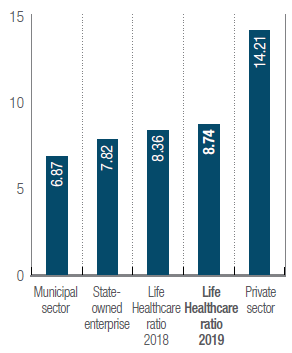 |
Source: African journal of Reward – Edition 2 (Bryden Morton and Chris Blair) – March 2017.
Our remuneration and human resources committee follows a systematic agenda to review remuneration strategy and overall policy. It oversees, without interfering in areas where management ordinarily have discretion, the implementation of policy over an annual cycle, verifies that policy enables fair and equitable remuneration, and ensures sound governance. At least annually, formal feedback is provided to the board on how the policy objectives are being achieved, and this feedback forms part of the process of obtaining approval of the remuneration report.
Life Healthcare's remuneration philosophy and supporting policies are widely shared with employees.
Remuneration framework
We take a total reward approach to remuneration. Our remuneration framework has been designed to achieve a fair and sustainable balance between annual, short and long-term variable remuneration, where participation in short and long-term incentive schemes depend on an employee's role and level within the Group. The King IV principles relating to fair and responsible remuneration guide application of our policy.
The below table summarises the remuneration components offered in Life Healthcare:
| ELEMENT | COMPONENTS | DESCRIPTION | UNDERLYING PRINCIPLES | MECHANICS | PARTICIPATION | |||||
| GUARANTEED PAY | Base pay | Fixed annual salary |
|
Reviewed annually (1 January) | All employees | |||||
| 13th cheque | An amount equivalent to one month's base pay payable in December |
|
Delivery in December provided employed in this month | All permanent employees of LHC Acute business (excluding executive and senior managers) | ||||||
| Benefits | Contributions to retirement, risk funds and medical benefits, leave entitlements, allowances and flexible work conditions |
|
Reviewed annually (1 January) | All employees | ||||||
| VARIABLE REMUNERATION | Short-term performance incentives | Variable compensation plan (VCP) |
|
Delivered in cash bi-annually based on performance outcomes (November, May) | Executives and senior managers who have line of sight and contribute to the profitability of the business | |||||
| Share-based awards | Employee share plan |
|
Employees need to remain in the employ of the Company for seven years to obtain the full quota of the rights of each allocation made. Delivered annually in July from year five | Permanent employees who belong to specified Company retirement funds and have one year's service at the date of grant are eligible for an allocation | ||||||
| Long-term performance incentives | Long-term incentive plan |
|
Delivered annually (January) | Executives and senior managers who have a more strategic focus and are able to influence the long-term performance and sustainability of the Group | ||||||
| NON-EXECUTIVE DIRECTOR FEES | Fees for service | A non-executive director is a member of a company's board of directors who is not part of the executive team and is involved in policymaking and planning exercises |
|
Reviewed annually (1 January) |
Non-Executive Directors | |||||
| ALL OTHER PAYMENTS | Including, for example, loss of office or termination payments and restraint payments |
|
Executive or senior management (as applicable) | |||||||
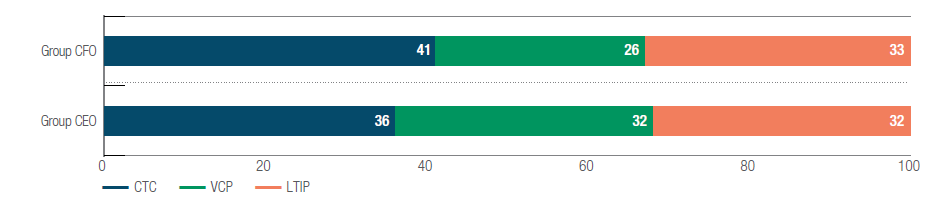
The on-target pay mix apportionment for the Group CEO and Group CFO in Life Healthcare is graphically displayed below.
| On-target pay mix Group Executive (%) | |
 |
Key changes to remuneration in 2019
In 2019 we implemented changes to several reward components in our efforts to ensure continued alignment between our reward and our strategy, and to respond to market factors. We have summarised these changes below, and explain each in more detail in the sections that follow.
Changes in remuneration policy – FY2019
| REASON FOR CHANGE | ||||
| SHORT-TERM INCENTIVE SCHEME |
|
|
||
|
|
|||
| LONG-TERM INCENTIVE SCHEME |
|
|
||
|
|
|||
Shareholder engagement
Subsequent to our AGM in January 2019 where we received a vote of 74.49% in favour of our remuneration policy, we engaged shareholders on the issues raised and also discussed our broader approach to executive reward design. The key issues raised by shareholders at our AGM are addressed below.
| TOPIC | SHAREHOLDER COMMENTS | REMUNERATION COMMITTEE RESPONSES | ||
| LONG-TERM INCENTIVE SCHEME | Inadequate disclosure of performance conditions and vesting scales in advance | The first allocation in terms of the restated scheme was made effective 1 January 2019. Performance conditions could only be agreed by the remuneration and human resources committee once the Group strategy had been approved by the board (June 2019), hence the delay in disclosure. The Company recognises this caused shareholder discomfort, and will continue to disclose performance conditions and relevant vesting scales, as done previously. | ||
| Rationale for change of performance conditions | The rationale for changing performance conditions in the previous financial year is as follows:
|
|||
| FY18 ONCE-OFF ALTERNATIVE | Rationale for link to short-term incentive measures | Utilisation of the chosen method of reward was tested against relevant legislation and best practice. One of the major limitations in scheme selection was the fact that we could not use any scheme that utilises the Life Healthcare share as a building block to determine the number of units awarded to participants (as a consequence of operating under a cautionary). | ||
| SHORT-TERM INCENTIVE SCHEME | Performance results generous | The 2018 process was consistent with the process followed in prior years and the final budget objectives were agreed at Group executive and board level. For financial targets we add inflation, GDP movement, impact of acquisitions and then additionally build in a management stretch component. We continue to set challenging stretch targets during our budget process, where budgeted target is only achieved if executives deliver fully to plan. We benchmark our STI reward levels at "on-target" level and thus demand excellent performance before benchmarked reward is earned. | ||
| ADDITIONAL SHORT-TERM INCENTIVE SCHEME | Rationale for introduction of additional scheme | Challenging FY2018 - operated under a cautionary which ran from 21 November 2017 to 19 September 2018 (as a result of the India/Max transaction). This, coupled with tough operating conditions, constrained our ability to reward and retain senior operations managers. The outperformance incentive scheme was designed to reward exceptional talent and performance to aid retention. | ||
Remuneration policy
Guaranteed pay
Historically Life Healthcare has paid at market median at an aggregate level, where we allow individual discretion to pay within a range which stretches from 12.5% below market rate to 12.5% above market rate.
In our efforts to attract and retain top performing talent in a competitive market, we have now established a formal guaranteed pay progression model that rewards employees for their contribution to value creation. As an organisation it is critical that we ensure correct base pay, as guaranteed pay serves as the foundation of our reward design and is hence a crucial determinant of variable pay.
Specifically, we will pay up to 75th percentile for exceptional/top performing employees, ensuring that average guaranteed pay for the Group remains anchored at market median via a symmetrical overall pay distribution.
We assess three pay progression factors: comparative ratio to market rate for job, individual performance and potential. Poor performers and those whose premium positioning in range isn't supported by their performance, potential or criticality of skills, will receive commensurately lower increases.
This pay model must be supported by a disciplined and rigorous annual talent review process. We completed our inaugural Global Talent Review in July this year, where we focused on both performance and potential, using best practice tools to interrogate and plot each of these dimensions. We will run this talent process annually, iterating and refining over time to ensure a robust talent identification and management practice which is shared across the Group, and demonstrating factually that we out-reward top talent in a disciplined and rigorous way.
We recently elected to pay our Group CFO at 75th percentile (effective 1 July 2019), aligned to this principle. Our CFO has 20 years of experience at Life Healthcare, serving as Group CFO since 1 April 2016. Over the past few years we have taken a conservative approach to his pay increases, but recognise the need for a more significant increase to position his guaranteed package and total remuneration competitively to local peers. This is particularly important from a retention perspective, given he is one of the few long-serving Group executive members, and holds the institutional knowledge which is critical for continued stability and sustainability of the Group.
Our CEO was newly appointed to the role in the prior year, and his remuneration was initially set below the market. We believe that he has demonstrated his ability to lead our company, and hence elected to adjust his guaranteed package to the market median of CEOs of companies of comparable size and complexity. This increase was effected on 1 July 2019.
We were supported in this process by a leading reward expert who guided the committee on:
- Emerging market practice
- Reward benchmarks
Details of Group CEO and Group CFO pay are provided in our implementation report.
Benefits
Life Healthcare Employee Benefit Structure
The benefits that form part of total cost to company include the following:
- Retirement funds
The Company operates two defined contribution retirement funds:
- The Life Healthcare Provident Fund
- The Life Healthcare DC Pension Fund
In addition, the Company operates two defined benefit funds that have been closed to new membership since 1996. The Life Healthcare DB Pension Fund provides retirement benefits for 92 active members and 236 pensioners.
The Lifecare Group Holdings (LGH) Pension Fund no longer has active members. The fund has purchased an annuity policy which covers the liability to pay pensions.
The Company-supported retirement funds offer Group life cover and disability benefits to members. Permanent disability and death are covered by lump sum payments that are underwritten by an insurer. The standard cover for new employees is three times annual salary for death and disability cover. Some historical anomalies to this standard cover exist.
- Medical aid
It is a condition of SA employment for permanent employees earning above R9 150 per month (with effect from 1 January 2019) to belong to a Company-supported medical aid, unless membership of a spouse's medical aid can be proven.
Membership of a principal member, spouse and up to two children is subsidised by the Company.
The Company participates in the open medical scheme market and offers Medshield and Discovery Health as options to employees. In addition, medical aid membership is voluntary for employees who earn below the threshold level referred to above.
However, the Company has procured a primary health benefit for employees earning below R9 150 per month who opt not to join a medical aid. This benefit covers, via a bespoke network, doctors' consultations, medication and a certain number of prescribed minimum benefits.
Variable remuneration
- Short-term incentive scheme (variable compensation plan (VCP))
- Group performance: capped at 225%
- Business unit performance: capped at 225%
- Personal performance: capped at 160%
- Clinical quality, including ensuring formulation and adoption of quality metrics across the Group.
- Strategic innovation, including progressing SA radiology, our SA outpatient model, and designing a long-term strategy for Poland.
- People, including retaining top and critical executive talent, building succession plans for the Group executive, and furthering the Group's diversity objectives.
- Clinical quality, including improving the average SA Acute composite quality score and international clinical metrics.
- Strategic innovation, including building a minimum network for SA radiology, strengthening Life Healthcare's partnership with SA government, optimising Life Healthcare's asset portfolio, and further progressing outpatient care.
- People, including building leadership capacity and delivering on the Group's diversity commitments.
Our executives and senior management receive short-term rewards aligned to our standard remuneration policy. The Group emphasises pay for performance, and any business and/or personal performance below a set threshold results in non-payment of incentives.
In setting targets, we are mindful that external factors, some of which are unpredictable, can mitigate performance. That said, we strongly believe overall sustainable performance should be evaluated and targeted, using a mix of financial and non-financial measures that are directly controllable, but equally affordable and aligned with shareholder outcomes. We continue to set challenging stretch targets during our budget process, where budgeted target is only achieved if executives deliver fully to plan. Thus, 95% achievement of financial targets attracts 100% of on-target reward and 100% achievement attracts 125% reward, where we benchmark our STI reward levels at 'on-target' level and thus demand excellent performance before benchmarked reward is earned.
The board may apply its discretion on all payments, to mitigate against unintended consequences, but this discretion is reluctantly applied and used only in exceptional circumstances. Such discretion for executives is fully disclosed in the implementation report.
We apply a balanced scorecard approach which rewards achievement of short-term strategic, financial and non-financial objectives aligned to our one-year business plan.
Balanced scorecard measures are weighted differently at each level of the organisation in line with the accountability of employees and the behaviour that needs to be encouraged; and both modifiers and gatekeepers are applicable where appropriate, where the gatekeeper acts as a penalty, and a modifier may enhance or decrease incentives for performance relative to targets.
Maximum rewards as a percentage of 'on-target' performance for all employees are as follows:
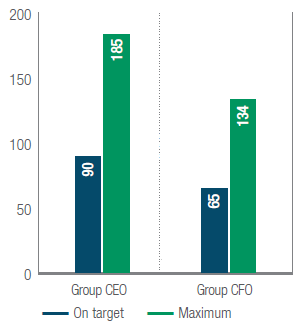
The maximum potential reward based on the above criteria ranges from 8% to 185% of guaranteed salary, depending on the management level.
Should the Group's financial performance be less than 75% of agreed financial targets, no VCP payments will be made. In addition, should job-required outputs in respect of personal performance not be met, no short-term incentive payment will be made, irrespective if other measures are met.
Measures are as follows:
1. Financial measures (70%): operating profit and working capital measurement.
2. Non-financial measures (30%): capture our key strategic objectives via personal measures.
Regarding financial measures, this year we amended our VCP metric from EBITDA to EBITA to ensure effects of depreciation are adequately accounted for, considering the capital-intensive nature of our business.
Regarding personal measures, in the case of the Group CEO, FY2019 measures included:
Where strategic initiatives extend over a period of time, the Group CEO's performance scorecard specifies achievement milestones for the period under review.
Concluding the sale of Max Healthcare in June 2019 was a notable achievement on the part of the Group CEO and Group CFO.
For FY2020, the Group CEO's personal measures include:
In the case of the Group CEO and Group CFO, the opportunity and maximum limit are as follows:
| Short-term incentive on target and maximum potential reward percentage of guaranteed package (%) | |
 |
- Long-term incentive plan (LTIP)
- Capital efficiency (40%)
- Normalised Group HEPS (40%)
- Life core purpose outcomes (20%)
The long-term incentive scheme is a performance share scheme. Progress on aligning reward practice across our geographies necessitated a review of our LTIP performance measures last year, which had not been reviewed in the three prior years.
This year we have not changed performance measures, but have spent considerable time deliberating the performance conditions underpinning the 2019 LTIP scheme, to ensure alignment to our Group strategy which was approved by the board in June 2019.
Weightings for our Group CEO and Group CFO are as follows:
The first allocation on this scheme was made effective 1 January 2019 with a three-year vesting period.
The scheme continues to allow for enhanced allocation of performance units at allocation based on personal performance and additionally for key talent retention, via a strategic modifier between 1 and 2.
Performance conditions for each metric are set out below, and will be measured on vesting outcomes on 31 September 2021:
Capital efficiency
In a constrained healthcare environment, management must simultaneously balance sweating its assets with investing for growth and sustainability of the Group. To resolve this dilemma, for the 2019 LTIP we measure capital efficiency in two parts:
- Satisfactory returns on business-as-usual capital versus WACC for our core business (79% weighting); and
- Prudent growth capital spend for delivery of business performance in line with business case for our key growth initiatives: SA radiology, new outpatient models, and Life Molecular Imaging (21% weighting).
Weightings for measures have been assigned based on 2025 forecast contributions to Group EBITDA, as this ensures management alignment to a long-term view of our strategy for sustainability of the Group.
Regarding the core business, our performance conditions are as follows:
- Threshold ROCE
= WACC
- On-target ROCE
= WACC + 1%
- Outperformance ROCE
= WACC + 2%
Regarding growth initiatives, we have set threshold, on-target and stretch EBITDA targets for forecast capital spend.
Normalised Group HEPS
In the case of the Group executives, we measure earnings performance utilising normalised Group HEPS. The choice of measure reflects the ability of these executives to influence the capital structure of the Group.
Performance conditions are as follows:
- Threshold HEPS
= CPI + 1%
- On-target HEPS
= CPI + 3%
- Outperformance HEPS
= CPI + 5%
Life core purpose (LCP) outcomes
As a healthcare business, patient outcomes and experience underpin everything we do. The LCP measure reflects the extent to which the Group achieves the clinical measures that drive long-term sustainability. We have identified country-specific measures and targets, which are aggregated to form a Group score against which the Group CEO and Group CFO are measured.
LCP performance measures by country are as follows:
- South Africa
- Patient incident rate as a percentage of admissions
- Patient experience
- UK, Italy, Ireland
- Radiology clinical audit (Grade 1 and 2 discrepancies)
- Patient satisfaction
- Radiopharmacy
- Dose reliability performance
- Poland
- Pressure ulcers acquired in hospital
- Re-admission rates
To warrant payment, an achievement of 80% or higher against target is required, applying a three-year rolling average between offer and vesting.
Performance conditions are as follows:
- Threshold
= 80% of target
- On-target
= 100% of target
- Outperformance
= 120% of target
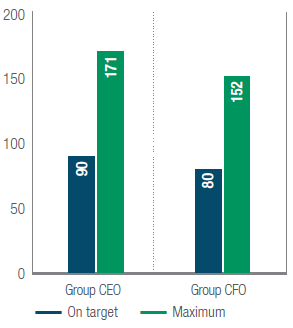
In the case of the Group CEO and Group CFO, the opportunity and maximum limit on the LTIP scheme are as follows:
| Long-term incentive (LTI) on target and maximum potential reward percentage of guaranteed package (%) | |
 |
Legacy LTI awards
Historical LTI scheme (2014 allocation)
The last allocation in terms of this scheme was made in 2014. All allocations have vested, and the restrictions on the Company matched shares were lifted in January 2019 in respect of employees who purchased shares. Details of payment to the Group CFO are included in the Implementation report.
Historical LTI scheme (introduced from 2015 to 2017)
The historical LTI scheme was a notional performance share scheme for all senior managers and executives. Allocations were made annually and the last allocation was made in January 2017.
Vesting of the 2016 allocation occurred at the end of December 2018. Performance against both measures at vesting did not meet threshold levels and thus yielded no payment to participants.
| Measure | Outcome | Result |
| Actual TSR | Not achieved | No payment |
| Actual EBIT growth | Not achieved | No Payment |
The final vesting of this scheme occurs at the end of December 2019. The outcome of the final vesting will be disclosed in the FY2020 implementation report.
Historical LTIP 2018 allocation
Once-off alternative LTI scheme 2018
As detailed in our 2018 remuneration report, the 2018 offer in terms of the 2015 LTIP scheme was not made as a result of the Company being in an extended closed period since November 2017. In order to provide a consistent pattern of long-term incentive awards, an alternative once-off long-term bonus scheme was approved by the board to cover this period.
One of the major limitations in scheme selection was the fact that we could not use any scheme that utilises the Life Healthcare share as a building block to determine the number of units awarded to participants (as a consequence of operating under a cautionary).
The once-off alternative offering is based on an additional third of the FY2018, FY2019 and FY2020 short-term bonus outcomes which will be banked and payment will be made in January 2021 to coincide with the date when the normal LTIP 2018 allocation would have vested.
Other retention schemes
- Employee share plan
- Employees need to remain in the employ of the Company for seven years to obtain the full quota of the rights of each allocation made.
- 25% of the allocated rights transfer to the employee in year five.
- 25% of the allocated rights transfer to the employee in year six.
- 50% of the allocated rights transfer to the employee in year seven.
- Historical performance
- Innovation
- Talent retention
- Being a cultural ambassador
- Complexity
An employee share ownership plan was implemented via a trust. Commencing in 2012, the Company funded, via the trust, the purchase of shares to the value of R50 million or more per annum for the benefit of employees. This year an increased contribution of R65 million was approved by the board to purchase shares on behalf of employees. This is a 3.59% increase on last year's purchase, which only partly offsets the impact of inflation. However, employees will benefit from the decrease in share price which will result in the acquisition of more shares per employee. This creates greater upside potential for participants.
The trust holds the shares and confers 'rights' or units to shares to employees. Permanent employees who belong to specified Company retirement funds and have one year's service at the date of grant are eligible for an allocation. The rights have been equally distributed to all qualifying employees.
The objectives of the plan are to incentivise and retain employees. To fulfil these objectives, certain conditions need to be attained by the employees to transfer these rights into actual shares:
Dividends start to flow to employees from the onset of the plan.
Employees who resign or are dismissed during the duration of the scheme will lose their rights to all allocations made, and their rights will be distributed equally among the remaining employees. Thus, the number of rights will increase by the time of transfer of shares to remaining employees. Good leavers, for example those who are retrenched or retire, will have the proportionate number of shares they hold at the time of termination paid out to them, less tax and costs. They will no longer participate in the employee share plan.
Shares, or the after tax equivalent in cash, are transferred from the trust to the employee after five years as follows:
The scheme is fully ramped up to provide 100% vesting to each employee who received their first allocation in 2012.
The Company will continue to acquire shares on an annual basis to ensure that the opportunity is granted to new employees and the objectives of the plan are continuously achieved. Each allocation will be managed separately and will vest according to the same criteria.
The efficacy of the plan is proving advantageous, as employee turnover for the qualifying participants has reduced substantially.
Outperformance incentive scheme
As detailed in our 2018 remuneration report, a short-term Outperformance (or kicker) scheme was introduced and will run annually for the next two years only (2019 and 2020), to secure the Company's key talent in the extraordinary circumstances of the extended period of corporate activity in the healthcare sector.
Its intention is to incentivise superior business and personal performance and further retain the loyalty and commitment of key management, and to ensure that true outperformance is rewarded. The scheme was only offered to senior management who were in service from at least 1 January 2016, thus the Group CEO is excluded from this benefit.
Actual bonuses generated as outcomes in the VCP are to be matched with a further 40% component, which matching component will be subject to a modifier between 50% and 150%, based on an assessment of a scorecard of critical sustainability measures. These factors include:
Additional reward design considerations
- Malus and clawback
Malus and clawback clauses are a reality and emerging best practice. Management supports the intention behind the mechanism, and hence solicited external advice and explored market practice and implementation practicalities to ensure clauses will achieve our intention of removing incentive for perverse behaviour, be fairly applied in the organisation, and be enforceable.
Management will include a malus and clawback provision for our Group executive* in both the short and long-term incentive schemes. The scheme rules and award letters to eligible employees will include these forfeiture provisions. Funds will be recovered after following due process and will not preclude legal action in instances where actions constitute a criminal act.
* Group CEO, Group CFO, SA CEO, International CEO, Group Executive Operations, Group Executive Strategic Planning, Chief Digital Officer, Group Company Secretary.
Employment contracts
Executive employment contracts for management are generally subject to a three-month notice period and a subsequent six-month restraint of trade. These conditions also apply to the Group CEO and Group CFO.
The letters of appointment for the Group CEO and Group CFO specify that he/she "be required to tender his/her resignation as an executive director on the board with effect from the third anniversary date of the date of commencement of the contract and on the anniversary date of each subsequent 3 (three) year period for the duration of the contract".
These directors are entitled, but not obliged, to offer themselves up for re-election as executive directors on the Life Healthcare board. If their re-election is supported by the board, but they are not re-elected, the executive director will resign and the notice period will apply, or alternatively, an appropriate payment in lieu of the notice period may be agreed upon between the parties.
On expiry of the notice period, Life Healthcare will make the following payments:
- An amount equivalent to 12 (twelve) months guaranteed remuneration and the amount of the 13th cheque payment (if applicable)
- An amount equivalent to 12 (twelve) months of the variable compensation plan payment, based on the amount paid to the executive director during the immediately preceding 12-month period, to be escalated by the CPI increase over the same period
These directors would be granted good leaver status with all benefits as provided for in the Life Healthcare LTIP.
Non-executive directors' remuneration
Fees in respect of non-executive directors are reviewed on an annual basis, and independent survey house data is used for benchmarking purposes. Fees are paid as a combination of a retainer and a fee per meeting to ensure alignment with emerging market practice.
A minimum increase of 6% was granted with effect from 1 January 2019 with higher increases granted, for example in the case of the lead independent director, to address anomalies to the market median. The objective is to migrate fees to at least a 92.5% comparative ratio to the market over time. The overall annual additional cost amounted to a 12.6% increase.
Group reward integration
In the past year we have continued to integrate remuneration practices across countries to ensure Group alignment and application of best practice. We have made significant progress in this regard:
- The project to align international territories with the Life Healthcare job grading and benchmarking principles commenced in June 2019. Senior roles across all geographies have been graded as a foundation for understanding various levels within the organisation. The total job grading exercise is scheduled for completion by December 2019.
- Consequently, this assisted with the process of aligning all short and long-term incentives in our international business with those of the rest of the Group.
- An EBITDA kicker scheme has been introduced for the Ireland and Italy senior executive teams in line with the scheme principles in operation in South Africa. Kicker schemes have not been introduced for other international countries due to performance against budget not forecast to reach the required entry level.
- Our integration efforts in the coming months will focus on organisational culture, global mobility and talent management, HR metrics, and reporting on retirement fund matters at a global level.