INTEGRATED REPORT 2019
SUSTAINABILITY – South Africa |
 |
|
| Sustainability is an integral part of how we do business and we consistently pursue social, environmental and financial stability across our business. This commitment is underpinned by effective engagements with our various stakeholders, who directly influence our success. |

| OUR 2019 PRIORITIES | OUR PROGRESS | |
Maintain a level 4 with regards to B-BBEE |
|
|
Continue to provide early orientation for specialists in training |
|
|
Continue to nurture talent and implement succession strategies |
|
|
Decrease dependency on
grid sources of electricity |
|
|
Install solar panels at additional facilities |
|
|
Continue to manage and reduce healthcare risk waste (HCRW) to below 2.5 kg/PPD |
|
|
Continue involvement in community projects |
|
| OUR 2020 PRIORITIES |
|
We remain aware of risks pertaining to sustainability-related projects, and during the year increased our efforts to ensure further alignment between our goals and responsibilities. We aim to proactively identify and address risks, as well as develop and implement solutions throughout the Group to mitigate any potential future adverse effects.
This year, all sustainability initiatives implemented from functional level were well received and positively embraced by hospital management and employees. Much of our efforts were focused on projects that could potentially increase the efficiency of our business and how we serve our patients, as well as the way we use those resources entrusted to us.
B-BBEE
We remain committed to substantive and meaningful transformation at all levels in South Africa. We strive for an inclusive, broad-based and integrated approach to empowerment, which is aligned with the pillars of the amended Code of Good Practice. We focus on preferential procurement from designated groups of exempted micro enterprises (EMEs), qualifying small enterprises (QSEs) and 51% black-owned companies.

| Available points | 2019 score | 2018 score | Commentary | |||||
| Ownership and management control | 25.0 | 10.7 | 16.7 | No new initiatives are underway; however, we continue to review opportunities to increase the shareholding of previously disadvantaged individuals. | ||||
|---|---|---|---|---|---|---|---|---|
| Management control | 9.0 | 6.9 | 6.7 | We continued to drive transformation through careful appointments to the Group board. | ||||
| Enterprise and supplier development (ESD) | 40.0 | 33.6 | 29.0 | We continued to maintain the minimum of 3% spend to ESD beneficiaries. | ||||
| Employment equity | 10.0 | 4.3 | 4.6 | We are committed to building an employee profile that reflects the demographics of the country and to create a culture of inclusivity. This year, we noted improved representation in all our management categories. | ||||
| Skills development | 20.0 | 20.8 | 21.1 | This year, 150 African male employees graduated from a management principles learnership programme – a national qualifications framework (NQF) level 5 programme. In light of the success of this programme, we have increased the 2020 financial year cohort to 165 employees, including both African and Coloured male employees. Our partnership with the South African National Council for the Blind (SANCB) Optima College provided vocational and life skills training to 120 visually impaired students in 2019. The training provided is accredited by the Services Sector Education and Training Authority (SETA) at an NQF level 2. We will sponsor a further 120 students for the 2020 financial year. |
||||
| Socio-economic development (SED) | 5.0 | 5.0 | 5.0 | Our corporate social initiatives (CSI) aim to contribute meaningfully and create real change. This year, we maintained a minimum spend of 1% net profit after tax on SED. | ||||
| Total score | 109.0 | 81.3 | 83.1 | |||||
| B-BBEE level | 4 | 4 | ||||||
HUMAN CAPITAL
The southern African landscape continues to experience a shortage of clinical skills such as nurses, doctors and pharmacists. Our vision of becoming a world-class provider of healthcare is dependent on appointing the right people with the right skills. We therefore remain focused on recruiting and developing talent, enhancing our EVP, investing in robust leadership development initiatives and implementing strategies that will ensure we build a highly engaged workforce.
Employee retention
This year, we continued to work with our business leaders to implement effective human resource (HR) strategies. Furthermore, in response to the tough market conditions in South Africa, Life Healthcare invested considerable effort in improving its EVP in ways that do not necessarily require additional financial resources. Our efforts have proved successful, as evidenced by an increased ability to attract and retain talent.
Pleasingly, we saw a significant improvement in the turnover rate of registered nurses, pharmacists, case managers and hospital managers. Our employee turnover rate, excluding those who retired during the year, is 10.5% versus 11.6% in 2018 – its lowest point in recent history. We believe that our staff retention rate is low given the current competitive labour market.
Headcount
| Category | 2019 | 2018 | 2017 | |||
| Administrative employees | 3 176 | 3 006 | 2 934 | |||
|---|---|---|---|---|---|---|
| Nursing personnel | 9 657 | 9 438 | 9 332 | |||
| Pharmacy employees | 371 | 349 | 333 | |||
| Rehabilitation employees | 281 | 249 | 241 | |||
| Services employees | 1 629 | 1 412 | 1 366 | |||
| Other | 271 | 271 | 260 | |||
| Total permanent | 15 385 | 14 725 | 14 466 | |||
| Temporary personnel1 | 991 | 1 116 | 1 094 | |||
| Total employees | 16 376 | 15 841 | 15 560 | |||
| 1 | Includes sessional, hourly paid employees and excludes agency employees. |
Employee health and safety
Our employees are our direct line to our patients. It is therefore critical that they remain healthy and feel safe in the places they work. We encourage a culture of safety within our operations, and motivate our employees to become actively involved in health and safety practices. We believe that a culture of safety among our employees will improve their safety and position the Group as a market-leading healthcare provider.
We comply with the OHS Act and the Compensation for Occupational Injuries and Diseases Act, 130 of 1993 (COID Act). New employees attend mandatory induction sessions on quality, health and safety, and the environment. As required by the OHS Act, we conduct a hazardous biological agents risk assessment every second year, which focuses on identifying risks and mitigating the exposures for employees, relevant service providers and other relevant team members.
We report on all employee incidents to identify trends and key risks areas. In this way, we are kept up to date of safety concerns. Our year-on-year employee adverse events rate deteriorated in 2019, from 4.09 in 2018 to 4.11 in 2019, mainly due to negligent practises on the part of staff. Our attention was placed on employee falling incidents, sharp injuries and mobility-related incidents.
In 2018, we finalised a Group-wide integrated employee wellness model, offered by Life Employee Health Solutions, this model provides our employees with a holistic wellness solution. This year, our employee usage rate increased from 17.0% in 2018 to 18.6%, against an industry benchmark of 10.0%.
Our 2019 employee health and wellness strategy focused on creating awareness around the range of services available – as a result, a further 18% of employees attended educational sessions. Our main focus areas were managing burnout, resilience and self-care. In 2020, we will target topics such as healthy eating. We aim to launch a feasibility project to assess the healthy eating options available in healthcare facilities, as well as health assessments for risk-based positions, thereby ensuring the continuum of health improvement is achieved. We also aim to integrate health and wellness dashboard reporting.
Nurses
To ensure that we continue to deliver high-quality patient care, it is critical that we attract and retain registered nurses. Pleasingly, staff turnover in critical skills such as registered nurses and experienced specialist nurses reduced substantially during the year, with a turnover rate of 16.3%, down from 16.6%, in 2018. Specifically, the turnover of qualified registered nurses working specialised units has reduced by 1%.
| Indicator | Year-on- year trend |
2020 target | 2019 | 2018 | 2017 | ||||
| Employee adverse events (per 200 000 labour hours) |  |
3.45 | 4.11 | 4.09 | 4.43 | ||||
|---|---|---|---|---|---|---|---|---|---|
We aim to have a total monthly agency employee count of 25% or less to aid flexible staffing and improve quality, while balancing culture internalisation and staff stability. This year, overall patient occupancies remained constant while our average agency utilisation decreased from 28.7% in 2018 to 26.3% in 2019.
Pharmacists
Pharmacists are critical to guiding and evaluating patient treatment in our hospitals and, where appropriate, making interventions in drug therapy to improve safety and quality care provided. Furthermore, pharmacists also play a vital commercial role in ensuring we provide cost-effective pharmaceutical and surgical products throughout our hospitals.
South Africa still has a significant shortage of pharmaceutical skills. It is estimated that the country requires an additional 12 000 pharmacists to meet the international benchmark of 50 pharmacists per 100 000 people. To mitigate this, Life Healthcare continued to enhance its initiatives to retain and develop talent in our pharmacy workforce. We further expanded the clinical pharmacy programme, and introduced structures aimed at establishing a professional career path aligned to our vision of being a clinically led organisation.
We reinforced our structured pharmacist intern programme this year, augmenting the capacity within our pharmacies, while also building strong industry visibility. Pleasingly, a significant number of interns who complete the programme return to our hospitals following their community service. We increased the number of pharmacists’ assistants in training to improve the ratio of pharmacists to pharmacists’ assistants.
Our annual turnover of both pharmacists and pharmacists’ assistants continued to decrease, with a turnover rate of 12.9%, down from 14.8%, despite tough competition from the retail industry. The turnover rate within the clinical pharmacy space is especially low, and illustrates the success of our strategic interventions to create an engaged and motivated workforce.
Pharmacy staff have access to internally developed online continuous education modules. A total of 1 083 training interventions were completed during 2019. We look forward to the finalisation of the pharmacy technician qualification and scope of practice to allow effective integration of these mid-level workers and further build the pharmacist support base.
Transformation
Life Healthcare is committed to cultivating an employee profile that reflects the demographics of southern Africa and to realising a culture of inclusivity among our employees. This year, we continued to improve our transformation objectives across different management levels.
Our national transformation committee continues to drive our efforts to shape an inclusive culture across the Group. This committee is supported by various forums, including consultative forums at hospital level and numerous employee communication forums. We also designed, and are in the process of implementing, a number of initiatives aimed at developing black talent across our South African operations.
We believe that by offering our employees comprehensive benefits, we will continue to attract and retain top talent. Women constitute 80.2% (2018: 82.0%) of our workforce. Of the Group’s middle management and above, 56.9% are women (2018: 58.0%), and three of the Group’s nine non-executive directors are women.
We are also committed to ensuring that our workplace is inclusive of people with disabilities. Currently, we have 87 employees with disabilities (2018: 94).
Employment equity representation in the management bands
| Management level | 2019 % |
2018 % |
2017 % |
|||
| Top management | 41.2 | 39.0 | 29.0 | |||
|---|---|---|---|---|---|---|
| Senior management | 40.8 | 38.0 | 36.0 | |||
| Middle management | 41.9 | 40.0 | 39.0 | |||
| Junior management | 63.9 | 61.0 | 59.0 | |||
| Total African, Coloured and Indian (ACI) employ | 75.8 | 74.0 | 72.6 | |||
Employee relations
Life Healthcare continues to balance the interests, needs and challenges of relevant stakeholders to make sustainable decisions surrounding wage negotiations with organised labour. While this remains challenging in an environment characterised by high wage settlements, we enjoy a good working relationship with organised labour. At those units where collective bargaining rights exist, we reached wage agreements without any workplace disruptions or industrial action.
Overall unionisation levels increased to 23.9% (2018: 22.7%). We also experienced some movement of members between trade unions.
| Trade union affiliation | 2019 % |
2018 % |
2017 % |
|||
| National Education, Health and Allied Workers’ Union (NEHAWU) | 14.7 | 13.2 | 12.6 | |||
|---|---|---|---|---|---|---|
| Health and Other Service Personnel Trade Union of South Africa (HOSPERSA) | 5.2 | 5.3 | 5.6 | |||
| Democratic Nursing Organisation of South Africa (DENOSA) | 1.1 | 1.3 | 1.4 | |||
| Other1 | 2.9 | 2.9 | 1.1 | |||
| 1 | Includes Botswana Private Medical and Health Services Workers Union (BPMHSW), General Industrial Workers Union of South Africa and National Union of Public Service and Allied Workers (NEPSAW). |
Training and development
We invested R201 million (2018: R177 million) on training and development in 2019. While this is only a marginal increase on our total spend in 2018, the total learners enrolled in nursing, pharmacy, and technical and vocational education training learnerships increased by 50%, from 722 learners in 2018 to 1 083 learners in 2019.
We also granted bursaries to 463 employees (2018: 310) to encourage further studies, of which 106 (2018: 114) are enrolled in registered nurse training and 128 (2018: 113) are enrolled in basic nursing degrees.
| Category of nurses in training | 2019 | 2018 | 2017 | |||
| Enrolled nurses1 | – | – | 44 | |||
|---|---|---|---|---|---|---|
| Bridging programme leading to registration as a nurse | 724 | 836 | 820 | |||
| Specialist nurses (ICU, high-care, theatre) | 101 | 101 | 271 | |||
| Total number of nurses registered in training | 1 005 | 1 075 | 1 358 | |||
| 1 | Programme phased out in 2017. |
In an effort to retain and develop staff for the Group, Life Healthcare operates a registered higher education institution called the Life College of Learning, which comprises seven learning centres across South Africa. Of the 1 005 registered students (2018: 1 075), 91.2% (2018: 90.2%) are female and 92.7% (2018: 91.5%) are ACI candidates.
For more information refer to www.lifehealthcare.co.za/careers/life-college-of-learning/.
The Life College of Learning continues to focus on maintaining a steady number of learners in the basic nursing programme offered. We expect the current nursing qualifications offered by the South African Nursing Council (SANC) to be phased out by the end of the 2019 calendar year. We still foresee that this will lead to no new nurse graduates in 2020. The number of nurses graduating from colleges and universities will reduce over the next three to four years. The plan is to embark on commencing the new qualifications in 2020 and explore foreign recruitment once again until the first cohorts of nurses emerge from the implementation of the new qualifications.
Identifying talented individuals for development and training is critical for Life Healthcare to establish a pipeline from which to draw on. A total of 150 African male employees graduated from a management principles learnership programme. In 2020, this number will be increased to 165 employees, which include both African and Coloured male employees.
| Student level education | 2019 | 2018 | 2017 | |||
| Basic | 724 | 836 | 864 | |||
|---|---|---|---|---|---|---|
| Post-basic diplomas | 101 | 101 | 221 | |||
| Operating department assistant1 | 21 | 40 | 66 | |||
| Midwifery | 31 | 31 | 50 | |||
| Short learning programme | 128 | 67 | 157 | |||
| Total | 1 005 | 1 075 | 1 35 | |||
| 1 | Three-year operating department assistant diploma in health sciences. |
Talent and succession management
We operate in a highly specialised environment, and the potential impact of losing key employees over a short period could significantly hamper the performance of Life Healthcare. To mitigate this, we ensure that Group-wide succession plans are in place, and the executive plans are reviewed annually by the board remuneration and human resources committee. Furthermore, targeted succession planning initiatives create opportunities for talented leaders which leads to improved retention.
We also consistently invest in robust leadership development initiatives and programmes are in place at all levels of management. Among others, we partner with the Gordon Institute of Business Science (GIBS) to deliver management learning interventions, specifically the GIBS Middle Management developed programme and Senior Management development programme. These programmes facilitate the improvement of functional management and leadership and, in total, 41 managers participated in these programmes during the year.
Reward and recognition
Fair and transparent remuneration practices, along with recognition of performance, are an important part of the value proposition we offer our employees. Furthermore, it is a key component of how we attract and retain talented employees.
We assess each individual, their role and responsibilities, as well as their performance, to ensure equitable and market-related reward and recognition. We perform regular market benchmarking of remuneration to ensure our packages remain competitive. We have a comprehensive recognition programme in place, which seeks to recognise those employees and teams who are committed to and represent the Group’s values. These employees are recognised each quarter and are then eligible for an award at the annual Life Achiever Awards.
For more information, refer to remuneration report.
DOCTORS
Doctor recruitment and retention
Sourcing and retaining appropriately trained and qualified doctors is crucial for any specialist hospital to function optimally. Life Healthcare has a reputation for cultivating good relationships with its specialists. This enables us to maintain a stable base of doctors which, in turn, ensures the sustainability of our hospital businesses by offering accessible and comprehensive healthcare services to the communities we serve.
We believe that recruiting the right specialists is the first step in constructing the right team of experts to deliver high-quality care to our patients. In 2019, we strengthened our focus on doctor recruitment and retention. To this end, we appointed a Doctor Stakeholder Manager to drive a variety of initiatives, including the short, medium and long-term recruitment and retention of doctors.
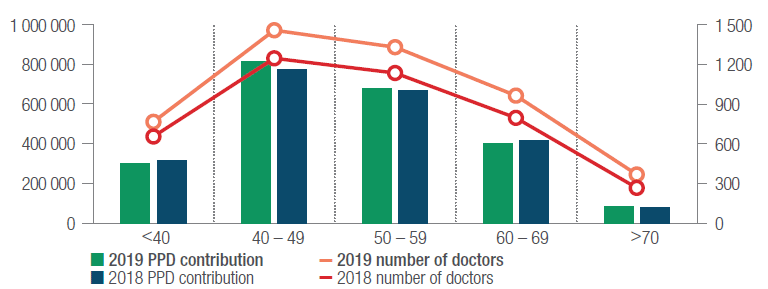
We successfully appointed 200 (2018: 152) new doctors to replace the 62 (2018: 101) who left due to relocation, retirement, or to pursue other opportunities. We have approximately 3 800 (2018: 2 985) doctors, specialists, and other healthcare professionals providing care at our facilities and have the capacity to recruit a further 150 specialists. The average age of our doctors is 51.0 years (2018: 51.5 years), which has increased marginally over time, while the average age of new doctors in 2019 was 38.0 years (2018: 41.3 years).
| DOCTORS’ AGE PROFILE (PPD contribution) (number of doctors) |
 |
We value and strive for long-term relationships with doctors and continue to build a portfolio to engage with hospitals, medical associations and tertiary institutions to establish a future pipeline of specialists. Furthermore, we monitor activities among specialists and doctors at hospital, regional and national levels to identify recruitment needs.
Life Healthcare hosts an annual registrar event for specialists-in-training. Thus far, we have hosted events in the Western Cape, Gauteng and the Free State. The attendance of these events has increased over time, offering us an opportunity to recruit attendees to our facilities.
We continue to engage with universities to train specific specialists in scarce disciplines for specific facilities. In recent years, we funded the training of specialists in cardiology and pulmonology. This initiative will be expanded to a wider range of specialities to train up to 15 specialists at any given time.
Risk and insurance
Life Healthcare continues its efforts to ensure that our doctors have appropriate insurance policies in place and we recently launched an online portal aimed at improving control in terms of doctors’ insurance renewals. We aim to have all doctors registered on the portal in the near future.
Life Healthcare’s policy is that all doctors with admission privileges at our hospitals are required to have insurance.
Electricity, water and waste
During 2018, we implemented several projects aimed at driving sustainability through efficiency, reducing our water and electricity usage, as well as decreasing our carbon emissions. Pleasingly, these projects led to increased electricity and water savings in 2019. Despite improving our efforts to reduce our impact on the environment, the metering of consumption of water and electricity is an ongoing concern due to infrastructural challenges and system performance.
Life Healthcare uses an ISO 14001 approved environmental management system (EMS) across our business. In addition, our environmental sustainability is driven by our environment and climate change forum. The forum is also responsible for the following:
- Providing direction to our quality and engineering departments on EMS-related matters
- Reports to the board on environmental issues via the social, ethics and transformation committee
Electricity
During the year, we reduced electricity consumption by 6.6% from 63.7 kWh/PPD in 2018 to 59.5 kWh/PPD in 2019. Solar harvesting has reduced grid electricity consumption by 13%, driven by the installation of solar PV panels in five hospitals – bringing the total number of plants in the Group to seven. Life Healthcare aims to remove pressure from the national grid, while also establishing a bigger reduction in our carbon dioxide (CO2) emissions and cutting operating costs and will install solar capacity at seven additional facilities during 2020.
Water
Group water consumption decreased by 29.2% during the year, from an average 0.48 kℓ/PPD in 2018 to 0.34 kℓ/PPD in 2019. This is mainly due to the autoclave water-saving project, whereby 132 autoclaves were installed across 41 hospitals resulting in a 60% decrease in water usage. Over and above that, approximately 70% of Life Kingsbury’s Hospital water requirements are supplied by a borehole.
Carbon emissions
In 2012, we committed to reducing our scope 2 carbon emissions at acute hospitals in southern Africa by 2% annually, with a cumulative reduction in emissions of 10% over five years from 2013 to 2017. We achieved a 7.9% reduction in scope 2 emissions for the first four years.
Several energy reduction projects were implemented during the financial year. The installation of solar PV panels resulted in further carbon savings in metric tonnes of CO2 equivalent. The initiatives resulted in carbon savings exceeding the set target.
| Indicator | Year-on- year trend |
2019 | 2018 | 2017 | ||||
| Electricity usage (kWh)1 |  |
135 083 292 | 142 934 448 | 148 560 938 | ||||
|---|---|---|---|---|---|---|---|---|
| Water usage (kℓ) | |
765 055 | 1 089 999 | 1 246 804 | ||||
| HCRW (kg/PPD)2 | |
1.96 | 1.88 | 1.81 | ||||
| 1 | These figures are based on best estimates using available information. |
| 2 | Indicator is externally assured.  |
Waste
We encourage our hospitals to explore opportunities to reduce waste. Different patient profiles will generate different levels of waste and our case mix can affect our waste totals year on year. HCRW is the only measurable waste stream reported throughout Life Healthcare. In 2019, the total HCRW increased to 1.96 kg/PPD (2018: 1.88 kg/PPD), primarily due to the growth in our complementary business.
During the year, we piloted two procurement-driven projects aimed at improving efficiencies and reducing our impact on the environment. Firstly, our containerisation project focused on aligning the business to international best practices and improving infection prevention practices within the central sterile services department (CSSD). Surgical instrumentation, which previously was wrapped in disposable cloth and treated as HCRW, was instead containerised. The project has been implemented in 12 of our facilities and has resulted in a 30% decrease in disposable cloth used, which previously would have ended up in landfill sites. The project will be rolled out to a further 10 facilities by December 2019.
Our large volume parenteral project focused on segregating intravenous (IV) drip bag waste from other HCRW, which will then be redirected from landfill sites to an accredited HCRW treatment facility. This facility sterilises, shreds and compacts the IV drip bag waste for use in other industries as an alternative energy source to fossil fuel. Following a successful pilot, the initiative was implemented in 56% of the acute hospitals. The project will be implemented in the remainder of our acute hospitals by December 2019. The larger hospitals have each been able to redirect 500 kg of waste on average per month over the past year.
Implementation of the above two projects is expected to divert Life Healthcare’s waste away from the landfill site. Life Healthcare is investigating a business wide integrated waste management approach in an effort to increase efficiency and further improve waste management.
CSI
We drive strategically relevant CSI programmes that complement shortfalls in public healthcare services and training in South Africa. Our focus areas include community upliftment, health and education, which align with our purpose of making life better.
Our CSI steering committee recommends projects for approval to the Life Healthcare Foundation Trust, and allocates funds to any approved projects. The steering committee comprises five executives and is chaired by the HR Executive – SA. Progress on CSI activities are reported during monthly executive management meetings, as well as during the quarterly meetings of the social, ethics and transformation committee.
| Indicator | Year-on- year trend |
2019 R million |
2018 R million |
2017 R million |
||||
| CSI spend |  |
106 | 71 | 43 | ||||
|---|---|---|---|---|---|---|---|---|
For more information, refer to our social and ethics management section.