
Currently viewing: Corporate governance overview / Next: Social, ethics and transformation committee report
Our vision is to be an international healthcare provider delivering measurable clinical quality through a diversified offering and people-centred approach. To support this vision, we have solid and embedded governance structures in place. Life Healthcare's established governance framework embodies the King IV principles and outcomes that continue to stand us in good stead.
Corporate governance philosophy
The governing body (the Board) remains Life Healthcare's overall custodian of sound corporate governance. The Board strives to entrench sound corporate governance principles and adhere to high levels of ethical standards and effective leadership throughout the business. This sets the tone for our organisation as a whole and reinforces our ability to generate and deliver long-term sustainable value to our stakeholders. We continue to ensure that we grow and evolve in this role through ongoing review of and improvement to our processes and policies.
The Board is satisfied that it has fulfilled its responsibilities in accordance with its charter and with all other applicable legislation for the year under review.
King IV
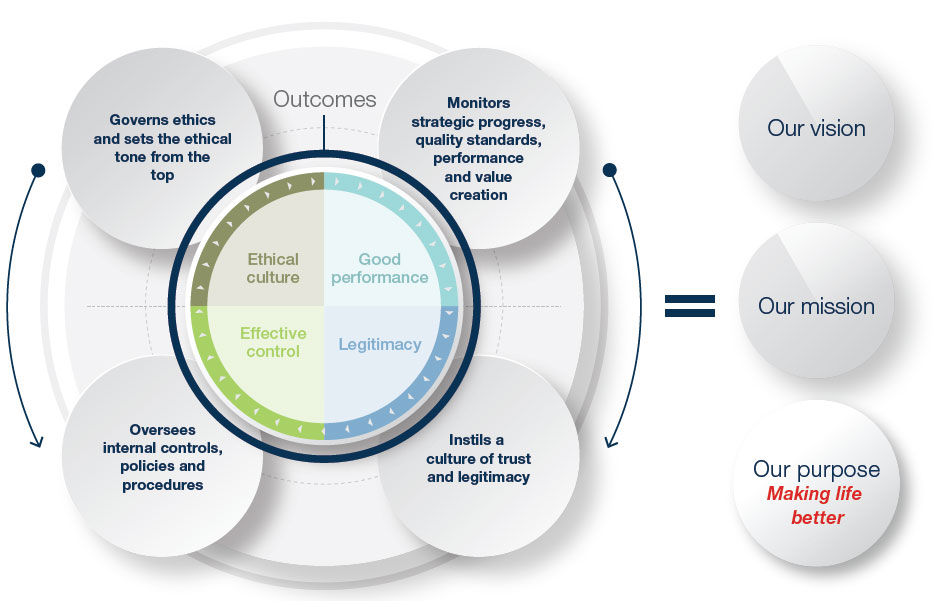
Life Healthcare endorses and endeavours to adhere to the guidelines and principles of King IV. The Group also embraces the achievement of King IV's governance outcomes, namely: an ethical culture, good performance, effective control and legitimacy, as depicted below. A King IV Implementation Report is available on the Group's website
Corporate governance outcomes
The Board is instrumental in ensuring that the Group achieves its governance outcomes, in order to realise our vision, mission and purpose. This is attained through the Board's wealth of knowledge, oversight, monitoring and guidance.
Group governance framework
The Group's governance framework was formulated to ensure effective and sustainable delivery of our overall strategy. This framework provides a structure within which the business is properly managed and the interests of our stakeholders are protected. The framework has been especially useful as we navigate our way through the impact of COVID-19; to provide clear and concise guidance on the most effective and pragmatic manner of governing the organisation.
Governance during COVID-19
Proactive and resilient corporate governance is critical in times of crisis, such as the current COVID-19 pandemic. The culture and inherent value system that is deeply entrenched within our business has played a material role in enabling the Board to guide the Group through the pandemic. Our governance framework continues to contribute towards the efficacy and resilience of our governance responses regarding the COVID-19 crisis. This continues to allow the Board and senior management to focus on the significant challenges and agile decision-making required to respond appropriately.

Our governance framework and accompanying policies and processes also provided clarity during a very challenging time, and clearly delineated roles and areas of accountability, ensuring proper alignment across the Group. The framework focused and informed decision making at the appropriate levels across our various operational jurisdictions.
Role of the Board
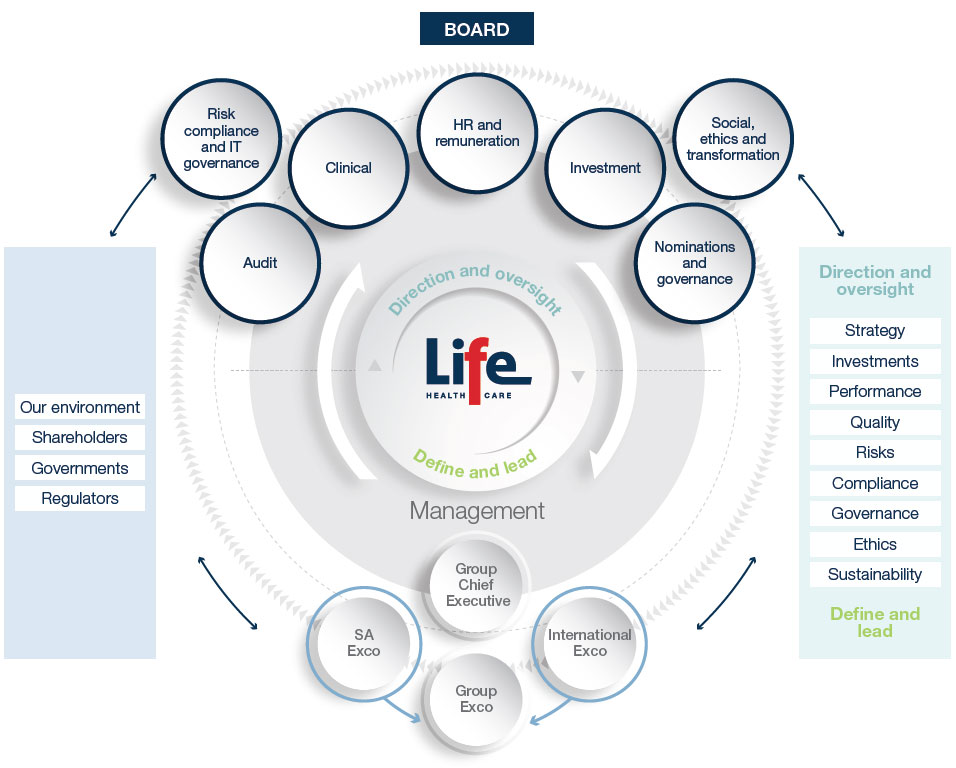
Life Healthcare has a unitary Board of directors that is supported in delivering its mandate through various Board committees, as well as a formal charter that clearly defines its role and responsibilities. The Board sets the overall strategic objectives of the Group, determines investment policy and performance criteria and delegates the detailed planning and implementation of policies to management within the appropriate risk parameters. The Board monitors compliance with policies and performance against objectives, by holding management accountable for its activities through quarterly performance reporting and budget updates.
The Board considers matters of strategic direction, significant acquisitions and disposals, and approves major capital expenditure, financial statements and other material matters. Board members are encouraged to debate and challenge matters in an atmosphere of mutual respect and cooperation. While retaining overall accountability, the Board has delegated authority to the Group Chief Executive (GCE) to manage the day-to-day affairs of the Group who, in turn, is supported by the Group executive committee.
The Group Operating Committee, comprising the Group Chief Executive and the top 26 senior leaders in the organisation, reviews and monitors policies and frameworks prior to Board approval. This committee is structured in a manner that strives to ensure an appropriate balance of diversity, knowledge, skills and experience.
| Key Board focus areas in 2021 |
Governance outcome |
Strategic objective addressed |
Material matters addressed |
| Ongoing response to the COVID‑19 pandemic | Good performance |  |
 |
| Driving quality and efficiency | Legitimacy |  |
 |
| Growth and innovation | Good performance |  |
 |
| Reviewing long-term strategy | Good performance |  |
 |
| Strengthening our ESG framework and reporting | Good performance Legitimacy |  |
 |
| Policies/frameworks reviewed in 2021 | |||
| Anti-bribery and corruption policy | Ethical culture | |
 |
| Treasury distribution policy | Good performance | |
 |
| Combined assurance framework | Legitimacy | |
 |
| Key Board focus areas for 2022 |
|||
| Retention of key people | Good performance |  |
 |
| Focus on IT technology stability, security and capability | Good performance |  |
 |
| Growth initiatives (SA imaging, LMI and Community Diagnostic Centres) |
Good performance |  |
|
Delegation of authority
Life Healthcare's operations span across a number of geographies. The business is capital-intensive and the strategy, operating and investment budget and plans are approved by the Board. To facilitate effective control of trading activities, it is the Board's philosophy that authority and responsibility be delegated, and management is expected to always act in accordance with the Group values and code of conduct.
The Group delegation of authority includes fundamental elements such as:
- An authority matrix for the Board, GCE and management in the different geographies
- Corporate, finance, governance and HR matters reserved for the Board
- Processes for the approval or amendment of the Group's business plan and annual budget
- Acquisitions and disposals
- Salary mandate
Roles of the Chairman, Lead Independent Director and GCE
The roles of Chairman, Lead Independent Director and GCE are separate, and there is a clearly outlined division of responsibilities as tabled below.
| Chairman's responsibilities | Lead independent director responsibilities |
| Provides Board leadership and oversees ethical conduct | Provides support and advice to the Chairman as a trusted confidante |
| Oversees the Group's strategy, Board succession and performance | Chairs Board discussions and decision-making where the Chairman has a conflict of interest or is unavailable |
| Manages any conflicts of interest | Leads discussions at Board and committee meetings regarding the Board Chairman's performance appraisal and remuneration |
| Engages with the GCE and ensures positive stakeholder relations are maintained | |
| Group Chief Executive's responsibilities | |
| Manages the business according to the Board approved strategy | Implements the policies and strategies adopted by the Board |
| Ensures appropriate internal control mechanisms are in place to safeguard assets and maintains compliance with all relevant laws and best practice | Guides and evaluates executive management's performance against strategic objectives |
|
Delegates the appropriate authority to the executive management within defined levels of authority and retains accountability to the Board |
|
The Board delegates its authority to the GCE who is supported by an executive team. The Board is kept apprised of developments through regular quarterly meetings and ad hoc meetings when material matters arise. Senior executives attend Board meetings as and when necessary to apprise the directors of important events and share strategy. This encourages communication and co-operation between the directors and executive management.
In accordance with the Board Charter, collegiality is encouraged amongst the directors without inhibiting candid debate and create tension among directors. Directors are encouraged to play a full and constructive role in the affairs of the Group; this ensures that there is no unfettered power in relation to decision making.
The Board ensures that shareholder interests are protected and considers whether there is an appropriate balance of knowledge, expertise and diversity among the non-executive directors. In doing so, the Board is satisfied that the non-executive directors have a mix of the required skills and experience to have objective judgement on matters of strategy, operational performance, resources, diversity and inclusion, employment equity, standards of conduct, evaluation of results, economic, social and environmental policies.
When required, directors are entitled to seek independent professional advice to further their duties and the cost will be covered by the Company. All directors have access to the Group Company Secretary, who is responsible for ensuring Group compliance with applicable legislation and procedures. In compliance with JSE Listings Requirements, non-executive directors do not participate in any share incentive or option scheme of the Group.
Board composition
Board Independence
The majority of the Group's Board members are independent directors, which complies with King IV and global best-practice.
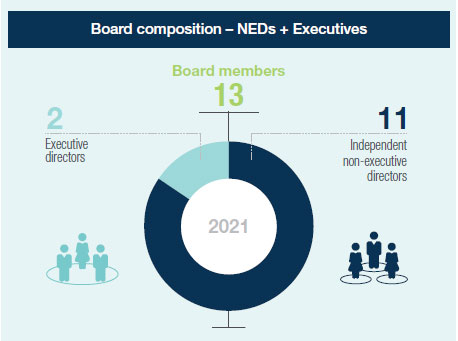
The Group's nominations and governance committee is responsible for assessing the independence of the Group's directors on an annual basis. Independence is determined according to the Companies Act, JSE Listings Requirements and the recommendations in King IV, which takes into account, among others, the number of years a director has served on the Board.
The Board was satisfied that its non-executive directors met its independence criteria for the 2021 financial year.
Board Diversity
Board diversity has been a focus area for the Company as it is an important dynamic for ensuring that the Company looks to richer conversation with a diversity of views and is important for remaining relevant and sustainable from both a South African and international perspective. The Board's diversity policy applies to the appointment of new directors and has been taken into account for purposes of succession planning for the Board. The nominations and governance committee ensure that diversity indicators are considered in relation to any proposed appointments to the Board.
Diversity at Board level
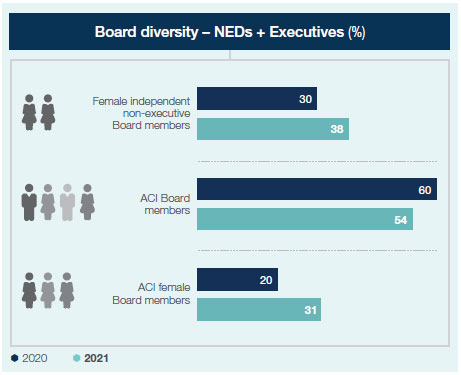
During 2021 we appointed two female independent non-executive Board members, and Mustaq Brey retired as Chairman. Consequently, the Board increased to 13 members (2020: 12).
Board Demographics
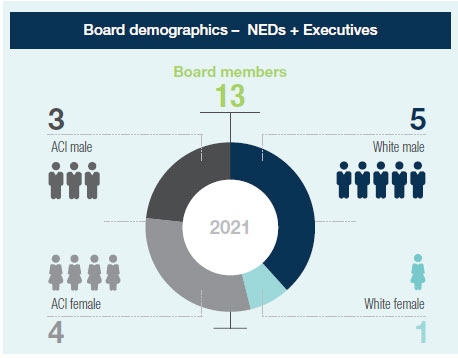
The Group's nominations and governance committee will make recommendations to the Board based on merit and will consider candidates against objective criteria with due regard to the benefits of international diversity, including gender and race, and the contribution that the candidate will bring to the Board. There is an ongoing commitment from the Board to strengthen female representation, and preference will be given to female candidates. This was evidenced by the appointment of two women this year.
Diverse skills and experience at Board level
Life Healthcare's Board has a broad range of skills and experience, which we believe enhances and promotes debate and helps create value in the interests of all stakeholders.
Board members' skills and expertise includes: financial and business acumen; investments, mergers and acquisitions; remuneration and human resources; healthcare and clinical; corporate governance and leadership; strategy and legal expertise; and information technology experience.
Board appointments will continue to introduce a diverse mix of skills, with a focus on increasing healthcare and multi-national corporate experience.
Board tenure and age
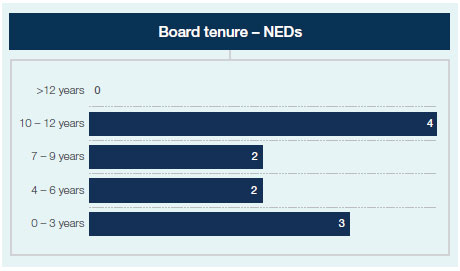
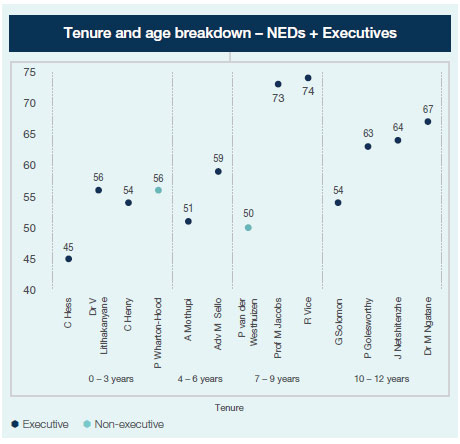
Maintaining a balance of experience and new ideas at Board level ensures continuity, sustainability and refreshment of thinking and debate.
Rotation of directors
Life Healthcare's memorandum of incorporation (MOI) stipulates that one-third of the Board members will retire from office at the AGM and will be eligible for re-election. The directors to retire are those who have been in office longest since their last election or who were appointed during the year. Executive directors are included in determining the rotation of retiring directors.
At the upcoming AGM, the following directors will stand for re-election: Royden Vice, Marian Jacobs, Garth Solomon, Malefetsane Ngatane, Peter Golesworthy and Joel Netshitenzhe. The appointment of the two new directors, Caroline Henry and Cindy Hess, will be confirmed.
Board processes
| Induction and training of directors | Key focus areas | Progress in 2021 | ||
It is important that directors are kept up to date with their duties, as well as changes in the Group. On appointment, new directors are briefed on their fiduciary duties and responsibilities by the Group Company Secretary. The nominations and governance committee has approved an induction policy which includes the requisite reading material and the required exposure to the business. The policy is reviewed annually by the nominations and governance committee. In addition, new directors receive information on JSE Listings Requirements, King IV, the Companies Act and obligations they must comply with. The Group Company Secretary assists the Chairman with the induction of directors. Directors are informed of relevant new legislation and changing commercial risks that affect the Group. During the year under review, the following training was conducted:
Directors have full and unrestricted access to management and information when required, and they are entitled to seek independent professional advice in support of their duties at the Group's expense. |
Enhanced engagement with relevant stakeholders within the healthcare industry. | Meetings with HASA, government departments and leaders in healthcare | ||
A firm focus on ensuring the efficacy and sustainability of the IT systems and infrastructure. |
Risk Committee mandate extended to include IT governance and cyber security | |||
A key focus on continued implementation of the Board succession strategy. |
Two new Board members appointed to the Board | |||
| Transformation and diversity. | Two new women appointed: one white female and one ACI female candidate |
Board and committee evaluations
External independent reviews of Board and committee effectiveness are conducted every third year, with the last external evaluation done in 2020. An internal evaluation was conducted in 2021 and based on the assessments the Board and its committees are functioning effectively and fulfilling their mandates.
Board succession
The Board succession strategy considers a number of criteria including but not limited to the tenure of Board members,
skills required and diversity. The strategy ensures continuity and sustainability of corporate and Board performance and effectiveness. The nominations and governance committee supports the Board in the execution of the succession strategy. Life Healthcare's skills matrix maps out the profile of competencies and demographics that guide new appointments to the Board.
Appointments and rotation
In accordance with the memorandum of incorporation (MOI), one-third of the Board members will retire at the AGM and will be eligible for re-election. As per the MOI, directors who have reached or exceeded the age of 70 years are annually evaluated to consider their continued service to the Board. Any new appointment to the Board involves a formal and transparent process and is a matter of consideration for the full Board, assisted by the nominations and governance committee, with due regard to TDI imperatives.
Internal controls
We maintain accounting records, and have developed systems designed to provide reasonable assurances as to the integrity and reliability of the financial statements. The Board delegates responsibility for the adequacy and operation of these systems to the GCE and Group CFO. These records and systems are designed to safeguard assets and minimise fraud. The systems of internal control are based on established organisational structures and written policies and procedures, which include budgeting and forecasting disciplines and the comparison of actual results against these budgets and forecasts. The Group has a key operational process checklist and has assigned responsibilities for controls in the processes to relevant employees. Compliance is tested by internal and external audit reviews.
The Group's combined assurance model enables an effective control environment that support the integrity of information for internal decision making and external reports. The Group's management approves relevant policies and processes in support of the combined assurance model.
Board and Board committees' activities
In fulfilling its duties, the Board is supported by various committees that focus on specific areas as prescribed by their terms of reference.
The Group has seven committees, and each committee comprises of at least three members, the majority of whom are independent. Specific executives and senior management are standing invitees to these meetings and in certain cases, for instance at the audit committee, the Group's external auditors are invited.
All committee's terms of reference are aligned to relevant codes and legislation including King IV, the JSE Listings Requirements and the Companies Act. These terms of reference are updated to include any new legislative requirements, as well as the evolving needs of the business.
During the year under review, each committee satisfied itself that it discharged its duties in terms of its specific terms of reference.
Number of BOARD
MEETINGS IN THE YEAR
4
attendance rate
98%
| Audit | Board | Investment | Nominations and governance |
Human resources and remuneration |
Risk, compliance and IT governance |
Social, ethics and transformation |
Clinical | |
| MA Brey1 | 1/1 | 1/1 | ||||||
| PJ Golesworthy2 | 5/5 | 4/4 | 6/6 | 5/5 | 4/4 | |||
| CM Henry3 | ||||||||
| CJ Hess3 | ||||||||
| ME Jacobs | 4/4 | 4/4 | 2/2 | 4/4 | ||||
| VL Litlhakanyane4 | 4/4 | 6/6 | 4/4 | 4/4 | ||||
| AM Mothupi | 5/5 | 4/4 | 4/4 | 2/2 | ||||
| JK Netshitenzhe | 4/4 | 4/4 | 2/2 | |||||
| MP Ngatane | 4/4 | 5/5 | 2/2 | 4/4 | ||||
| M Sello5 | 3/4 | 2/2 | 3/4 | 4/4 | ||||
| GC Solomon6 | 5/5 | 4/4 | 6/6 | 4/4 | 4/4 | |||
| PP van der Westhuizen | 4/4 | 4/4 | 4/4 | |||||
| RT Vice | 5/5 | 4/4 | 6/6 | 4/4 | ||||
| PG Wharton-Hood | 4/4 | 5/6 | 4/4 | 2/2 | 4/4 |
| 1 | Mustaq Brey retired from the Board on 27 January 2021 |
| 2 | Peter Golesworthy stepped down as Chairman of the Nominations and Governance Committee on 27 January 2021 |
| 3 | Cindy Hess and Caroline Henry were both appointed to the Board effective 1 September 2021 |
| 4 | Dr Victor Litlhakanyane was appointed as Chairman of the Board effective 27 January 2021 and was appointed as Chairman of the Nominations and Governance Committee on 27 January 2021 |
| 5 | Adv Mahlape Sello was appointed a member of the Nominations and Governance Committee on 17 June 2021 |
| 6 | Garth Solomon stepped down from the Audit Committee effective 31 August 2021 |
| Audit committee | Chair: P Golesworthy | ||||
| Role | Key focus areas during 2021 | Members | |||
|
The committee is constituted as a statutory committee in terms of section 94 of the Companies Act. It has an independent role and is accountable to the Board and shareholders. The overall functions of the committee are to:
|
The committee is satisfied that it executed its duties in accordance with its terms of reference during the financial year. |
A Mothupi, R Vice, INDEPENDENCE ATTENDANCE RATE |
Outlook
- Continued oversight of key IT initiatives across the Group with a focus on those affecting reporting processes
- Monitoring changes to the finance structure
- Continued evaluation of the IT environment, in consultation with the Risk, Compliance and IT Governance Committee
- Continued monitoring of the assessment of internal controls to enable the GCE and Group CFO attestation
- Consideration of the evolving ESG-related reporting requirements
| Risk, compliance and IT governance committee | Chair: J Netshitenzhe | ||||
| Role | Key focus areas during 2021 | Members | |||
|
The role of the committee is to assist the Board to set the direction for the manner in which risk is managed and addressed, compliance is embedded into the organisation and IT governance is implemented. This is all executed while adopting a stakeholder-inclusive approach. The committee also oversees and directs that the Company has implemented an effective policy and plan for risk management and compliance encompassing the opportunities and associated risks to be considered when developing strategy and the potential (positive and negative) effects of these on the achievement of the Company's strategic objectives. |
The committee is satisfied that it executed its duties in accordance with its terms of reference during the financial year. |
P Golesworthy, Prof M Jacobs, INDEPENDENCE ATTENDANCE RATE |
Outlook
- Firm focus on cyber security, data security and accessibility of data
- Continued evaluation of IT platforms and the introduction of new IT systems
- Monitoring of key IT initiatives and project management across the Group
- Continued review of patient safety and care according to industry best practice
- Monitoring macroeconomic, political and other risks
- Monitoring compliance with relevant laws and regulations in all jurisdictions in which the Group operates
| Investment committee | Chair: G Solomon | ||||
| Role | Key focus areas during 2021 | Members | |||
|
The overall functions of the committee are to:
|
The committee is satisfied that it executed its duties in accordance with its terms of reference during the financial year. |
Dr V Litlhakanyane, INDEPENDENCE ATTENDANCE RATE |
Outlook
- Consideration of the Group's 2022 budget
- Implementation of the SA Imaging strategy in South Africa
- Development of Clinical Diagnostic Centres (CDCs) in the International operations
- Expansion of radiopharmacy in South Africa and Internationally
| Human resources and remuneration committee | Chair: R Vice | ||||
| Role | Key focus areas during 2021 | Members | |||
|
The overall functions of the committee are to assist the Board in ensuring that:
|
The committee is satisfied that it executed its duties in accordance with its terms of reference during the financial year. |
C Hess, Adv M Sello, G Solomon INDEPENDENCE ATTENDANCE RATE |
Outlook
- A review of the Company's reward philosophy
- Due consideration of shareholder views when planning the reward strategy
- Ensure continued performance-driven reward
- Global integration focusing on organisational culture, global mobility, talent management, HR metrics and retirement funds
- Diversity, equal opportunity and fair representation of the communities we serve
| Social, ethics and transformation committee | Chair: A Mothupi | ||||||
| Role | Key focus areas during 2021 | Members | |||||
|
The social, ethics and transformation committee is constituted as a statutory committee in terms of section 72(4)(a) of the Companies Act. The committee monitors matters in relation to:
|
The committee is satisfied that it executed its duties in accordance with its terms of reference during the financial year. |
C Henry, Prof M Jacobs, INDEPENDENCE ATTENDANCE RATE |

Outlook
- Assessment of progress against sustainability targets
- Monitor the integration of ESG imperatives across the business
- Review of the Group's CSI initiatives across the geographies
- Monitor TDI and progress against the previous year
| Clinical committee | Chair: Prof M Jacobs | ||||||
| Role | Key focus areas during 2021 | Members | |||||
|
The overall functions of the committee are to assist the Board in:
|
The committee is satisfied that it executed its duties in accordance with its terms of reference during the financial year. |
Dr M Ngatane, INDEPENDENCE ATTENDANCE RATE |
Outlook
- Review of the Clinical Governance Framework, organisational structures, and integration across the Group
- Standardisation of Clinical Governance processes both in southern Africa and in the International operations
- Review of the quality assessment and scoring and the introduction of Statistical Protocol Methodology
- Review mechanisms for eliciting outcome measures, specifically patient outcome measures
| Nominations and governance committee | Chair: Dr V Litlhakanyane | ||||
| Role | Key focus areas during 2021 | Members | |||
|
The overall functions of the committee are to assist the Board in:
|
The committee is satisfied that it executed its duties in accordance with its terms of reference during the financial year. |
P Golesworthy, INDEPENDENCE ATTENDANCE RATE |
Outlook
- Board succession with due regard to transformation, diversity and inclusion
- Review of governance frameworks across the business with a focus on the International operations
- Continued training and updates to the Board on changes in legislation and/or the JSE Listings Requirements
Ethical leadership
The Group recognises that ethical leadership starts at the top, and the Board subscribes to the Group's code of conduct. In so doing it ensures fairness and ethical behaviour in all its business dealings and processes. The Board sets the values by which the Group abides and a culture of ethical conduct throughout the company.
Code of conduct
Guidance for appropriate behaviour throughout the Group is based on the Code of Conduct (the code). The code sets out policies and procedures to be followed in all aspects of professional, clinical and business dealings, and establishes a set of standards. It guides employees in their behaviour towards supporting healthcare professionals, patients, customers, suppliers, shareholders, co-workers, and the communities in which the Group operates. The code also extends to safety, health, security, conflicts of interest, environmental matters and human rights. While common sense, good judgement and conscience apply in managing a difficult or uncertain situation, the code assists in detailing the standards and priorities within the Group. New employees are familiarised with the code as part of their induction.
Tip-offs anonymous
Employees, doctors and suppliers can report suspected irregularities anonymously to an independent hotline operated by a leading international audit firm. Reported incidents are independently assessed and, where relevant, independently investigated. These incidents are also reported to the audit, and social, ethics and transformation committees.
During the year under review, 46 (2020: 36) tip-offs were received in SA. There were no tip-offs in the international business. Of the 46 (2020: 36) tip-offs received in the year, 41 (2020: 28 cases) have been closed and 5 are recent and remain under investigation.
 Conflicts of interest
Directors and employees are required to avoid a situation where they may have a direct or indirect interest that conflicts with the Group's interests. Directors disclose conflicts of interest at every meeting in terms of section 75 of the Companies Act.
Directors present an updated list of their directorships and interests to the Group Company Secretary annually, and the comprehensive list is tabled at the Board meetings.
Insider trading 
Life Healthcare observes a closed period from the end of the accounting period to the announcement of the interim or annual results, and when otherwise required in terms of the JSE Listings Requirements. During this time, no employee or director who might be in possession of unpublished price sensitive information may deal, either directly or indirectly, in the shares of the Company. Comprehensive guidelines on how to comply with insider-trading restrictions and how to deal with analysts are provided in the insider-trading policy.
 Political party contributions
In line with the code of conduct, employees may not make any direct or indirect political contribution on behalf of the Group unless authorised by the Board. This includes contributions to candidates, office holders and political parties. There were no political contributions made in 2021.
GROUP COMPANY SECRETARY
Joshila Ranchhod was appointed as the Group Company Secretary, with effect from 1 March 2021, following the resignation of Avanthi Parboosing, with effect from 28 February 2021. Her primary role is to ensure that the Board is cognisant of its fiduciary duties and responsibilities. The Group Company Secretary plays a key role in providing guidance to the Board members on the execution of their duties, keeping the Board aware of relevant changes in legislation and corporate governance best practice and emerging trends. Other key performance areas of the Group Company Secretary include overseeing the induction of new directors, and ongoing education of directors.
An assessment of the Group Company Secretary was carried out for the year under the auspices of the nominations and governance committee. The Board confirms that the Group Company Secretary has the requisite experience and qualifications to carry out the role, and that she maintains an arms-length relationship with the Board.
IT GOVERNANCE
The Board is responsible for the governance of technology and information within the Group. It provides direction and oversight of the Group's IT strategy to ensure alignment with the achievement of the Group's strategic objectives. The Board's risk, compliance and IT governance committee supports the Board in discharging its technology and information oversight duties. At a management level, the IT management forum ensures that relevant IT policies are developed, approved and embedded within the organisation. This committee also ensures that technology is leveraged to enhance our service offering to patients and to provide accurate data and analytics for the Group to make informed decisions.
Key focus areas in 2021 included improving the security of our data and systems while at the same time starting the process of upgrading our IT platform and phasing out legacy systems. In addition, a dedicated cyber security function was set up.
Going forward the Group will continue to focus on the modernisation of our IT platform along with migration of systems and data into the cloud. This will facilitate improved security whilst also building a platform on which to build a digitally enabled healthcare ecosystem which will enhance our data and analytic capabilities.
GOOD CORPORATE CITIZENSHIP
The Board is responsible for ensuring that the Group is and is seen to be a responsible corporate citizen that includes economic growth, environmental stewardship and social progress. The Board's social, ethics and transformation committee supports the Board in fulfilling this duty. At management level, the sustainable development committee continues to oversee the Group's sustainability journey and ensures that relevant policies and frameworks are in place to achieve the Group's strategic objectives. The Group's social, ethics and transformation committee's report provides details on the focus areas for 2021 as well as the Group's focus going forward, as its sustainability journey evolves.
STAKEHOLDER RELATIONS
The Board acknowledges that the Group's sustainability depends on fostering positive relationships with our key stakeholders. While stakeholder engagement takes place at various levels within the organisation, the messaging is consistent Group-wide. The Group has adopted a stakeholder-inclusive approach to stakeholder engagement that considers the needs of our key stakeholders, at each point of our value chain, and responds appropriately so that we can consistently create value in the short, medium and long term.
CODES, REGULATIONS AND COMPLIANCE
The Board is responsible for the Group's compliance with applicable laws, rules, codes and standards. The enforcement of compliance principles is incorporated into the Group's global code of conduct and the Group considers compliance an integral part of the Group's culture in ensuring the achievement and sustainability of its strategic goals.
The Board has delegated the implementation of an effective compliance framework to management. Oversight of compliance risk management is delegated to the risk, compliance and IT governance committee, which reviews and approves the arrangements in place to monitor compliance. The Group complies with various codes and regulations such as the Companies Act, the JSE Listings Requirements and King IV.
There were no material or repeated regulatory penalties, sanctions or fines for contraventions of, or non-compliance with, statutory obligations or environmental laws.
GOING CONCERN
The Board considers and assesses the Group's going concern basis in the preparation of the annual and interim financial statements. In addition, the solvency and liquidity requirements per the Companies Act are considered. The Board is satisfied that the Group will continue as a going concern into the foreseeable future.
MATERIAL LITIGATION
During the financial year, the Group was not involved in any material litigation or arbitration proceedings, nor were the directors aware of any pending or threatened legal issues which may have a material impact on the Group's financial position. Institutions in the healthcare sector are subject to patient lawsuits and the directors are of the opinion that the Group has sufficient insurance to mitigate financial risk.