
Currently viewing: Our material matters / Next: Our strategy
Our material matters are those issues that could affect our ability to deliver care, or the economic, environment and social value we create for our stakeholders through our business strategy. We manage our material matters strategically to ensure sustainable value in the short, medium and long term.
MATERIAL MATTERS DETERMINATION PROCESS:
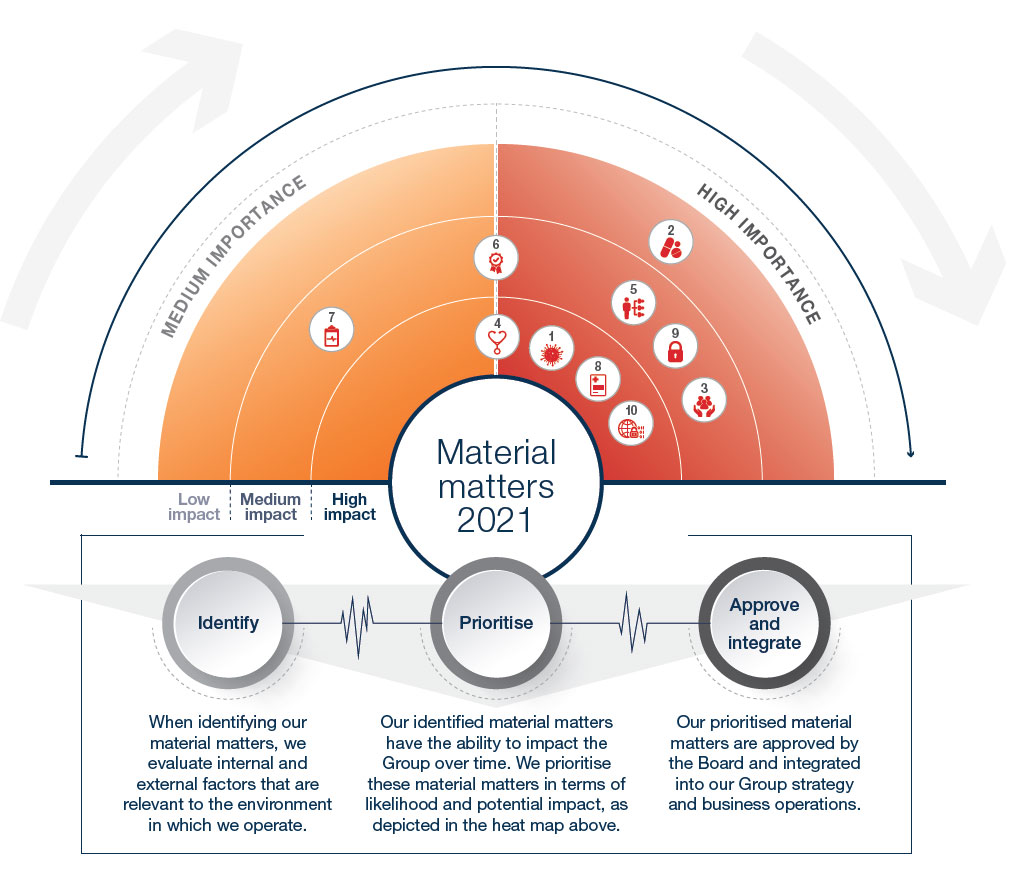
Our material matters determination process (depicted below) involves assessing our operating environment, considering and discussing what matters most for our various key stakeholders and what risks and opportunities the Group faces. These matters are then identified, prioritised and integrated into the business. The matters are also approved by the Board annually. Following this process during 2021, ten matters were identified as the most material to our current operations and stakeholders (see below).
Our material matters influence the Group’s strategy, the Board’s agenda, management reports, the external operating environment, our relationships with stakeholders, and our key risks and opportunities.
Change in severity year-on-year:
 Unchanged
 Decreased
 New material matter
Levels of control:

WE HAVE IDENTIFIED THE FOLLOWING MATERIAL MATTERS THAT COULD IMPACT OUR ABILITY TO CREATE VALUE IN THE SHORT, MEDIUM AND LONG TERM
 |
COVID-19 | Change: |
||||
| Why matter is considered material | Factors impacting this material matter | Level of control: | ||||
|
COVID-19 continues to impact economies and societies world-wide and, given our international footprint, our operations were at the frontline in combatting the effects of the pandemic. We continue to prioritise the safety and health of our nurses, clinicians, employees and patients. Our response has been informed by best practice local and international guidelines and procedures to safeguard the Group’s sustainability. COVID-19 has introduced additional operational costs for all of our operations, including the costs of PPE, absenteeism (due to sickness or isolation). We have introduced a mandatory vaccination policy across the Group, starting with our corporate head office and then rolling out to our clinical facilities during 2022. |
|
 |
||||
| Affected stakeholders | Related key risks and opportunities | Our response – strategic pillars | ||
 |
|
 |
 |
Business disruptions due to social unrest and shortages of critical supplies | Change: |
||||
| Why matter is considered material | Factors impacting this material matter | Level of control: | ||||
|
COVID-19 continues to impact economies and societies world-wide and, given our international footprint, our operations were at the frontline in combatting the effects of the pandemic. We continue to prioritise the safety and health of our nurses, clinicians, employees and patients. Our response has been informed by best practice local and international guidelines and procedures to safeguard the Group’s sustainability. |
|
 |
||||
| Affected stakeholders | Related key risks and opportunities | Our response – strategic pillars | ||
 |
|
 |
 |
Labour relations and employee retention | Change: |
||||
| Why matter is considered material | Factors impacting this material matter | Level of control: | ||||
|
The shortages in critical skills lead to an increase in salary costs which, in turn, can impact the affordability of care. Furthermore, this could also affect the level of quality care provided to our patients. Employee retention is crucial for the future growth of Life Healthcare. |
|
 |
||||
| Affected stakeholders | Related key risks and opportunities | Our response – strategic pillars | ||
 |
|
 |
 |
Healthcare funders and the cost of care | Change: |
||||
| Why matter is considered material | Factors impacting this material matter | Level of control: | ||||
|
Healthcare funders have a significant influence on patients' accessibility to healthcare. Healthcare funder decisions affect our revenue and market share. Private healthcare funders reimburse c.95.0% (2020: 95.1%) of our hospital division's revenue in southern Africa. Internationally, a large proportion of revenue is derived from public funders, ranging between 40% to 90% in the different geographies in which we operate. The increased cost of care remains a reality across the regions in which we operate. Providing efficient and affordable care options is crucial in enabling us to achieve our mission of improving the lives of people through the delivery of high-quality yet cost-effective care. |
Healthcare funders
Cost of care
|
 |
||||
| Affected stakeholders | Related key risks and opportunities | Our response – strategic pillars | ||
 |
|
 |
 |
Specialised skills shortage | Change: |
||||
| Why matter is considered material | Factors impacting this material matter | Level of control: | ||||
|
The limited availability of skilled health professionals, including doctors, pharmacists, specialist and registered nurses, as well as ICU nurses, continues to be a concern globally. The skills provided by these specialists are a key driver of the Group's future growth across southern Africa and internationally. |
|
|
||||
| Affected stakeholders | Related key risks and opportunities | Our response – strategic pillars | ||
 |
|
 |
 |
Quality of care standards | Change: |
||||
| Why matter is considered material | Factors impacting this material matter | Level of control: | ||||
|
Maintaining and improving the quality of care is linked to our core values. It is also a crucial part of building strong and mutually beneficial relationships with our stakeholders, which is one of the ways in which we protect our reputation. |
|
|
||||
| Affected stakeholders | Related key risks and opportunities | Our response – strategic pillars | ||
 |
|
|
 |
Portfolio performance | Change: |
||||
| Why matter is considered material | Factors impacting this material matter | Level of control: | ||||
|
Each business division is critical to delivering on our strategy and growth ambitions. We leverage our intellectual capital across the Group to support the expansion of our footprint. |
|
|
||||
| Affected stakeholders | Related key risks and opportunities | Our response – strategic pillars | ||
 |
|
 |
 |
Government relationships | Change: |
||||
| Why matter is considered material | Factors impacting this material matter | Level of control: | ||||
|
The governments in the regions where we operate are among our key stakeholders who have significant influence over our business and form a primary source of revenue in our international operations. |
|
|
||||
| Affected stakeholders | Related key risks and opportunities | Our response – strategic pillars | ||
 |
|
 |
 |
Increased regulations | Change: |
||||
| Why matter is considered material | Factors impacting this material matter | Level of control: | ||||
|
The healthcare industry is highly regulated and, while this is often necessary, it does impact on our cost of care and growth. We fully support regulators' intentions, but the scale and pace of change in our regulatory landscape remains unprecedented, placing an unavoidable burden on the Group. We protect our reputation and licence to operate by complying with all applicable regulations. |
|
|
||||
| Affected stakeholders | Related key risks and opportunities | Our response – strategic pillars | ||
 |
|
 |
 |
Cyber-security and data protection | Change: |
||||
| Why matter is considered material | Factors impacting this material matter | Level of control: | ||||
|
Cyber-crime is increasing globally |
|
|
||||
| Affected stakeholders | Related key risks and opportunities | Our response – strategic pillars | ||
 |
|
 |