Currently viewing: Group quality review / Next: Our people
GROUP CHIEF MEDICAL OFFICER’S REVIEW OF THE QUALITY METRICS ACROSS THE GROUP
 Quality is one of Life Healthcare's key strategic pillars and continually improving the safety and quality of care is core to the way we work. Striving to consistently improve patient outcomes, enhance the patient experience and work closely with our doctors has been, and remains at the epicentre of our business, as evidenced by our Group quality and patient safety outcomes.
The quality improvement journey is the progressive, incremental improvement of clinical processes, safety, and patient care. Sometimes this improvement is breakthrough in nature, but more often it is a gradual process resulting from the constant questions: "How are we doing?" and "What can we do better?"
It is an iterative process, where improvements are made, the effect of the improvements are measured, and the process, supported by systems and training, is repeated until the desired outcome is achieved.
An important part of continuous learning is transparency and accountability. In 2018 we became the first private hospital group in South Africa to publish our hospital quality scores on our website, on a per- hospital basis.
The ongoing COVID-19 pandemic highlighted the need for all our employees and senior leaders to work together, with decision making and problem solving happening as close to the issues being experienced as possible. Despite the COVID-19 challenges, quality care and clinical excellence remained a constant focus. After adjusting for some of the direct effects of COVID-19, virtually all our patient safety and quality metrics show year-on-year improvement across our Life Healthcare and Alliance Medical operations.
The commitment of our frontline employees to their patients and colleagues across the group has not diminished with multiple daily reports of brave individual team members going well beyond the call of duty to care for patients and their families or support colleagues. The opening and operation of our vaccination sites across South Africa has been a wonderful success story despite the enormous logistical effort required and the additional strain this had placed on our employees and other resources. The enthusiasm shown by our teams to support their local communities and our country with vaccines has been truly heart-warming.
SATISFIED PATIENTS
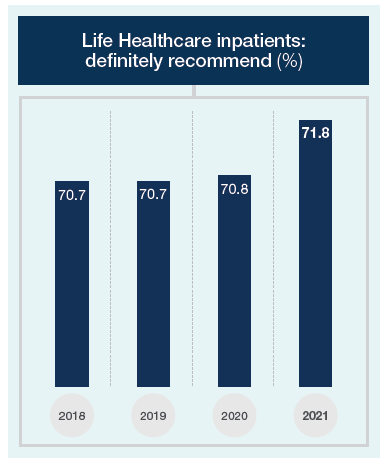
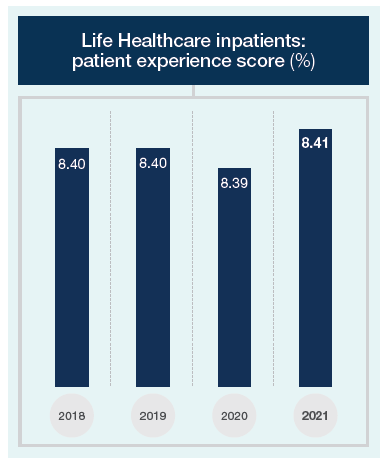
Our commitment to improving patient experience is entrenched in our core values. Better patient experiences, which involves seeing patients as unique individuals, are not only critical to the success of our business but increase the likelihood that they and their families or other caregivers will become more engaged in their own health outcomes. Multiple studies have connected higher levels of clinical outcomes to a focus on patient experience.
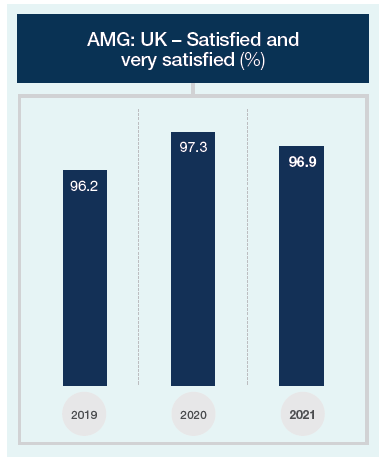
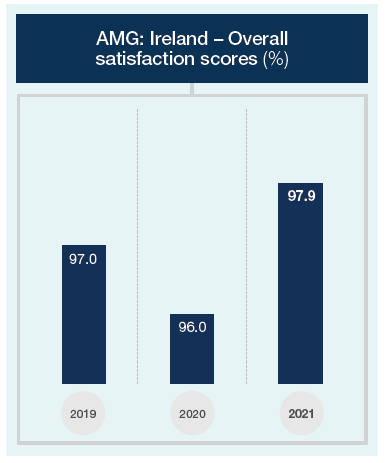
Multi-national market research firm Kantar Millward Brown administers our patient experience measure (PXM) process in South Africa, providing us with comprehensive feedback on all aspects of the patient journey - from admission to discharge. Our PXM is based on the internationally recognised Hospital Consumer Assessment of Healthcare Providers and Systems (HCAHPS) methodology, which we have tailored to our specific needs. Our international operations use tools to measure patient satisfaction, as advised by their respective National Health Services.
SAFE HOSPITALS
Safe for patients:
At Life Healthcare we focus on the reporting and mitigation of all adverse events. Regarding patient safety adverse events specifically, we focus on four key risk areas which are internationally used as benchmarks of patient safety:
- Patient falling (safety) adverse events per 1 000 PPDs

This measure includes all slips and falls related to nursing, patient, equipment, and therapy-related environment. Falling events do not have to result in injury to be included as an event.
- Patient medication adverse events per 1 000 PPDs
Includes pharmacy dispensing, nursing administration and issuing events, and other medication events, such as adverse drug reactions.
- Patients acquiring pressure ulcers per 1 000 PPDs
Pressure ulcers developed in Life Healthcare facilities during patients' hospital stay. A pressure ulcer is caused by the breakdown of skin tissue (not present on hospital admission) due to insufficient pressure relief.
- Healthcare-associated infection rates (HAIs) per 1 000 PPDs
Combines all the HAIs determined according to the CDC guidelines - VAPs, SSIs, CLABSIs, CAUTIs and other infections associated with the hospital stay. Rate per 1 000 PPDs.- Specific HAIs we report as per CDC guidelines
- Ventilator-associated pneumonia (VAP) per 1 000 ventilator days.
- Surgical site infections (SSI) per 1 000 theatre cases.
- Central line-associated bloodstream infections (CLABSI) per 1 000 central line days.
- Catheter-associated urinary tract infections (CAUTI) per catheter days.
- Specific HAIs we report as per CDC guidelines
| Patient safety measures* | 2018 | 2019 | 2020 | 2021 |
| Medication errors | 1.09 | 0.92 | 0.70 |  0.66 |
|---|---|---|---|---|
| Patient falling (safety) adverse events |
0.68 | 0.71 | 0.68 | 0.63 |
| Pressure ulcers | 0.12 | 0.10 | 0.08 |  0.08 |
| * | The international medical literature has shown that COVID-19 infection is an independent risk factor for increased occurrence of pressure ulcers, and healthcare-associated infections. The rates reported in the tables above for the periods 2020 and 2021 for Pressure Ulcers; HAIs; VAP; CLABSI and CAUTI exclude patients known to have had COVID-19 infection. This Covid adjustment was done to present directly comparable data with our pre-COVID outcomes. |
| Infection prevention and control measures* | ||||
| HAI (per 1 000 ppds) |
0.41 | 0.41 | 0.32 | 0.32 |
|---|---|---|---|---|
| VAP (per 1 000 ventilator days) | 1.09 | 0.91 | 0.65 | 0.48 |
| CLABSI (per 1 000 central line days) | 0.99 | 0.84 | 0.60 | 0.46 |
| CAUTI (per 1 000 catheter days) | 0.31 | 0.34 | 0.16 |  0.17 |
| * | The international medical literature has shown that COVID-19 infection is an independent risk factor for increased occurrence of pressure ulcers, and Healthcare-associated Infections. The rates reported in the tables above for the periods 2020 and 2021 for Pressure Ulcers; HAIs; VAP; CLABSI and CAUTI exclude patients known to have had COVID-19 infection. This Covid adjustment was done to present directly comparable data with our pre-COVID outcomes. |
ANTIMICROBIAL STEWARDSHIP (AMS) PROGRAMME
The rapid increase in antimicrobial resistance globally has been highlighted by the WHO as a crisis that must be managed with the utmost urgency, and that an all-out effort is needed to optimise the use of antimicrobial medicine in human health.
We can optimise infection treatment and reduce adverse events and antimicrobial resistance by improving rational antimicrobial use and decreasing inappropriate antimicrobial use. This ultimately enables our healthcare professionals to enhance quality patient care and safety and preserve the usefulness of antimicrobials. Several of our clinical pharmacists have assumed important national leadership roles in the fight against antimicrobial resistance.
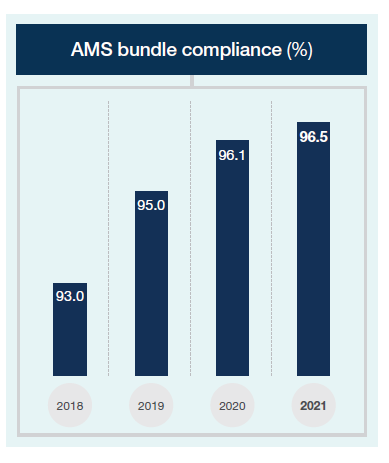
We remain committed to aligning our multi-functional AMS programme with internationally acknowledged best practice, tracking compliance with well-recognised key stewardship principles. We continue to develop interventions to address any non-compliance, however we are pleased to report that our AMS programme has demonstrated significantly improved bundle compliance.
Safe place to work:
The health and safety of our employees, both permanent and temporary, is an essential focus area at Life Healthcare and we take our responsibility to provide, as far as possible, an environment that is safe and without risk to the health of our employees very seriously.
Our employees play an integral role in creating and developing a safety culture at our facilities and contribute to a safe environment. We have trained health and safety representatives and have establish health and safety committees at all facilities. Representatives perform monthly inspections where hazards are reported and addressed.
We drive preventative action through the risk assessment and alert reporting processes. All adverse events are reported, investigated, analysed and monitored to identify trends and to ensure the health and safety of our employees, patients, the public, equipment and property.
- Employee adverse events rate
While we measure and report a wide range of employee adverse events - we pay specific attention to sharp injuries, trips and falls and mobility injuries including strains and sprains.
| Life Healthcare employee safety measures (per 200 000 labour hours) | 2018 | 2019 | 2020 | 2021 |
| Employee adverse event rate excluding COVID-19 cases | 4.11 | 4.26 | 4.10 | 3.59 |
|---|---|---|---|---|
| Sharp injuries | 1.07 | 0.96 | 0.98 | 0.95 |
| Falling | 0.82 | 0.93 | 1.03 | 0.82 |
| Mobility | 0.62 | 0.71 | 0.56 | 0.56 |
| Employee adverse event rate (per 1 000 scans) | 2019 | 2020 | 2021 | |
| AMG: UK | 0.23 | 0.21 | 0.21 | |
|---|---|---|---|---|
| AMG: Ireland | 0.14 | 0.1 | 0.11 | |
| AMG: Italy | 0.02 | 0.02 |
HIGHLY RANKED ORTHOPAEDIC SERVICES
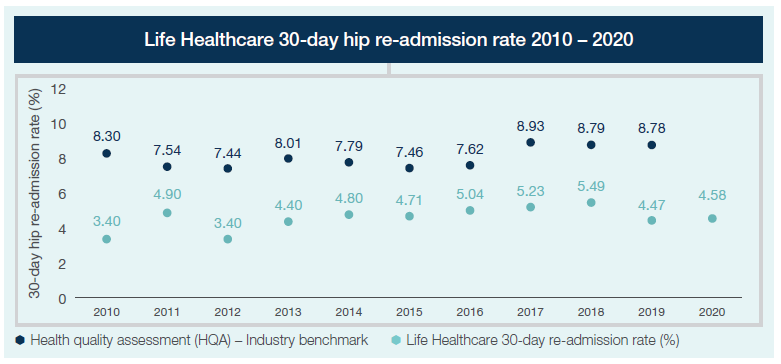
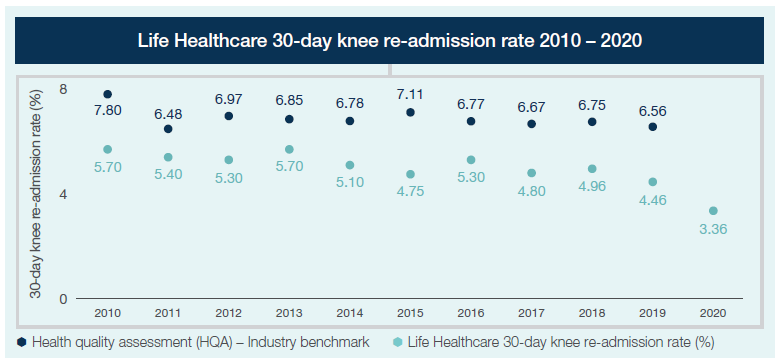
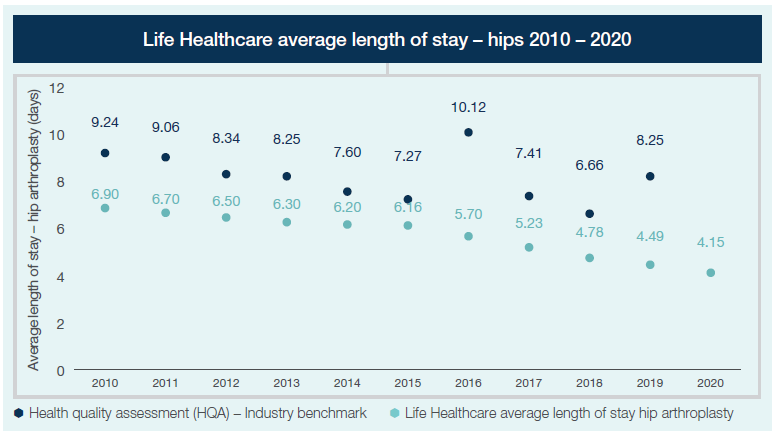
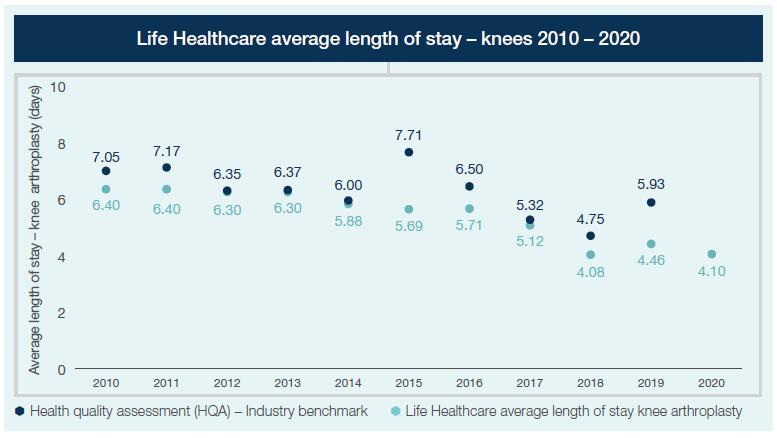
Our Major Joints for Life programme continues to demonstrate improved quality care for hip or knee arthroplasty surgery patients.
Major Joints for Life is a multi-disciplinary approach to hip or knee arthroplasty surgery, providing patients with an improved clinical treatment solution. Effective execution of the clinical pathway mitigates the possibility of the patient developing intra-operative complications and expedites both post-operative recovery and rehabilitation.
This programme measures quality from the patients' perspective for hip and knee replacement surgeries, using the Hip Osteoarthritis Outcomes Score (HOOS) and Knee Osteoarthritis Outcomes Score (KOOS). Patient-reported outcomes data is used to determine patients' perception of the success of an operation in terms of its impact on their self-reported symptoms and functional status.
Important outcome measures include 30-day readmission rates and average length of hospital inpatient stay. In all these metrics our Major Joints for Life programme outcomes exceed the published Health Quality Assessment (HQA) industry benchmarks.
EXCELLENCE IN CANCER CARE
Life Oncology's mission is to deliver best in class personalised patient care that will improve patient experience and optimise the overall health outcomes for cancer patients by employing evidenced based innovative treatment and treatment protocols, cancer care pathways, best in class facilities, equipment and human resources.
Building on our mission Life Oncology is establishing a leading oncology unit at Life Vincent Pallotti Hospital. Using an interdisciplinary team approach to cancer treatment, the facility will offer an integrated end-to-end cancer care service including preventative screening, diagnostics, surgical oncology, medical oncology, radiation oncology, inpatient oncology care, precision/targeted therapy, clinical trials, research, a survivorship programme, as well as palliative care.
THE FUTURE OF RENAL CARE IN SOUTH AFRICA
The Life renal dialysis business has invested significantly to ensure we have a national footprint and participate as a preferred designated provider to all medical schemes. We continue to invest in our clinical leadership team ensuring that each dialysis facility is nephrologist led. This includes having established a national clinical review panel that meets quarterly to review and ratify the quality improvement projects and standards at our facilities nationally. The close working relationships with all our stakeholders has allowed us to move swiftly during the covid-19 adversity to respond to better manage our clinical risk. Life renal dialysis engages with the South African Renal Society and Dialysis Association of South Africa regularly to support the industries improvement projects and quality initiatives.
Our dialysis units are purpose built to cater for the complexity of patients presenting at acute hospitals meeting all requirements for infection management and clinical isolation. We have over the years been able to ensure the seamless operational model is de-emphasised and the caring clinical environment promoting a peaceful and rejuvenating session is promoted.
In 2021 we invested significantly in system development to enhance our capturing of clinical metrics guiding focused clinical care programmes at facility level. We are redesigning our IT architecture to support an integrated clinical pathway capability to enhance the complex patient care model where early responsiveness reduces mortality and morbidity, admission to hospital and direct hospital costs.
SCREENING AND EARLY DIAGNOSIS
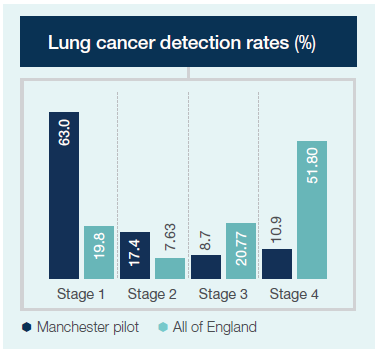
Following the successful community-based lung cancer low-dose CT screening pilot in Manchester, where Alliance Medical teamed up with the local NHS, Manchester City Council and MacMillan Cancer Support, lung cancer screening programmes are now being rolled out across England.
The results of this pilot, published in the peer-reviewed medical journal Thorax, demonstrated that circa 80% of lung cancers detected were in the early stage, and that 90% of patients in whom lung cancer was detected were offered curative treatment.
These screening programmes have continued, despite the COVID pandemic and in this last year Alliance Medical has commenced two more. The first in Doncaster and Bassetlaw and the second in Lancashire and South Cumbria.
Alliance Medical manages the end-to-end pathway in these programmes. The pathway starts by identifying patients at risk and inviting them for a telephonic Lung Health Check administered by a specialist respiratory nurse. High risk patients are then invited for a low dose CT at a convenient, accessible, and local venue where we will have sited our CT mobile medical unit and our support vehicle. The studies are reported by fully vetted, trained, and experienced specialist chest radiologists who also participate in the local lung multi-disciplinary team meetings where individual cases are reviewed and discussed. As is standard practice in Alliance Medical, we also ensure continued independent audit of reports.
Alliance Medical is pleased to have been awarded the contract for the first lung cancer screening programme in Germany. The programme screened the first patient on the 22nd July 2021.
 90%
PATIENTS OFFERED
CURATIVE TREATMENT