Currently viewing: Southern African business review / Next: Group quality review
Our footprint and capabilities
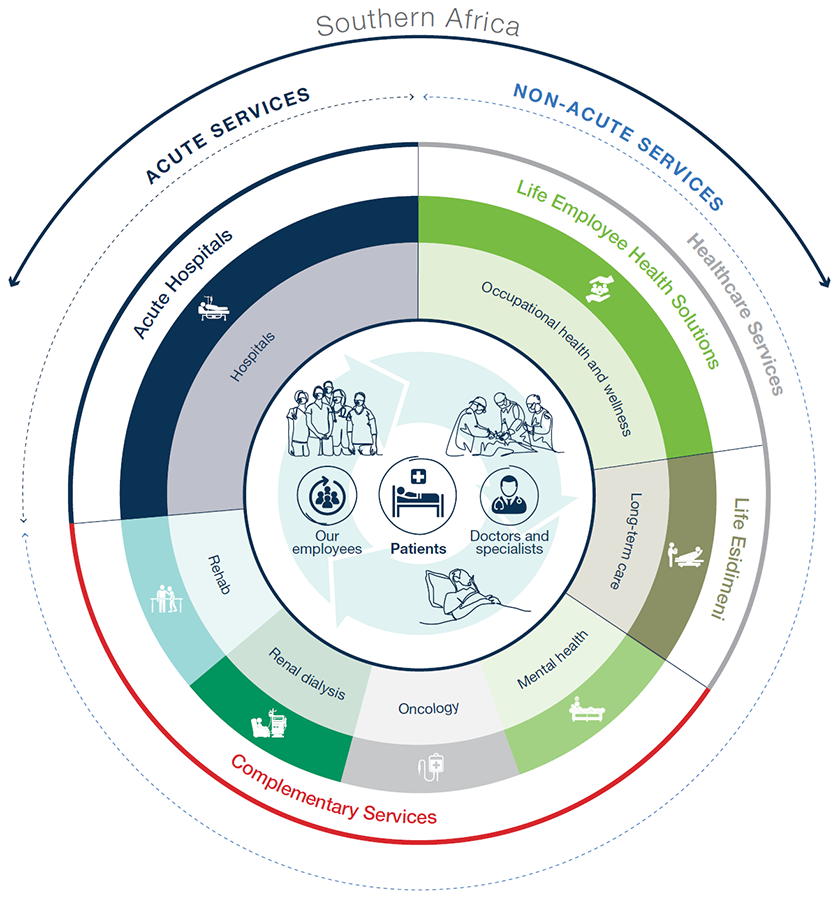
We have a diversified healthcare offering across the care spectrum including acute hospital care, acute physical rehabilitation, mental health, renal dialysis, oncology long term and occupational health and wellness care services. With 14 972 (2020: 15 060) of our own employees and approximately 3 000 supporting healthcare professionals and specialists, we are able to deliver quality, compassionate and effective care.
 |
Acute hospitals |
Factors impacting this material matter: | ||
|
||||
| Our acute hospitals are located in the metropolitan areas in seven of
South Africa’s nine provinces, as well as in Botswana.
Our hospital facilities are world-class, technologically advanced and multi-functional. |
||||
Facilities
49
49
49 in 2020
PPDs
1 706 205
1 706 205
1 703 015 in 2020
Theatres
304
304
304 in 2020
Cathlabs
14
14
14 in 2020
Registered beds
8 256
8 256
8 240 in 2020
Length of stay
4.07 days
4.07 days
3.74 in 2020
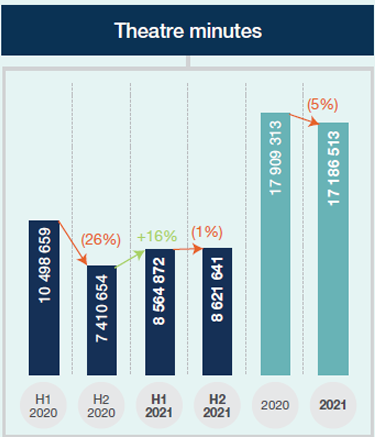
Theatre minutes
17.2 million
17.2 million
17.9 million in 2020
Occupancy
58.1%
58.1%
57.0% in 2020
Cathlab cases
13 257
13 257
13 478 in 2020
 |
Complementary services | |
| Life Healthcare provides specialised healthcare facilities that offer both inpatient and outpatient services, including acute rehabilitation, mental healthcare, renal dialysis and oncology. Our specialised care model promotes continuity of care and uniquely positions Life Healthcare to provide comprehensive therapeutic interventions for chronically ill patients. | ||
 |
Acute rehabilitation | Services offered: | ||
|
||||
| Our rehab facilities cater for patients with disabling or traumatic brain injuries, offering acute physical and cognitive rehabilitation. Our focus on patient care helps to restore quality of life for our patients and their families. | ||||
Facilities
7
7
7 in 2020
Admissions
2 758
2 758
2 506 in 2020
Occupancy
71.6%
71.6%
74.1% in 2020
Beds
319
319
319 in 2020
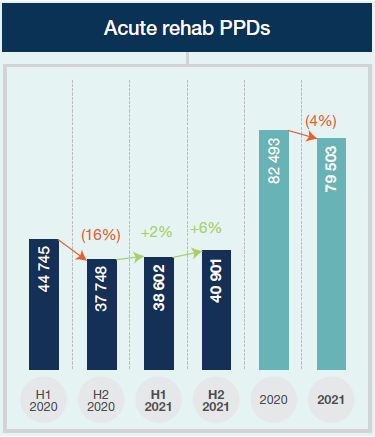
PPDsA
79 503
79 503
82 493 in 2020
 |
Mental health |
Services offered: | ||
|
||||
| Our multi-disciplinary mental healthcare service offerings are designed for transitory care in a therapeutic and tranquil environment. Our facilities house voluntary, assisted and involuntary mental healthcare users. We also operate theatres with anaesthetic capability for electroconvulsive therapy. | ||||
Facilities
9
9
9 in 2020
Admissions
11 764
11 764
11 484 in 2020
Occupancy
59.3%
59.3%
58.4% in 2020
Beds
602
602
592 in 2020
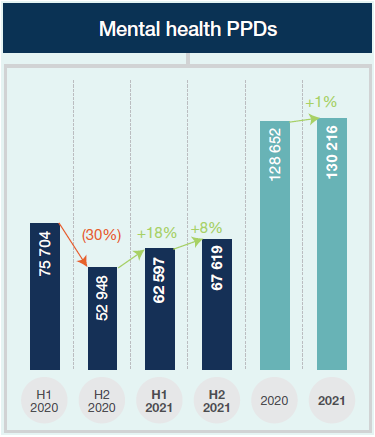
PPDsA
130 216
130 216
128 652 in 2020
 |
Renal dialysis |
Services offered: | ||
|
||||
| Our renal facilities are for patients with renal failure who need outpatient-based chronic dialysis, inpatient-based acute renal dialysis or home-based peritoneal dialysis. | ||||
Facilities
29
29
29 in 2020
Stations
440
440
375 in 2020
Treatments
176 083
176 083
167 322 in 2020
 |
Oncology |
Services offered: | ||
|
||||
| Our oncology centres offer a holistic care model with technologically
advanced diagnostic and interventional services supporting
comprehensive cancer management. Our significant investment in technologies place our oncology centres at the forefront of advanced treatments in surgical, medical, gynaecological and radiation oncology. |
||||
Facilities
5
5
5 in 2020
Treatments
27 872
27 872
25 607 in 2020
 |
Healthcare services | |
| Our Healthcare services relate to specialised care offered by Life Esidimeni, occupational health, employee wellness services offered by Life Employee Health Solutions. | ||
 |
Life Esidimeni |
Services offered: | ||
|
||||
| We offer specialised care for the most vulnerable in our society. We partner with South Africa’s provincial health and social development departments to provide comprehensive, long-term services. These services are offered on contract, which are awarded through the National Treasury tender processes. | ||||
Facilities
10
10
10 in 2020
Admissions
1 052 685
1 052 685
1 034 042 in 2020
Beds
3 163
3 163
3 135 in 2020
 |
Life Employee Health Solutions (Life EHS) |
Services offered: | ||
|
||||
| We offer an integrated health risk management service providing wellness programmes, occupational and primary healthcare to corporate and institutional clients. We provide contracted on-site occupational and primary healthcare services to large employer groups in various industries and various government departments and specialise in implementing and delivering comprehensive health strategies for employees. We furthermore provide outcomes-based employee wellness programmes (EWPs), helping companies and institutions in the public and private sector to encourage and support healthy and balanced living for their employees. The goal is to improve their well-being and promote maximum productivity through health. |
||||
Occupational health clinics
281
281
281 in 2020
Total enrolled employees
477 751
477 751
606 058 in 2020
Employee wellness clinics
78
78
82 in 2020
OUR OPERATING ENVIRONMENT |
Looking forward to 2022 | ||||
| Our southern African operations, with facilities in South Africa (SA) and Botswana, remain the largest contributor to the Group. |
|
70.8% of GROUP REVENUE 72.3% in 2020
|
|||
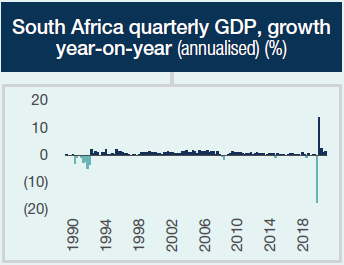
| The region has been severely impacted by the COVID-19 pandemic over the past 18 months. Reduced economic activity, as evidenced by the largest SA GDP contraction on record, was driven by restrictive lockdowns; reduced tourism; disruptions to local and global trade; trends in illness, absenteeism, work-from-home, and others; weak policy responses and poor support for the local economy, etc. |
|
 |
|||
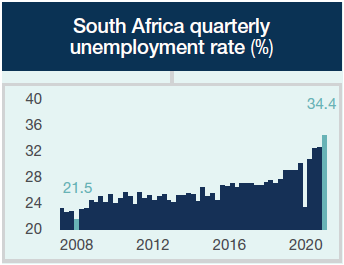
| While GPD figures may have rebounded during
2021, there may well be a long-lasting impact on
the labour market with increased unemployment
from disrupted business activities and education
along with diminished business and consumer
confidence. Shortages of skilled employees were already a concern prior to COVID-19, and a competitive market for labour had led to high wage inflation and employee turnover. These factors have continued during 2021. |
|
 |
|||
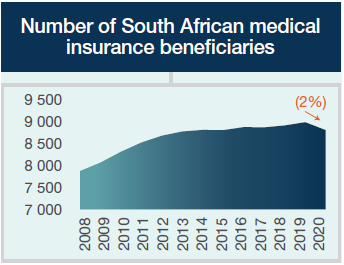
| While demand for some of our services has
diminished over the last 18 months, due to the
COVID-19 pandemic, the number of lives covered
by private medical insurance has thus far
remained resilient, falling 2% during 2020 after
being largely flat for many years. Given that the
bulk of our revenue for this segment is derived
from these insured lives, this bodes well for the
sustainability of the healthcare sector and our
business going forward. That said, the outlook for
2022 continues to be uncertain. Much depends
on the future trajectory of the pandemic – if future
COVID-19 waves are similar to the ones we
experienced in 2021, then overall activity levels
may remain below those seen prior to the
pandemic. This is our base case expectation. Conversely, if future COVID-19 waves diminish in severity and as associated with fewer lockdowns, it is possible that we experience a strong rebound in demand for our services. |
|
 |
|||
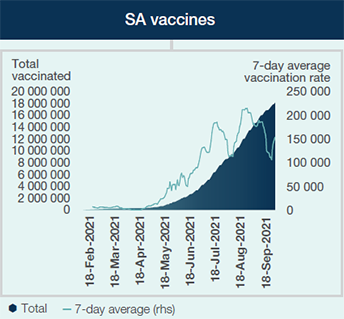
| COVID-19 vaccinations present an opportunity
to break the cycle of COVID-19-related waves,
hospitalisations, deaths and lockdowns. While
in South Africa the roll-out of vaccines started
slowly, this has picked up considerably during
the last few months. While only c.40% of the
adult population has received their first vaccine,
c.60% of >65yr-olds are now fully vaccinated.
We are hopeful that this will reduce severe
illness and deaths in this more vulnerable
category of South Africans (as evidenced by
studies in the UK and Israel), in the likelihood
of fourth and even fifth COVID-19 waves. Over 80% of our frontline employees are fully vaccinated, which will enhance our ability to provide high quality care 24/7 with fewer employee members becoming ill, or needing isolation, whilst also reducing the need for agency employees. |
|
 |
Managing through COVID-19 waves
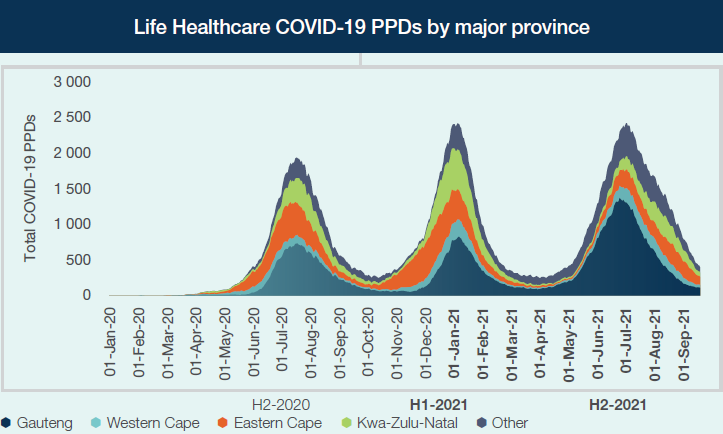
During the 2021 financial year we have had to navigate two COVID-19 waves, with the most recent third wave being the most severe in terms of duration, admissions and deaths. The different waves have impacted our geographic regions at different times depending on when COVID-19 waves emerged, as we show below.
In each successive wave we have needed to reduce elective surgical activities in our facilities once our ICU and High Care beds fill up with COVID-19 patients, to ensure beds were available for COVID-19 patients while also maintaining capacity for urgent non-COVID-19 surgical or medical admissions.
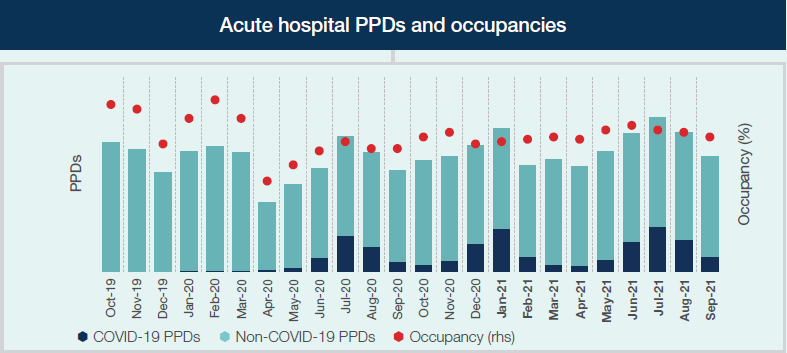
Over the last 18 months our employees have learned from prior waves and have become better at managing the different demands which emerge during and between COVID-19 waves. At the same time, less restrictive lockdowns have allowed people to move more freely, and as our understanding of COVID-19 has grown, patients (and their referring medical specialists) have been less reluctant to be admitted into our facilities. This has led to faster recoveries in non-COVID-19 admissions between waves, which has driven our average occupancies higher over each six-month period leading up to September 2021.
34 500
COVID-19
ADMISSIONS IN LIFE HOSPITALS
COVID-19
ADMISSIONS IN LIFE HOSPITALS
11 000 in 2020
R625 million
spent on
COVID-19
personal protective equipment
spent on
COVID-19
personal protective equipment
since the start of the pandemic
2 900
employee infections
during 2021
employee infections
during 2021
2 700 in 2020
How we performed in 2021
The southern African segment delivered revenue in 2021 of R19.0 billion up 10.3% versus 2020, driven by top-line growth in each sub-segment.
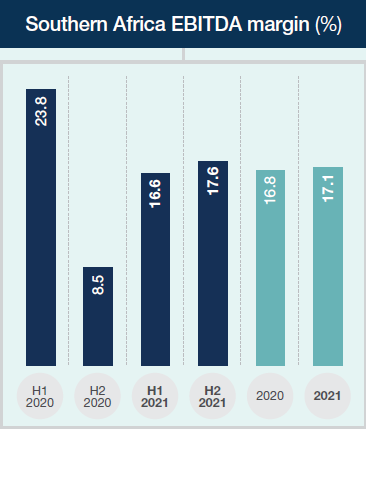
2021 normalised EBITDA for the segment was up 12.2% year-on-year to R3.3 billion (2020: R2.9 billion) with the normalised EBITDA margin improving to 17.1% (2020: 16.8%.)
10.3%
Southern African REVENUE GROWTH
Southern African REVENUE GROWTH
+0.2%
PPD GROWTH for ACUTE HOSPITALS and COMPLEMENTARY SERVICES
PPD GROWTH for ACUTE HOSPITALS and COMPLEMENTARY SERVICES
17.1%
NORMALISED EBITDA MARGIN
NORMALISED EBITDA MARGIN
16.8% in 2020
The current period has been impacted by COVID-19 for a full 12-month period, including two severe COVID-19 waves, whereas our 2020 year was only affected in the second half of our financial year, the six months from 1 April to 30 September 2020 (H2-2020). However, the initial lockdowns severely restricted movements of people within SA and the cancellation of elective surgical work, had a marked impact on our H2-2020 period. The impact of COVID-19 and lockdowns has not been as severe since then as lockdowns were less restrictive and the business benefitted from lessons learned over the last 12 months.
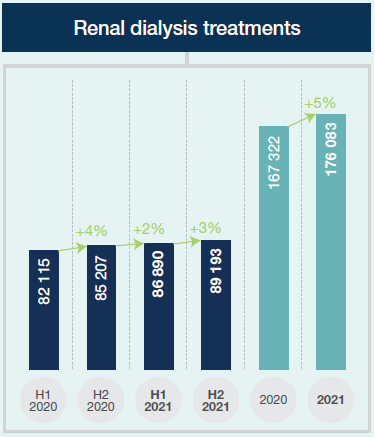
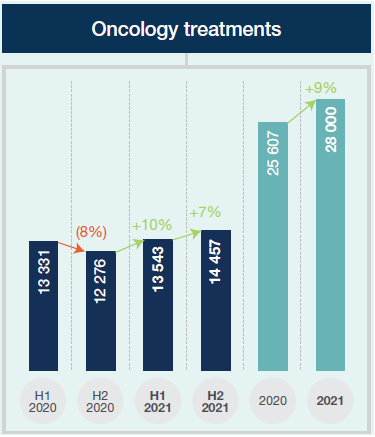
This makes comparing the results of 2021 with those of 2020 challenging, so we have also included details showing our sequential six-month periods in 2020 and 2021 as this demonstrates the improvements we have seen in the business.
Revenue for the acute hospital and complementary services division was up 10.5% to R17.6 billion (2020: R15.9 billion) driven by growth in both acute hospitals and complementary services. While revenue is now similar to 2019 levels, the lower occupancy levels seen across the acute hospital and complementary services division, along with additional COVID-19 related costs, have led to normalised EBITDA margins remaining below those seen in 2019. However, the less restrictive lockdowns in the last 12 months, along with applying learnings from three COVID-19 waves, have led to occupancies and margins improving sequentially over each six-month period since 31 March 2020.
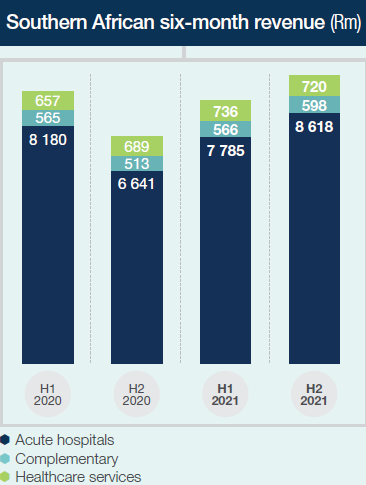
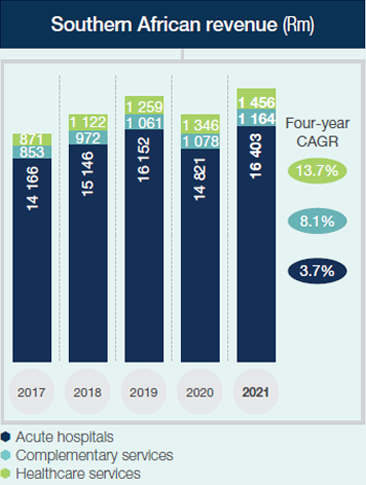
Acute hospital revenue for 2021 was up 10.7% to R16.4 billion (2020: R14.8 billion). This performance was driven by PPD growth which was up +0.2% year on year and 9.8% revenue per PPD growth made up of 4.0% tariff growth and 5.8% mix change. The mix effect on revenue per PPD was due to the underlying change in case mix.
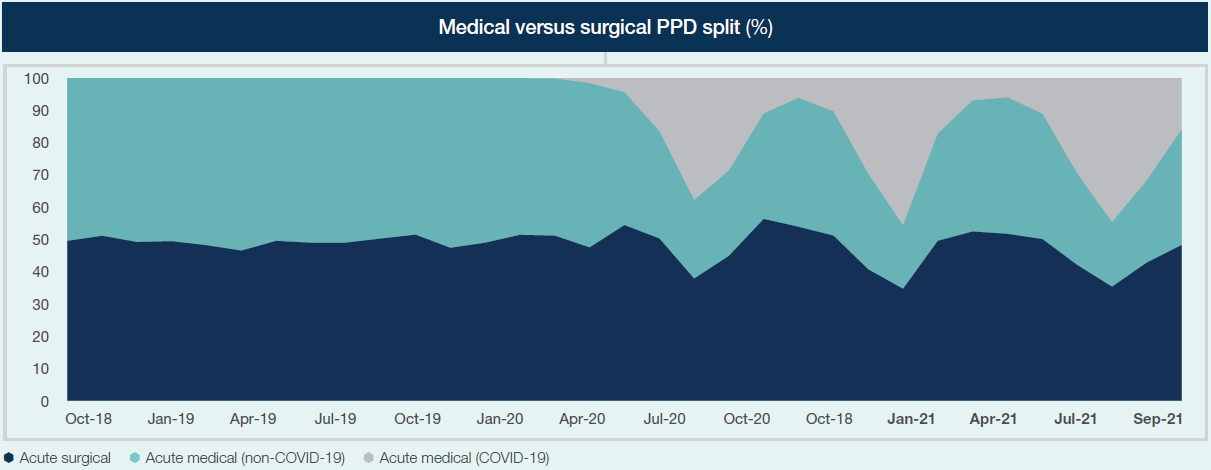
This underlying change in case mix in our hospitals continues to be skewed by COVID-19-related cases. The COVID-19 environment has resulted in a sharp reduction in non-COVID-19 medical cases and a reduction in surgical cases, particularly during COVID-19 waves as evidenced by the reduction in theatre utilisation. Overall PPDs still remain c.15% below the pre-COVID-19 levels.
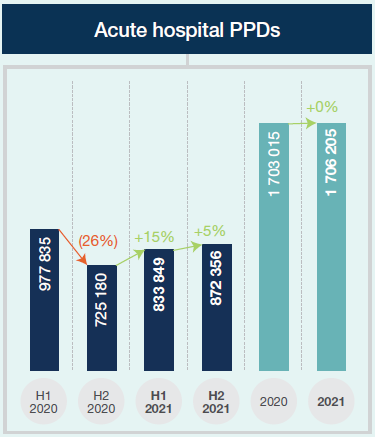
Complementary services revenue for 2021 was up 8.0% to R1.2 billion (2020: R1.1 billion). Complementary services PPDs for 2021 were down 0.7% versus 2020, driven by a decline of 16.0% year-on-year in H1-2021 and a recovery of 19.7% year-on-year in H2-2021 given the depressed H2-2020 base. The contribution from the four sub-sections is detailed below.
Mental health as a business was significantly impacted by COVID-19 and admissions declined significantly during H2-2020 and H1-2021, but recovered during H2-2021. Despite the two COVID-19 waves in 2021 mental health PPDs for 2021 were up 1.2% versus 2020.
Acute rehabilitation activity is typically correlated with acute hospital activity, albeit with a small-time lag. Given the reduced elective surgical work, as well as reduced trauma and emergency work during the year, acute rehabilitation PPDs for 2021 declined by 3.6% versus 2020, following a 13.7% decline year-on-year in H1-2021 and a partial recovery of 8.4% growth year-on-year in H2-2021. Despite this, occupancies remained above 70%.
Renal treatments have held up well during the pandemic and were up 5.2% for 2021 versus 2020, with consistent growth shown in each half-year period. We added 65 dialysis stations during the year.
Oncology treatments initially declined early on in the pandemic, but we have seen growth since then with treatments in 2021 growing 9.3% versus 2020.
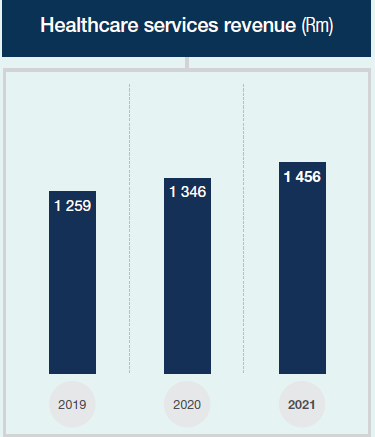
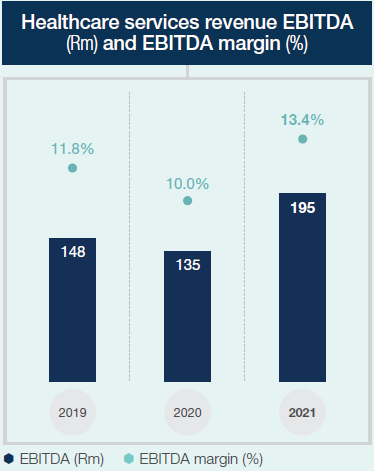
Healthcare services revenue for 2021 was up 8.2% to R1.5 billion (2020: R1.3 billion) and EBITDA grew 44.4% to R195 million (2020: R135 million) with a margin improvement to 13.4% (2020: 10.0%). This performance was largely driven by growth in revenue and EBITDA per life covered through Life EHS. Life Esidimeni produced a consistent performance in terms of both revenue growth and EBITDA margins.
Looking forward
Our key priority is to get our existing operations back to pre-COVID-19 activity and profitability levels. This is likely to remain a significant challenge in 2022 given the low vaccination rate in South Africa and the concomitant high probability of further COVID-19 waves. We will continue to focus on delivering excellent patient care while also introducing further efficiencies into our business.
| We have a number of growth opportunities that we will pursue during 2022 | ||||||
| Oncology | Renal | SA Imaging | SA radio-pharmacy joint venture |
|||
| Following licensing approval at Vincent Pallotti hospital during 2021 we have successfully recruited specialists to the unit. During 2022 we will be expanding the facility to meet our aim of developing an oncology centre for excellence. |
We will continue to expand the number of renal stations we operate, while also developing a value-based care package for renal dialysis. | We have made good progress in acquiring imaging businesses and have entered into co-operation and partnering discussions with practices regarding imaging services. The HPCSA approved the employment of radiographers, which is a significant step forward and will enhance our ability to offer an integrated and cost‑efficient imaging service in South Africa. | In November 2021 we announced that we have entered into a joint venture with AXIM to build and operate cyclotrons within South Africa. We will be building two cyclotrons in Gauteng initially. These will serve the molecular imaging market in southern Africa, a market which we think has exciting growth potential over the next five to ten years. | |||
| 2021 priorities/KPIs | Looking forward to 2022 priorities/KPIs | ||
|
We have budgeted for R1 billion of maintenance capex in 2022 and R300 million for the growth opportunities highlighted above (excluding any SA imaging acquisitions). |