
Currently viewing: Remuneration report / Next: How we manage risk
I am pleased to present the 2021 remuneration report on behalf of the Board and the Company. This report highlights the key components of our remuneration philosophy and focuses on how this philosophy underpins and aligns with the Group’s key strategic objectives.
Royden Vice
Chairman: Human Resources and
Remuneration Committee
CONTENT
This report sets out Life Healthcare’s remuneration policy and implementation report for the year under review and is presented in three sections: Human Resources and Remuneration Committee Chairman’s report Life Healthcare’s remuneration philosophy, policy, and framework for the forthcoming year Implementation report for the past year
This report sets out Life Healthcare’s remuneration policy and implementation report for the year under review and is presented in three sections: Human Resources and Remuneration Committee Chairman’s report Life Healthcare’s remuneration philosophy, policy, and framework for the forthcoming year Implementation report for the past year
Section 1
Human resources and remuneration committee chairman’s report
Dear Shareholder
Our people remain at the heart of our business. Our priority for the year under review focused on ensuring that we rewarded our employees for their individual and collective contributions to the Group in a fair and responsible manner. The COVID-19 pandemic continues to have a severe impact on our employees, our clinical partners, our suppliers, our patients and other stakeholders. The effort and resilience, however, with which the Group has responded has been nothing short of exceptional.
KEY DEVELOPMENTS AND HIGHLIGHTS FOR THE YEAR INCLUDE:
In Southern Africa, the
company implemented a salary
increase for frontline and clinical
employees on 1 January 2021,
but, as a cash preservation
measure, increases were delayed
for head office and non-frontline
employees until 1 May 2021.
In a similar vein, salary increases
for our International senior
executives were also deferred.
The continued impact of the pandemic with the associated increase in demand, such as the roll out of vaccination sites in SA or additional imaging services to meet pent-up demand in Europe, has created a substantial increase in the demand for clinical skills, both locally and abroad, with a concomitant increase in market rates for these skills. This contributed to an increase in clinical employees’ turnover rate.
January 2022 will see the first vesting of the long-term incentive for our international colleagues which is a significant step in terms of creating an integrated senior executive reward structure.
In Europe, COVID-19 related recognition awards were made to the majority of patient-facing employees in our international operations alongside regular competency-based salary reviews to ensure continued competitiveness.
In South Africa, the Committee approved several interventions to address the loss of key skills, which are detailed below:
- Bringing forward the annual salary review from 1 January 2022 to 1 September 2021 for all employees excluding middle management and above. This is a once-off initiative and with effect from January 2023, will revert to the normal increase date.
- The Group will pay professional registration fees on behalf of our employees with effect from 1 January 2022 onwards. This represents a significant benefit, especially to our nursing employees.
- We have put a process in motion to offer our employees flexible contributions to their retirement fund. We are awaiting FSCA approval.
- A further tranche of Life Healthcare shares was purchased for the benefit of employees participating in the Life Healthcare Employee Share Plan.
The Group maintains excellent working relationships with representative trade unions, and we were able to reach agreement on wage increases for 2022 well in advance of the effective date.
Progress has been made in respect of Environmental, Social and Governance (ESG) matters:
- Diversity and clinical governance objectives were included in senior executive annual performance measures.
- A Group-wide sustainability committee was established which will develop a strategy and set objectives, measures, and targets during 2022, which are likely to feature in annual performance measures in future years.
The year under review
Factors that have influenced the company's remuneration decisions during the year under review were as follows:
- The impact of the COVID-19 pandemic resulted in a drain of key critical clinical skills and exposed the country-wide nursing shortage and resulted in an increase in competition for these skills. The competition for nursing talent was extended from other private hospitals and the public sector to retail pharmacies and medical aids to facilitate the roll-out of country-wide vaccination sites. In addition, the consequent rise in burnout of employees required enhanced employee wellness programmes to be put in place to ensure the well-being of our people.
- The change in the nursing qualification framework resulted in an inability to train registered nurses.
- The Group needed to review and improve its overall nursing strategy to ensure our nurses are prioritised for retention and sustainability of our core business.
- Remuneration elements needed to be revised to ensure retention of talent in a globally attractive market. This included reviewing our short-and long-term incentives to include the application of alternative methodology for unforeseen market influences and threats.
Remuneration outcomes
The Board remains focused on ensuring that there is a robust and rigorous process in place whereby significant oversight and prudence are applied to ensure remuneration outcomes are aligned both with individual and Group-wide performance, with outcomes delivered to our shareholders. In addition, it aims to retain key critical skills and be market competitive ensuring productivity, performance excellence and company sustainability.
Adaptations and revisions to certain remuneration elements have been required to give effect to this:
- Short-term incentivisation
The short-term incentive payment has been changed to an annual payment to align with the Group's annual budget cycle and market best practice. Given the uncertainty in trading conditions, short-term incentive financial targets were structured on a rolling budget basis for the year under review but will revert to the normal application for the new financial year, with fixed financial performance measures. To improve individual accountability, the performance assessment of the Group Executive has been changed to a combination of financial, clinical and individual deliverables as opposed to the previous team-rating approach and the weightings have been adjusted to include clinical metrics.
- Long-term incentivisation
As a result of the uncertainty brought about by the COVID-19 pandemic, the financial performance metrics in respect of the Long-term Incentive Plan (LTIP) 2021 allocation have been revised to focus exclusively on Normalised Headline Earnings per Share (Normalised HEPS). In addition, the introduction of a retention element was implemented for the Group Executive.
- Co-Investment Policy (CIP)
In response to current economic conditions and the varying effects of the COVID-19 pandemic, the Board has determined that the loss of key personnel stationed throughout the Group could have a material effect on the management, sustainability of operations and growth strategy of the Group. To address this risk, the Committee supported by the Board approved the introduction of an additional long-term incentive, the CIP. At its core, the CIP is designed to secure not only the retention of participants for a minimum period of four years, but also significant buy-in and alignment of interests of participants with the Group's stakeholders. In essence, the CIP requires a significant investment by a participant upon entry to the structure (through deferral of a significant portion of their potential 2021 short-term incentive). A participant will receive a matching incentive for the potential deferral and for their continued contribution to the Group over a set period. If a participant's employment is terminated before the CIP's vesting, various onerous conditions and additional measures apply. In addition, performance shares may be awarded, linked to strategic performance conditions. Participation in the CIP is not limited to executives or the Group's most senior management, but to a certain number of individuals who have been identified as key personnel, including, inter alia, hospital management and operational heads.
- Employee Share Plan (South Africa)
The Board has approved the purchase of shares, as a retention measure, for the benefit of qualifying employees.
- Once-off gratuity payment (South Africa)
In recognition of the unwavering commitment, dedication and support of our non-management employees, a once-off gratuity was paid to all permanent employees during October 2020. The total payment amounted to R45 million.
Further details on each of these points can be found in sections 2 and/or 3 of the remuneration report.
Life Healthcare continues to strive towards delivering strong company performance over the short- and long-term. To achieve this objective, we must attract, motivate, and retain competent people whilst upholding and aligning their interests with shareholders.
Voting outcomes and shareholder engagement
During the Annual General Meeting (AGM) held on 27 January 2021, the outcome of the non-binding advisory vote was as follows:
- 89.71% (2020: 70.1%) of the total number of shares voted were in favour of Life Healthcare's remuneration policy; and
- 63.97% (2020: 66.7%) of the total number of shares voted were in favour of the remuneration implementation report.
As we did not receive the required 75% favourable vote in respect of the implementation report, we engaged with our key shareholders to address their concerns. During the engagement the Chairmen of the Board and Committee, the GCE, the Chief People Officer and other executives shared key philosophies in respect of remuneration with those attending the engagement. Specific concerns raised by our shareholders are highlighted within this report, along with our rationale/action plans to address them.
Achievement of remuneration objectives
One of our primary objectives has been to ensure that the company's employee value proposition allows the attraction and retention of the human capital required to deliver on the company's strategic objectives. We are concerned about the increase in clinical employees turnover but believe that the measures we have implemented will mitigate this risk successfully. I am therefore satisfied that we have achieved the outcomes we have set notwithstanding the many challenges we have faced during the past year. The Committee is satisfied that the remuneration policy has fulfilled its stated objectives during the reporting period.
Future focus areas
Looking forward the Committee's focus areas will be to ensure:
- A full, holistic review of the Group's reward philosophy remains a key consideration.
- We will consider the views of our shareholders when planning our reward strategy to ensure a holistic approach to total reward.
- The Group Executive team is encouraged to hold Group shares to better align the interests of executives with shareholders.
- Continued performance-driven reward.
- Global integration continues to focus on organisational culture, global mobility, talent management and HR metrics.
- Diversity continues to be a strategic objective to ensure equal opportunity and fair representation of the communities we serve.
Remuneration consultants
During the year under review, the Group engaged the services of PwC, Deloitte and 21st Century for benchmarking of non-executive director fees, executive remuneration and general market benchmarking of jobs. The Committee is satisfied that the remuneration consultants engaged were independent and objective in providing the relevant services.
Confirmation
In signing off this remuneration report, the Committee is satisfied that the remuneration policy is fair, transparent and responsible in that it is reviewed and approved annually. The Committee is satisfied that it has executed its duties over the reporting period, according to its terms of reference, relevant legislation, regulation and governance standards.
Closing
We will table our current remuneration policy and implementation report as two non-binding advisory votes at the 2022 AGM to be held on 26 January 2022. We look forward to engaging with you further and implementing the proposed changes as contained in this report, with your support.
In closing, the Committee and I extend our sincere appreciation to the executive management and the Board for the support and dedication during the year under review. This appreciation extends to the entire workforce, who continue to make Life better.
Royden Vice
Chairman: Human Resources and Remuneration Committee
Section 2
Remuneration philosophy, policy and framework
2.1 SCOPE AND AIMS OF THE POLICY
The remuneration policy is approved by the Board and forms part of our operating philosophy, policies, and protocols which apply to all permanent employees of the Group. In line with King IV, we set out below the remuneration elements and design principles applicable to the executive management and on a high-level, other employees.
Our remuneration framework and policies, which are a key component of our broader employee value proposition, aim to:
- attract, motivate, reward and retain our people;
- promote the achievement of strategic objectives within the Group's values and risk appetite;
- to promote diversity in our workforce to align with the communities we serve;
- promote an ethical culture and responsible corporate citizenship; and
- provide a balanced remuneration mix within the Group's financial constraints.
Life Healthcare's remuneration philosophy is to make certain that employees are rewarded fairly, responsibly and appropriately for their contribution to value creation for the Group. Our remuneration philosophy informs our reward framework and guides policy. In a continually evolving context, we continually review our remuneration policies to ensure our approach remains relevant, fair, and responsible.
The Group periodically consults market survey providers for an indication of the guaranteed remuneration and annual cash incentive payments made generally and sectorally. We utilise these inputs, along with guidance from external remuneration experts, to assess our positioning compared to the market in terms of key talent. We then overlay various contextual factors, including industry trends, the Group's financial position and legislative requirements, evaluating our performance in delivering fair and equitable remuneration as part of our employee value proposition.
Ultimately, our goal is to design reward for business sustainability, balancing what is required to attract and retain the best talent with affordability considerations.
2.2 Remuneration governance
In line with best market practice, our Committee is appointed by the Board and has delegated authority, in accordance with its terms of reference (which is available on our website www.lifehealthcare.co.za), to establish and administer a remuneration strategy and to review and make decisions regarding our remuneration policies and the implementation thereof to ensure alignment with the principles of fair, transparent and responsible remuneration and legislative and regulatory requirements, as well as the needs of the Group. The remuneration strategy includes remuneration at all levels, including Executive Directors.
Our Committee follows a systematic agenda to review remuneration strategy and overall policy. It oversees, without interfering in areas where management ordinarily have discretion, the implementation of policy over an annual cycle. This verifies that policy enables fair and equitable remuneration and ensures sound governance. In South Africa, we comply with King IV and draft guidelines and practice notes of the IoDSA. Formal feedback is provided to the Board on how the policy objectives are being achieved, and this feedback forms part of the process of obtaining approval of the Remuneration Report. Life Healthcare's remuneration philosophy and supporting policies are widely shared with employees.
The Committee consists of the following independent non-executive directors who collectively have the appropriate experience and qualifications –
Royden Vice (Chairman and independent non-executive director)
Cindy Hess (independent non-executive director, appointed with effect from 1 September 2021)
Adv Mahlape Sello (independent non-executive director)
Garth Solomon (independent non-executive director)
Further details on these non-executive directors and the Committee can be viewed on pages in the Board of directors and Human resources and remuneration committee.
In addition to Committee members, the following individuals are invited to attend meetings as and when required by the Committee but none of them are present when their own remuneration is discussed and do not participate in any voting:
| Invitees | |
| Dr VL Litlhakanyane | Non-Executive Director/Chairman |
|---|---|
| P Wharton-Hood | Executive Director – Group Chief Executive |
| A Parboosing | Chief People Officer |
| C Gouws | Human Resources Executive – SA |
| P Winchester | Human Resources Director – International |
| In attendance: | |
| J Ranchhod | Group Company Secretary |
The chairperson of the Committee attends the AGM to respond to questions from shareholders within the Committee's areas of responsibility.
2.3 Fair and responsible remuneration - Flattening the curve of the wage gap (South Africa)
In this context, the Group applies the 10:10 methodology to gauge the fairness of our wage gap. This is conducted on an annual basis. The 10:10 ratio expresses the sum of the salaries of the highest paid 10% of employees as a ratio of the sum of the salaries earned by the lowest earning 10% of employees. The larger this ratio, the more inequality exists. The ratios are based on 2019 South African salaries and are as follows:
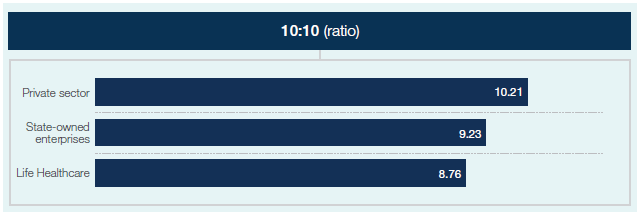
Life Healthcare continues to demonstrate a smaller income gap between the top and lower earners compared to both SOEs and the private sector in general.
In addition, the company annually reviews and grants higher increases to the lowest earners as it aims to transition from applying a minimum wage to a minimum living wage. This process is supported by a focus on skills development.
2.4 Performance management
The aim of our performance management process is to promote alignment of individual and team performance objectives with strategic focus areas, as follows:
- Performance management is consistently applied;
- Objectives feature both financial and non-financial indicators aligned to strategic imperatives;
- Outcomes are appropriately differentiated to reflect the different levels of contributions made by employees and constructive interventions are made to improve poor performance; and
- Performance outcomes influence remuneration to ensure appropriate differentiation based on contribution and performance.
State-owned-enterprises
9.23
Private sector
10.21
8.76
21st Century’s salary database (www.21century.co.za)
– (Morton & Blair, 2019)
2.5 Linking pay to strategy and performance
The Group's remuneration philosophy is to ensure that employees are rewarded appropriately for their specific contribution to the strategy of the Group and higher weightings are assigned to specific measurables relevant to their portfolio. The remuneration policy is designed to attract, engage, attract, and motivate the right, diverse talent to ensure long-term sustainability of the Group. Remuneration policies are designed to achieve alignment between business strategy, company values and behaviour of employees. Individual responsibility, performance, potential and behaviour in the achievement of business goals are recognised and rewarded. Participation in short- and long-term incentive schemes are dependent on the individual's role and level within the Group. Performance contracts are reviewed annually and goals for the ensuing year are agreed with employees to ensure clarity, focus, and clear measurables on outcomes are in place.
2.6 Remuneration framework
We take a total reward approach to remuneration. Our remuneration framework has been designed to achieve a fair and sustainable balance between annual, short-, and long-term variable remuneration, where participation in short- and long-term incentive schemes depends on an employee's role and level within the Group.
The King IV principles relating to fair and responsible remuneration guide application of our policy. The Committee will continue to monitor remuneration practices to ensure that any potential for unfair bias is eliminated and fairness prevails in the attraction and retention of top talent.
The remuneration components offered at Life Healthcare include guaranteed package, short- and long-term incentives and share-based incentives.
Our policy will be enhanced during 2022 in respect of certain elements of pay that were offered during 2020 and 2021.
| ELEMENT OF PAY |
Description | Eligibility | 2022 policy changes | Disclosure reference |
||
| Guaranteed remuneration |
Cash pay and benefits | All employees | Approval sought from FSCA to allow for flexible employee retirement fund contributions. Company will pay for professional registration fees. |
Section 2 | ||
| Variable remuneration – short-term |
Short-term incentives in terms of the Variable compensation plan (VCP) | Executives, middle and senior management | Offered in 2022, with some implementation changes, as disclosed in further detail below | Section 2 | ||
| VCP voluntary deferral into bonus shares in terms of the new proposed CIP | Discretionary, executives, senior management and key personnel | New offering for 2022 | Section 2 | |||
| Variable remuneration – long-term |
Performance awards under the Long-term incentive plan (LTIP) | Executives and senior management | Offered in 2022, with some implementation changes, as disclosed in further detail below | Section 2 | ||
| Bonus shares based on the voluntary bonus deferral in terms of the new proposed CIP | Discretionary, executives, senior management and key personnel | New offering for 2022 | Section 2 | |||
| Matching shares based on the acquisition of the bonus shares (calculated in accordance with the matching ratio) in terms of the new proposed CIP | Discretionary, executives, senior management and key personnel | New offering for 2022 | ||||
| Performance shares in terms of the new proposed CIP as a result of the election to participate in the CIP | Discretionary, executives, senior management and key personnel | New offering for 2022 | ||||
| Matched shares based on investment | GCE and Group CFO | Not offered in 2022 | Section 3 (table of unvested LTIs) |
|||
| Retention shares | International CEO and SA CEO | Not offered in 2022 | Section 3 (table of settled and unvested LTIs) | |||
| Share-ownership | The company procures Life Healthcare shares on an annual basis for the benefit of permanent employees with one years' service at date of allocation. These shares are held in a Trust and vest to participants in years 5, 6 and 7. | All SA employees not participant on the long-term incentive scheme. | Additional grant to be approved for 2022 by the Committee. | Section 2 | ||
2.7 Guaranteed remuneration
| Guaranteed Remuneration | Base salary | Fixed Benefits | ||||||||||||
| Annual individual performance review for all employees |
|
|
| ELEMENT | Description | ||
General |
Life Healthcare operates pay progression models that reward employees for their contribution to value creation. As an organisation it is critical that we ensure correct base pay, as guaranteed pay serves as the foundation of our reward design and is hence a crucial determinant of variable pay. We assess three pay progression factors: comparative ratio to market rate for job, individual performance and potential. Poor performers and those whose premium positioning in range isn't supported by their performance, potential or criticality of skills, will receive commensurately lower increases. This pay model is supported by a disciplined and rigorous annual talent review process that focuses on both performance and potential, using best practice tools to interrogate and plot each of these dimensions. This talent process continues to be refined over time to ensure a robust talent identification and management practice which is shared across the Group, demonstrating factually that we out-reward top talent in a disciplined and rigorous way. Pay is reviewed regularly to ensure that employees are rewarded equitably per legislation, market, and performance. In exceptional circumstances, this may involve adjusting the pay rate of certain individuals during the year. Should an employee perform in a more senior job for a minimum period of two continuous weeks, while another employee is away from work, an acting allowance equivalent to 10% of current salary is paid. |
||
Benchmarking |
The Group makes extensive use of survey houses to support its reward benchmarking process for all employees. The services of Deloitte, PwC, Remchannel and Willis Towers Watson are utilised. We typically benchmark against market median, but in respect of top talent and critical skills, our reward philosophy allows payment up to the 75th percentile. Benchmarking is reviewed annually prior to the annual salary review process. In respect of the Group executives, we benchmark remuneration against direct healthcare competitors and utilise the Deloitte executive market survey which takes cognisance of the following three criteria: a) Size of the organisation (complexity); b) Level of the executive job within the organisation; and c) Nature and scope of the job (responsibility and accountability). |
||
Retirement benefits |
South Africa The revised tax legislation applicable from 1 March 2021 has aligned the retirement options of provident fund members with pension fund members, compelling provident fund members to purchase an annuity at retirement to provide a monthly pension for their monies saved after 1 March 2021. As there is no longer a distinction between pension and provident funds, the company transferred all defined contribution pension fund members to the flagship Group Provident Fund and dual fund membership no longer applies. The effective date of the transfer was 1 July 2021 to coincide with the start of the Group Provident Fund's new financial year, however actual transfer will be determined following the approval of the transfer by the FSCA. |
||
|
In addition, the company operates two defined benefit funds that have been closed to new membership since 1996. The Life Healthcare Defined Benefit Pension Fund provides retirement benefits for 77 active members and 218 pensioners (July 2021). The Lifecare Group Holdings (LGH) Pension Fund no longer has active members. The fund no longer has any liability towards members or pensioners but is currently in the process of distributing surplus due to former members who left the fund prior to the surplus apportionment date in 2004. All statutory reports of the fund are up to date. Based on the history of the fund and to mitigate future risk, the intention is to appoint a liquidator at a future date, to ensure that once the fund is closed it can never be re-opened. The Group Provident Fund offers Group life cover and disability benefits to members. Permanent disability and death are covered by lump sum payments that are underwritten by an insurer. The standard cover for new employees is three times annual salary for death and disability cover. Some historical anomalies to this standard cover exist. It is currently compulsory for the employer and employee to contribute to the retirement fund with most employees contributing 7.5% of basic salary. Approval is being sought from the FSCA to allow employees to structure the employee contribution to the retirement fund with a minimum contribution of 2.5%. As a responsible employer, this flexibility in choice will be accompanied by proper education to employees for careful consideration of the long-term implications to retirement fund savings. Rule amendments and system updates will be required to accommodate this change. International Our international businesses operate a range of retirement funds in line with legal requirements and local market practice. Defined contribution pension schemes are in operation in the UK, Ireland, Germany, and Holland, all of which are provided by third party pension providers, with other regions contributing to government social security plans as required by regional legislation. The UK launched an interactive pension portal in 2020 which allows for direct communication with the portal and allows employees to model future pension benefits based on their current level of savings. In January 2021 the UK changed the default position of contribution collections from Net Deductions to Salary Exchange, with the latter offering approved employee and employer national insurance savings on contributions. The change saw a substantial increase in employees contributing to their pensions in a more cost-effective manner. |
||
Medical aid benefits |
South Africa It is a condition of SA employment for permanent employees earning above R10,000 per month to belong to a company-supported medical aid, unless membership of a spouse's medical aid can be proven. Membership of a principal member, spouse and up to two children is subsidised by the Group. The Group participates in the open medical scheme market and offers Medshield and Discovery Health as cover options to employees. In addition, medical aid membership is voluntary for employees who earn below the threshold level, however, the Group has procured a primary health benefit for employees earning below this threshold who opt not to join a medical aid. This benefit covers, via a bespoke network, doctors' consultations, medication, and a certain number of prescribed minimum benefits. International Our international businesses operate a range of healthcare benefits in line with local market practice. All such schemes are provided by third party healthcare insurance providers and cover a range of benefits including private medical insurance, life assurance and permanent illness or injury insurance. |
||
Other benefits |
Benefits are industry benchmarked, priced and reviewed as part of the annual salary review process. Review of practices by direct competitors, the State and those identified by the Remchannel market surveys are utilised to ensure benefits are competitive and aid in retention. These are integrated towards wellness to drive employee effectiveness and engagement and comply with relevant legislation. Additional specialist and market retention allowances are paid to recognise skills and to incentivise and retain employees. Other variable allowances are paid for additional services rendered. |
||
2.8 Wage negotiations
Unionisation in the Group is relatively low at 23.2% as at 30 September 2021, the reason being that we believe that the consultative forums are operating effectively in terms of regular and transparent communication with employees. We are also pleased to confirm that the Group managed to negotiate and conclude the wage negotiations with all hospitals where recognition agreements are in place by the end of August 2021 for implementation as at 1 September 2021.
2.9 short-term incentive scheme (VCP)
| Short-term Incentive Scheme | Variable Compensation Plan (VCP) | ||||
| VARIABLE PAY |
Executives and senior managers who have line-of-sight and contribute to the profitability of the business |
|
| ELEMENT | Description | ||||||||||||||||||||||||||||||||||||||||||||||||||||||||||||||||||||||||||||||||||||||||||||||||||||||||||||||
Policy and formula |
Life Healthcare has defined four strategic focus areas which are quality, growth, efficiency and sustainability. Success requires strongly committed and appropriately incentivised executives, management and employees. The Variable Compensation Plan (VCP) policy is a short-term reward scheme and forms part of the overall reward plan. The VCP policy applies a balanced score card approach which measures and rewards behaviour aligned to each strategic focus area. The VCP policy and the implementation thereof are focused on rewarding the achievement of short-term strategic, financial and non-financial objectives in the one-year business plan aligned to the strategic focus areas. This policy applies to executives, middle and senior management roles. The short-term incentive bonus is formula-driven. Participants receive short-term rewards aligned to our standard remuneration policy, calculated based on a bottom-up additive approach (that is, each individual's salary multiplied by weighted Group, business unit (if applicable), strategic innovation measures and non-financial measures). The VCP operates in accordance with the following formula: STI = Targeted award percentage (dependent on level) x salary x (Group performance against stretched budget x weighting %) + (Business unit performance against stretched budget x weighting %) + (Strategic Innovation measures x weighting %) + (Non-financial measures x weighting %). The stretch targets and performance measures are set and approved annually by the Committee and communicated to each participant at the beginning of the financial year. |
||||||||||||||||||||||||||||||||||||||||||||||||||||||||||||||||||||||||||||||||||||||||||||||||||||||||||||||
Performance conditions weightings and vesting targets |
All employees have a link to Group company and non-financial measures. In addition, some employees are also measured on business unit performance. The following weightings and performance thresholds determine delivery of payment:
We continue to set challenging stretch budgets annually, where target is only achieved if executives deliver fully to plan. Thus, 95% achievement of financial targets attracts 100% of on-target reward and 100% achievement attracts 125% of on-target reward, where we benchmark our STI reward levels at on-target level and thus demand excellent performance before benchmarked reward is earned. Maximum reward is earned as follows in respect of the different measurement categories:
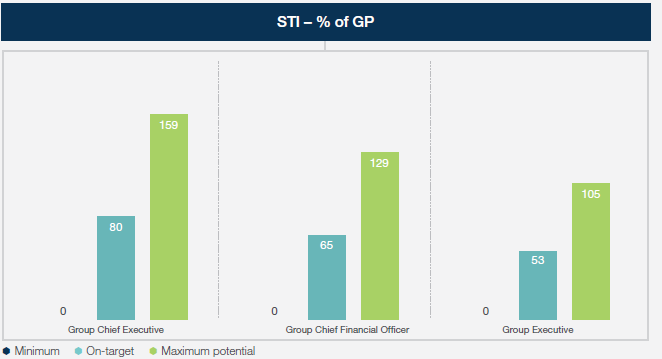
Further details for Group Executives: Maximum reward is influenced by the weighting of each reward key performance area (KPA) and in respect of the Group Executive, this translates to the following maximum percentage of targeted reward:
In setting targets, we are mindful that external factors, some of which are unpredictable, can influence performance. That said, we strongly believe overall sustainable performance should be evaluated and targeted, using a mix of financial and non-financial measures that are directly controllable, but equally affordable and aligned with shareholder outcomes. The Board may apply its discretion on all payments, to mitigate the impact of unintended consequences, but only in exceptional circumstances. The application of any such discretion for executives will be fully disclosed in the implementation report. We apply a balanced scorecard approach which rewards achievement of short-term strategic, financial, and non-financial objectives aligned to our one-year business plan. Balanced scorecard measures are weighted differently at each level of the organisation in line with the accountability of employees and the behaviour that needs to be encouraged; and both modifiers and gatekeepers are applicable where appropriate. The concept of the gatekeepers ensures that the scheme does not reward participants if overall performance does not justify payment. In respect of individual performance, the gatekeeper ensures that poor performers do not qualify for any payment. |
||||||||||||||||||||||||||||||||||||||||||||||||||||||||||||||||||||||||||||||||||||||||||||||||||||||||||||||
Gatekeepers |
The Group emphasises pay for performance and the achievement of the threshold level of performance is a prerequisite for the delivery of any bonus. Should the Group's financial performance be less than 75% of the agreed financial targets, no VCP payments will be made, irrespective of business unit or individual performance. In addition, should job-required outputs in respect of personal performance not be met (a personal performance rating below a 3), no short-term incentive payment will be made, irrespective if other measures are met. |
||||||||||||||||||||||||||||||||||||||||||||||||||||||||||||||||||||||||||||||||||||||||||||||||||||||||||||||
Maximum earning potential for executives |
The on-target and maximum** opportunity is graphically displayed below:
|
||||||||||||||||||||||||||||||||||||||||||||||||||||||||||||||||||||||||||||||||||||||||||||||||||||||||||||||
Changes for 2022 |
The Group has successfully migrated to an annual evaluation and payment methodology following consultation with all scheme participants. The weightings of the performance metrics have been adjusted for 2022, with the weighting of the financial outcomes reduced as a means of enhancing focus on ESG, clinical and personal deliverables during the recovery period following the COVID-19 pandemic. However, the budget performance is still stretched to drive recovery on prior years' results. Weightings of the metrics will be as follows for the Group Executives:
|
||||||||||||||||||||||||||||||||||||||||||||||||||||||||||||||||||||||||||||||||||||||||||||||||||||||||||||||
Performance conditions for 2022 |
|
||||||||||||||||||||||||||||||||||||||||||||||||||||||||||||||||||||||||||||||||||||||||||||||||||||||||||||||
2.10 LONG-TERM INCENTIVE PLAN)
| Long-term performance incentives | Long-term Incentive Plan (LTIP) | ||||
| VARIABLE PAY | Executives and senior managers who have a more strategic focus and can influence the long-term performance and sustainability of the Group |
|
| ELEMENT | Description | ||||
Policy |
The long-term incentive scheme is a notional performance share scheme with a three-year performance and vesting period. The first allocation in this scheme was made on 1 January 2019 and further allocations were made in January 2020 and 2021. The purpose of the LTIP is to drive long-term performance, retain executives and senior management who are able to influence the long-term performance and sustainability of the Group, and align the interests of participants with those of shareholders. |
||||
Allocations |
The notional value of the performance shares is determined by the price of Life Healthcare shares on the JSE using a 30-day VWAP preceding the date of allocation. The allocation value is influenced by expected salary increases, share price movement, tier, and individual performance. The scheme continues to allow for enhanced allocation of performance units at allocation based on personal performance and additionally for key talent retention, via a strategic modifier. The methodology to enhance allocations is applied as follows:
The number of Performance Shares = Guaranteed Package ** x Job Grade Modifier x Performance Modifier x Strategic Modifier Share Price
|
||||
Instrument |
Conditional shares |
||||
Performance conditions for 2022 |
The performance conditions applicable to the 2022 allocation appear in the table below, alongside those from the previous allocations under the LTIP. |
||||
Vesting |
All notional performance and retention shares vest at the end of the third year. Retention shares are subject to continued employment and notional performance shares are subject to performance related vesting criteria being met. The proceeds after tax will be delivered as follows:
|
||||
Termination of employment |
The conditions applicable to LTIP awards upon termination of employment are as follows: No Fault Termination: Participants shall retain a pro-rata number of retention and notional performance shares to date of termination if more than one year before vesting. Participants will retain all notional shares, which will be settled at normal vesting date if one year or less before vesting. Fault Termination: All notional performance and retention shares held by the participant shall be forfeited and cancelled. |
||||
Focus areas for future allocations |
Improved communication during the vesting period to foster a drive within the workforce that would ultimately deliver a benefit to the shareholders, by identifying and addressing gaps in Group performance and ensure pay-outs to the team.
|
||||
Maximum earning potential for executives |
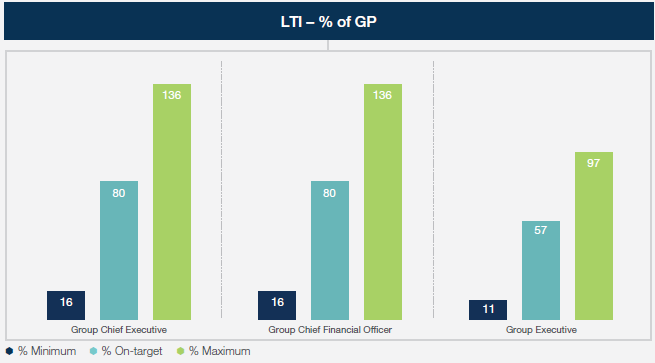
In the case of the Group Executive, the opportunity and maximum limit on the LTIP scheme based on an on-target allocation are as follows (see explanation below**)
Once an allocation is made, the performance of the Group has a significant impact on the extent to which vesting occurs. The weighted impact of maximum outperformance in all KPAs is illustrated below.
|
||||
Malus and |
Notwithstanding anything to the contrary herein contained, in the event of pending disciplinary or poor performance procedures against a participant, or the contemplation of such procedures, then vesting or settlement shall be suspended until the conclusion of such procedures, at which time the vesting and settlement will take place, or the provisions of fault/no fault termination shall apply, whichever is applicable. Where a participant has intentionally manipulated information which directly or indirectly influences the performance measurables, or misrepresented any information, then all the retention and notional performance shares held by the participant shall be immediately forfeited or cancelled for no consideration on the forfeiture date. If misconduct is identified after settlement, the participant shall, within 30 days after forfeiture date, deliver to the Company the number of shares equal to the shares delivered pursuant to the settlement or a formula driven amount. |
||||
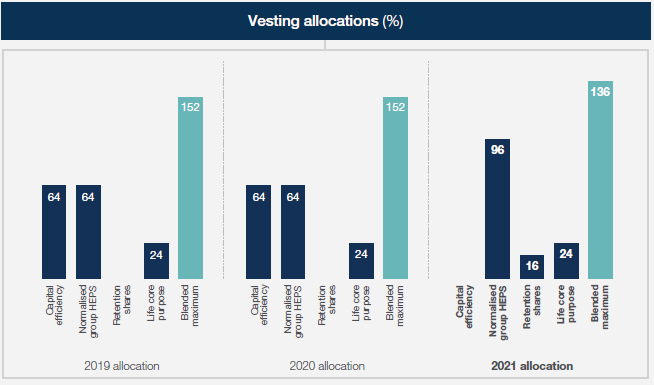
Performance conditions per allocation:
The only financial performance target for the 2021 allocations was normalised HEPS, which will be adjusted for group structure changes. Group HEPS will be measured against South African CPI as Life Healthcare is a South African listed entity and HEPS is measured in South African Rand.
Financial measures utilised in the computations will come from the Group's audited financial statements for the measurement period applicable to each allocation, unless otherwise stated. Assurance will be obtained from Internal Audit on the results before payment is approved and made.
Agreed performance targets will need to be amended if management and the Board approve any material changes to strategy, including but not limited to new acquisitions, growth initiatives, and or sales of any businesses.
The metrics and underlying performance conditions for participants who are responsible for multiple geographies will be weighted relative to the contribution of turnover per geography. The weighting applies to performance targets as well as any underlying inflation hurdles.
Amendments of targets will be subject to Board approval and scheme participants will be notified in writing.
The following table summarises the weighting, thresholds and performance conditions for historical and future allocations:
| Performance conditions | Vesting criteria |
2019 allocation |
2020 allocation |
2021 allocation |
| Capital efficiency | Weighting | 40% | 40% | 0% |
|---|---|---|---|---|
| ROCE (79%) | No vesting: | ROCE>WACC @ 0% | ROCE>WACC @ 0% | |
| Compared to WACC | 100% vesting: | ROCE>WACC @ 1% | ROCE>WACC @ 2% | |
| Vesting date calculated as a 3-year rolling average | 200% vesting: | ROCE>WACC @ 2% | ROCE>WACC @ 4% | |
| Satisfactory returns on business-as-usual capital ("BAU") versus WACC for our core business (excluding acquisitions) | Grant date WACC | 12.4% | 11.7% | |
| EBITDA growth on growth initiatives (21%) Prudent capital allocation for delivery of business performance in line with business case for our key growth initiatives. |
|
Growth against criteria Linear vesting between criteria | Growth against criteria Linear vesting between criteria | |
| Earnings | Weighting | 40% | 40% | 60% |
| Normalised Group HEPS | No vesting: | CPI +1% per annum | CPI +1% per annum | CPI<2% per annum |
| Growth exceeding headline | 50% vesting | CPI + 2% per annum | ||
| CPI | 100% vesting: | CPI + 3% per annum | CPI + 3% per annum | CPI + 4% per annum |
| Linear vesting between
criteria The choice of measure reflects the ability of these executives to influence the capital structure of the Group. |
200% vesting: | CPI + 5% per annum | CPI + 5% per annum | CPI + 10% per annum |
| Normalised Country EBIT | No vesting: | 50% of CPI | 75% of CPI | |
| 100% vesting: | CPI + 0% | CPI + 1% per annum | ||
| 200% vesting: | CPI + 1% per annum | CPI + 2.5% per annum | ||
| Retention shares | Weighting | 0% | 0% | 20% |
| Group Executive ONLY | No performance conditions. Vesting based on continued employment | |||
| Life core purpose measures | Weighting | 20% | 20% | 20% |
| Average performance for
each of the 3 years. Vesting based on average performance over period Linear vesting between criteria As a healthcare business, patient outcomes and experience underpin everything we do. The LCP measure reflects the extent to which the Group achieves the clinical measures that drive long-term sustainability. Country-specific measures and target are set, which are aggregated to form a Group score against which the GCE and Group CFO are measured. |
No vesting: | 80% of target | Below 90% | Below 90% |
| 100% vesting: | 100% of target | 100% of target | 90% or higher against target | |
| 150% vesting: | 120% of target | 100% is earned if >90% of target achieved | 100% is earned if >90% of target achieved | |
| Country: SA
|
 |
|
|
|
|
|
|
|
|
UK
|
|
|
|
|
|
|
 |
|
|
|
|
|
|
|
Italy & Ireland
|
|
|
|
|
|
|
|
|
|
Poland
|
|
|
Not applicable sold in March 2021 | |
|
|
|
||
|
|
|
||
|
|
|
||
Radiopharma/Northern Europe
|
|
|
|
| *** | 2022 allocation and associated performance measures will only be approved during Jan/Feb 2022. |
Achieved
Not applicable
| Allocation date | Vesting date | Measurement period | Performance conditions |
| 1 January 2019 | 31 December 2021 | 1 Oct 18 - 30 Sept 21 | Per table below |
| 1 January 2020 | 31 December 2022 | 1 Oct 19 - 30 Sept 22 | Per table below |
| 1 January 2021 | 31 December 2023 | 1 Oct 20 - 30 Sept 23 | Per table below |
Glossary of performance conditions:
The following definitions apply to the respective LTIP allocations:
| Weighted average Cost of Capital (WACC) | Capital efficiency is measured based on ROCE vs WACC. WACC is a pre-tax rate and will be determined as per the SA government 10-year bond rate + 3.4% Average WACC = (rate at beginning of financial year + rate at end of financial year)/2 |
| Return of Capital Employed (ROCE) | ROCE = Group Normalised EBIT |
| Group Total Assets - Group cash on hand - Group Current liabilities + Group short-term interest-bearing borrowings (excluding net deferred tax liability and tax liability). |
|
ROCE will be based on business as usual (BAU) and will exclude any acquisitions in the year of the acquisition and growth initiatives. Acquisitions will be included in subsequent years and the growth evaluated from year two to vesting date.
|
|
| Earnings before Interest and Tax (EBIT) | Normalised EBIT = Operating profit before interest and tax excluding once-off items impacting on operating profit.
|
| Earnings before Interest, Tax, Depreciation and Amortisation (EBITDA) |
Defined as operating profit before depreciation on property, plant and equipment and amortisation of intangible assets. It will be determined based on the initiatives contribution to the Life Healthcare consolidated results. |
| CAPEX spend | Will be based on the actual capital investment as well as capital spend into each growth initiative over the vesting period of the scheme. This will be obtained from the Group audited cash flow statement at the end of each financial year. Should the capex spend be more/less than the target measures, the ratio of actual spend to target spend will be computed. This ratio will be applied to the EBITDA targets to determine vesting. |
| Normalised Headline Earnings per Share (HEPS) | Per Group audited financial statements, adjusted for exceptional items and group structure changes as approved by the Committee. |
| Headline Consumer Price Inflation (CPI) | Weighted CPI as at end of financial year per official publication. The weighting of the CPI will be based on the actual normalised EBIT contribution per geography. |
| Life Core Purpose (LCP) | Non-financial measures that reflect the extent to which the Group achieves the clinical measures that drive long term sustainability. Country-specific measures and target are set, which are aggregated to form a Group score against which the Group Chief Executive and Group CFO are measured. The most critical LCP measure remains patient satisfaction. The clinical teams are working to standardise this measure across all countries in the course of 2022. |
2.11 SCANMED EXIT INCENTIVE PLAN
In February 2020, the Committee approved a Scanmed exit incentive plan (the Plan). Under the Plan, three categories of incentive were agreed:
| Equity Value Incentive | For Management, Board and senior operational leaders only. Variable payment based on a total pool of 1.5% of the exit value. Payment subject to successful completion of the exit process. |
|
| Retention Incentive | Fixed payment for selected management to support retention. Payments subject to successful completion of the exit process or being in employment as of 1 July 2021, whichever is the sooner. | |
| Contribution Incentive | Fixed payment for selected management to recognise additional activity. Payments subject to successful completion of the due diligence process. |
It was also agreed that the plan incentives would be paid in addition to standard LTIP allocations for eligible participants. Outstanding LTIP allocations were settled on exit for the Scanmed participants ensuring that there were no outstanding legacy entitlements on exit. Details are outlined in the implementation report.
2.12 Co-investment policy (cip)
| Variable pay | Long-term performance incentives | Co-investment policy (CIP) | |||
| Selected executives and senior managers who have a more strategic focus and can influence the long-term performance and sustainability of the Group, deemed critical to retain |
|
| ELEMENT | Description | |
| Policy (and specific link to strategy) | As a Company operating in a concentrated healthcare market in South Africa, the Group's employees form part of a small talent pool of niche skills. In the event that the Group is unable to retain its executives, senior management and certain key employees, it is placed at significant risk due to the difficulty in replacing the skills lost. Hiring these skills from foreign jurisdictions is viewed as an unnecessarily costly exercise, when it is, perhaps, more plausible to incentivise and retain the talent the Group already has. The CIP which was introduced at the start of 2022, aimed at:
|
|
| Allocation | Selected employees are invited to participate in the CIP, by deferring a percentage of any potential VCP award:
|
|
| Instrument | Restricted shares (Bonus Shares and Matching Shares) and forfeitable shares (Performance Shares) are purchased in the market and are therefore non-dilutive | |
| Conditions | Performance under the VCP will determine the value of a participant's VCP award which in turn will be used to calculate the number of Bonus Shares. No performance conditions apply to the Matching Shares, however, participants must remain employed by a company within the Group throughout the vesting and holding periods applicable to their award.The Performance Shares will vest if, in assessing and calculating the Group's relative performance to its comparator group (ie Netcare Limited and Mediclinic International Plc) over the performance period, an average TSR of 75% or higher in comparison to the Group's comparator group is achieved.In addition, in accepting an invitation to participate in the CIP, employees agree:
|
|
| Vesting and release |
|
|
| Malus and clawback | Malus and clawback apply to every award under the CIP in accordance with the CIP malus and clawback policy. | |
| Termination of employment | Upon termination of employment:
|
|
2.13 Share-ownership awards
| Variable pay | Share-based rewards | ||||
| Employee Share Plan (ESP) | Permanent employees who belong to specified company retirement funds and have one year's service at the date of grant are eligible for an allocation. Not applicable to managers participating in the long-term incentive plan. |
|
| ELEMENT | Description | |
| Allocations | The Committee agreed to a further purchase of Life Healthcare shares to the value of R20 million for the benefit of qualifying employees this year. Despite the reduced purchase, the decrease in the share price will result in the acquisition of more shares per employee and creates a greater upside potential for participants. These shares will be held in a trust until years 5, 6 and 7, where vesting will occur as follows, provided participants are still in the employ of the company:
|
|
| Instrument | Restricted shares | |
| Vesting | The vesting of 50% of the 2014 ESP grant and 25% of the 2015 and 2016 ESP grants occurred at the end of June 2021. Most participants (96%) opted to sell their shares. | |
| Termination of employment | Employees who resign or are dismissed during the duration of the scheme will lose their rights to all allocations made, and their rights will be distributed equally among the remaining employees. Thus, the number of rights will increase by the time of transfer of shares to remaining employees. Good leavers, for example those who are retrenched or retire, will have the proportionate number of shares they hold at the time of termination paid out to them, less tax and costs. They will no longer participate in the employee share plan. The scheme is fully ramped up to provide 100% vesting to each employee who has been employed since inception of the scheme. |
|
2.14 Once-off gratuity payment (southern Africa)
As reported in the remuneration report for 2020, the COVID-19 pandemic caused several operational challenges. To stem the outflow of key clinical skills and assist our employees during this difficult time, the Group decided to pay a once-off gratuity bonus to all permanent employees who do not participate in the long-term incentive scheme. This payment also served as recognition for the incredible efforts, bravery and commitment of employees during the Covid-19 surge. The value of the total payment made amounted to R45 million and was distributed equally to approximately 15 000 South African employees.
2.15 Group reward integration
Over the past years we have continued to integrate remuneration practices across countries to ensure Group alignment and application of best practice.
Alignment of international territories with Life Healthcare in terms of job grading, benchmarking principles and short- and long-term incentives is in place.
Our integration efforts in the coming year will focus on organisational culture, global mobility and talent management, HR metrics, and reporting on retirement fund matters at a global level. The Group is exploring implementation of a group-wide HR information management system that will improve the overall employee value proposition, management of human capital and business analytics.
2.16 Pay for performance and remuneration mix
The on-target and maximum pay mix apportionment for the Group Executive in Life Healthcare for 2022 is graphically displayed below:
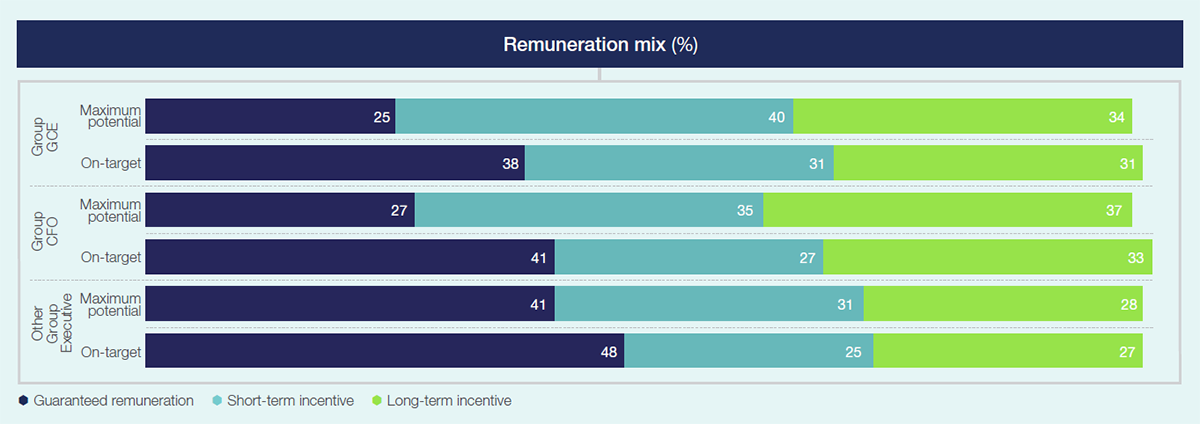
As indicated above, the relationship between the respective reward elements is illustrated based on on-target and maximum potential payment in terms of incentive schemes. The maximum outperformance potential on the VCP scheme (STI) is illustrated in paragraph 2.13 above.
Details of each remuneration element are outlined above.
2.17 Executive contracts of employment
Executive employment contracts for management have historically been subject to a three-month notice period and a subsequent six-month restraint of trade. However, given the fact that the Group operates globally, the Group's policy position has been changed to:
- A six months' notice period
- A three months' global restraint of trade
- A twelve months' undertaking to refrain from the recruitment of Life Healthcare employees.
These provisions have been applied to the employment contract of the new Group Chief Executive, the Chief Executive Officer, the Chief People Officer and the Company Secretary. This is currently being extended to the rest of the Group executive committee. No provision is made in contracts of employment that may trigger payment upon termination of employment, nor any sign-on payments or allowances for buy-outs or ex gratia payments on termination, other than what is reported in this report.
2.18 Malus and Clawback
The company has a malus and clawback policy, in respect of remuneration earned under its short- and long-term incentive schemes (STI and LTI, respectively). The policy allows the company to reduce or recoup STI or LTI awards in specific circumstances (defined as trigger events). Trigger events include manipulation and/or misrepresentation of information in a manner which results in directly or indirectly influencing the performance outcomes to the benefit of themselves or others. Following a guilty finding following a disciplinary process, malus would be applied before awards have vested or been paid to an employee, whilst clawback could be applied to awards for a period of 3 years from the date of payment or vesting (in terms of the new Co-Investment Policy, clawback may operate for a longer period). Where bona fide errors have been made, the monies will be corrected or recovered against the ensuing incentive payment.
The scheme rules and award letters to eligible employees include policy provisions for both malus and clawback. Funds will be recovered after following due process and will not preclude legal action in instances where actions constitute a criminal act.
During the reporting period, no trigger events occurred or were discovered to have occurred and accordingly, neither malus nor clawback was applied to STI or LTI awards.
The company also has a CIP malus and clawback policy which only applies to participants who have been invited and elected to participate in the CIP.
2.19 Non-executive directors remuneration
Fees in respect of non-executive directors are reviewed on an annual basis, and a comprehensive benchmarking exercise was conducted by Deloitte and PwC against other industry sector companies (our peer group, consisting of direct and indirect competitors) and other similar-sized JSE listed companies.
Fees are paid as a combination of a retainer and a fee per meeting to ensure alignment with emerging market practice. The Group's policy is to pay non-executive director fees at or above the median market rate. If above median, this is to acknowledge key scarce skills and competencies. Non-executive directors are formally on-boarded through a letter of appointment and do not participate in any Group STI or LTI awards. In addition to the non-executive director fees being paid, reasonable travel expenses to attend meetings are reimbursed.
To align with shareholder recommendations, the Committee approved a weighted average increase of 4.1% to the non-executive director fees effective 1 January 2021, with higher increases where comparative ratios against the market benchmark were low. The base increase was 3.5%. Where current fees lag market rates, our approach will be to correct these anomalies over several years subject to obtaining the necessary shareholder approval. The fees paid to non-executive directors during the reporting period are included in the implementation report below, while the proposed fees for 2022 can be found on page 99.
2.20 Non-binding advisory shareholder votes
At the 2021 AGM held on 27 January 2021, 63.97% of shareholders voted in favour of the implementation report. We engaged with the dissenting shareholders and asked for their reasons for voting against the implementation report. We collated a number of their queries and concerns, which we have tabled below, along with our responses.
Shareholder queries raised on the 2021 implementation report
| Life Healthcare response/action plan | ||
Poor linkage between pay and performance. |
Stringent budget setting protocols are in place to ensure rigorous stretch targets in short-term incentivisation, which are agreed by the Group Executive and Board. For financial targets, the Board considers inflation, GDP movement, the impact of acquisitions and builds in a management stretch component. The achievement thereof, via a balanced scorecard of measures (both financial and non-financial) is not easily attained and hence warrant significant reward for outperformance. All employees have a link to Group company and non-financial measures. And where applicable, some employees are also measured on business unit performance. There are gatekeepers in place for both STI and LTI schemes, whereby no payment is made if thresholds are not met. For 2021, the assessment process of the Group Executive is a combination of team and individual deliverables as opposed to the previous team-rating approach to ensure enhanced accountability. This includes delivery on key financial and strategic deliverables, leadership, and stakeholder management. |
|
The generosity of remuneration arrangements |
The company ethos is to pay for performance. It aims to reward appropriately for top performance to ensure retention via wealth creation. All reward decisions are influenced by thorough market research (Remchannel and Deloitte) and incentive payments are subject to the achievement of stretch financial and other targets. |
|
Poor use of Committee discretion during 2020 (COVID-19 related payments made during a year of overall negative shareholder and employee experience, sans compelling rationale). |
During the economic and social disruption caused by the pandemic as well as the cyber-attack on the business, individual roles and responsibilities were unclear, and leadership, hard work and resilience came to the fore. Hospital management teams needed to mobilise timeously and deal with the management of all facets of the unprecedented pandemic. Personal sacrifices were made whereby Group executive contributed a portion of their guaranteed remuneration to the Life Healthcare Employee Assistance Fund and senior management voluntarily deferred their short-term incentive bonuses to the end of the year (2020) to alleviate cash constraints on the company. |
|
Poor disclosure of performance conditions and their link to strategy/ the creation of shareholder value. |
The company is committed to improved disclosure of performance measures and has made further improvements in this regard |
|
Pay frameworks where short-term incentives are more valuable than long-term incentives do not provide adequate alignment with shareholders' long-term interests. |
The targeted reward for short-term incentivisation is a smaller percentage of guaranteed package than the targeted reward for long-term incentivisation for all levels of employees. Only outperformance of stringent performance parameters allows for outperformance reward. |
|
The Group will table this year’s remuneration policy together with the implementation report for two separate non-binding advisory votes by the shareholders at the 2022 AGM, in line with best practice, King IV and the JSE Listings Requirements. If more than 25% of the ordinary shareholders present votes against either or both the remuneration policy and Implementation report, the Committee has to engage with those shareholders in order to address their concerns. The SENS announcement on the results of the AGM will include an invitation for shareholders to engage on the reasons for their dissent. The Committee will respond and provide feedback on shareholders’ queries and/or concerns. Following this engagement, the Committee may amend aspects of the remuneration policy.
Section 3
Implementation report
3.1 INTRODUCTION
This implementation report provides a summary of how the remuneration policy was applied and implemented by the Committee in recognition of the agility, strategic and operational steer, commitment and dedication of Life Healthcare employees in providing healthcare services during the prolonged, unprecedented COVID-19 pandemic. The report discloses the remuneration outcomes for executive directors, non-executive directors and prescribed officers for the 2021 financial year. The Board is satisfied with the implementation of the remuneration policy during 2021.
Fair and responsible pay
- The Committee monitored the implementation of the remuneration policy throughout the year in terms of fairness, responsibility and transparency and is of the view that the Group was in material compliance with the 2020 remuneration policy.
- A discretionary once-off dispensation to the short-term incentive scheme was approved by the Committee for targeted retention of key and critical skills for exceptional performance of employees during the COVID-19 pandemic.
- There were no circumstances which warranted the application of any malus or clawback provisions.
- The Committee is committed to ensuring the remuneration of executive management is fair and responsible in the context of overall employee remuneration.
3.2 REMUNERATION OUTCOMES
3.2.1 Guaranteed remuneration
3.2.1.1 Annual increase
To mitigate against cash constraints due to the COVID-19 pandemic, only frontline employees received an increase in January 2021. The salary increases for executives, head office employees, regional non-clinical employees and non-frontline employees were delayed until May 2021 and no payments were made retrospectively.
The outcome was as follows:
| South Africa | Average % increase |
Other geographies | Average % increase |
| Group executive** | 0.8 | Ireland | 2.7 |
|---|---|---|---|
| Non-frontline employees | 3.7 | UK | 3.1 |
| Front-line employees | 4.7 | Italy | 1.1 |
| Northern Europe and Radio pharmacy - Germany | 2.9 | ||
| Total SA | 4.3 | Northern Europe and Radio pharmacy - UK | 4.0 |
| ** | Only two Group Executives received an increase in May 2021. |
The salary increases for non-management employees (below middle management) were brought forward from January 2022 to September 2021 to address the loss of critical skills. An average increase of 5.3% was granted.
3.2.1.2 Total single figure of remuneration - Executive Directors and Prescribed Officers
The tables below reflect the actual amounts paid as well as earned year-on-year for 2020 and 2021:
| Financial year |
Salaries R'000 |
Benefits R'000 |
Guaran- teed package R'000 |
VCP cash2 R'000 |
CIP equity deferred3 R'000 |
Long-term incentive4 R'000 |
Other5 R'000 |
Other R'000 |
Single figure remun- eration R'000 |
|
| P Wharton-Hood1 | 2020 | 641 | 37 | 678 | – | – | – | – | – | 678 |
|---|---|---|---|---|---|---|---|---|---|---|
| 2021 | 7 800 | 735 | 8 535 | 4 460 | 4 660 | – | – | 9 120 | 17 655 | |
| P van der Westhuizen | 2020 | 5 333 | 378 | 5 711 | 3 394 | 2 629 | 2 425 | 8 448 | 14 159 | |
| 2021 | 5 500 | 301 | 5 801 | 2 579 | 2 695 | 3 236 | – | 8 510 | 14 311 | |
| A Pyle7 | 2020 | 3 331 | 175 | 3 507 | 2 012 | 1 678 | – | 3 690 | 7 196 | |
| 2021 | 4 079 | 188 | 4 267 | 1 811 | 1 892 | 2 201 | – | 5 903 | 10 170 | |
| M Chapman6 | 2020 | 5 535 | 828 | 6 362 | 3 525 | – | – | 3 525 | 9 887 | |
| 2021 | 5 842 | 838 | 6 680 | 2 173 | 2 454 | – | – | 4 627 | 11 307 |
| 1 | Peter Wharton-Hood commenced services as GCE on 1 September 2020. His remuneration for 2020 only reflects one month of service and no bonus as tenure was too short to measure performance. |
| 2 | Short-term incentive cash amount (not deferred) relating to the performance against target for the financial year. |
| 3 | Short-term incentive equity amount relating to the performance against target for the financial year and deferred to the CIP scheme as restricted bonus shares as detailed in the Remuneration Report (2021). |
| 4 | LTI payment for 2020 is inclusive of outperformance incentive scheme and LTI 2018 Once-Off alternative bonus paid to Group CFO (as detailed in prior year's Implementation Report). |
| 5 | Includes payments made to the Group CFO in 2020 in respect of acting allowance and bonus as detailed in prior year's Implementation report. |
| 6 | M Chapman's remuneration is reflected in SA Rands applying the average exchange rate of £1 = R20.69 as of 30 September 2020 and £1 = R20.32 as of 30 September 2021. |
| 7 | The guaranteed remuneration of the CEO SA was adjusted to address lag to market including direct private healthcare competitors |
3.2.2 Short-term incentivisation
The outcome of the performance scorecard for the Executive Directors in respect of 2021 was as follows:
| Measure | Weighting | Threshold | Target R'000 |
Stretch | Actual outcome R'000 |
Weighted outcome |
| Financial stability | 60% | 75% | ||||
|
3 232 | Maintain current operational performance under COVID-19 environment | 3 434 | 84% | ||
|
4 772 | 5 403 | ||||
|
44% | 38% | ||||
| Clinical measures | 15% | 3 out of 7 | 5 out of 7 | 18% | ||
| Personal measures (Other) | 25% | 3 out of 7 | 4 out of 7 | Out of 7 | ||
|
6 | 35% | ||||
|
6 | 35% | ||||
|
6 | 35% | ||||
|
5 | 30% |
In addition to the Company performance targets, the achievement of strategic clinical and personal objectives accounted for 40% of Group Executives’ balanced scorecard as set out below.
MEASURE |
Objectives | Achievement | |
| Clinical metrics(15%) | Objectives to improve on clinical governance and quality metrics. |
|
|
| Other (25%) | |||
| Management of COVID-19 pandemic | Objectives pertained to the successful management of the impact of the COVID-19 pandemic. |
|
|
| People | Ensure Board and executive engagement & alignment on the TDI strategy and narrative - Ensure the embedding and driving of TDI imperatives across the Group |
|
|
| Stakeholder management | To enhance meaningful engagement with doctors, government stakeholders, funders, senior executives, and non-executive board members as well as with shareholders and analysts. |
|
|
IT delivery |
Stabilise the SA technology platform |
|
|
Operational delivery |
Drive nursing excellence programmes, PET-CT and AMG key performance delivery |
|
|
Strategic delivery |
Run a Group-wide strategy function with data and analytics for improved oversight of key strategic imperatives. |
The data and analytics strategy has been refined and execution is underway. |
|
Leadership, values, culture and teamwork |
Progress of teamwork and reduction of silos |
|
|
Overall rating |
6 out of 7 rating was approved by the Committee |
||
The targeted % of total cost to company for the Executive Directors and the payment made in respect of each period using the VCP formula disclosed in part 2, is set out below. Please note that no STI payment was made to the newly appointed Group Chief Executive in 2020 as one month's service was insufficient to measure his performance contribution:
| VCP = A x B x [(C + D)] | Total VCP | |||||||
| TGP R'000 (A) |
STI allocation (%) (B) |
Weighted financial score (C) |
Weighted non-financial score (D) |
Cash R'000 |
CIP Bonus share award quantum deferred R'000 |
Total VCP R'000 |
Total VCP as % of total guaran-teed package1 |
|
| P Wharton-Hood | 8 321 | 80.0% | 84% | 53% | 4 460 | 4 660 | 9 120 | 110 |
|---|---|---|---|---|---|---|---|---|
| P van der Westhuizen | 5 923 | 65.0% | 84% | 53% | 2 579 | 2 695 | 5 274 | 89 |
| A Pyle3 | 4 700 | 57.5% | 84% | 53% | 1 811 | 1 892 | 3 702 | 79 |
| M Chapman2 | 6 096 | 57.5% | 72% | 48% | 2 173 | 2 454 | 4 627 | 76 |
| 1 | Total STI (inclusive of deferred portion) to Co-Investment Policy (CIP). |
| 2 | Exchange rate of R20.32 to the Pound for 2021. |
| 3 | The guaranteed remuneration of the CEO SA was adjusted to address lag to market including direct private healthcare competitors. |
3.2.3 Long-term incentivisation
The Long-term Incentive Plan (LTIP) details regarding the 2018 once-off long-term bonus payment and the three unvested LTIP 2019, 2020 & 2021 allocations are set out below.
3.2.3.1 Historical LTIP allocations
- LTIP 2018 once-off alternative
The once-off alternative cash offering was based on an additional third of the 2018, 2019 and 2020 short-term bonus outcomes which were banked, and payment was made in January 2021 to coincide with the date when the normal LTIP 2018 allocation would have vested. Please refer to 2.1.4 of the 2020 remuneration report for further details in this regard. The final payment made in January 2021 is detailed below.
| STI 2018 1/3rd earned R'000 |
STI 2019 1/3rd earned R'000 |
STI 2020 1/3rd earned R'000 |
Total payment R'000 |
|
| P van der Westhuizen | 916 | 1 188 | 1 131 | 3 236 |
|---|---|---|---|---|
| A Pyle | 745 | 786 | 671 | 2 201 |
- Unvested LTIP 2019 (performance period ended on 30 September 2021) and unvested LTIP 2020 and 2021 scheme allocations
The details of LTI allocations made from 2019 to 2021 are set out below:
| LTI Plan | Title | Date of allocation |
Offer price R/share |
Perfor- mance shares |
Vesting date |
Allocation value R'000 |
Value based on 30 Sept 2021 share price R'000 |
| P van der Westhuizen | 01-Jan-19 | 25.86 | 220 803 | 31-Dec-21 | 5 710 | 5 032 | |
|---|---|---|---|---|---|---|---|
| 2019 LTIP Allocation1 | A Pyle | 01-Jan-19 | 25.86 | 114 969 | 31-Dec-21 | 2 973 | 2 620 |
| M Chapman | 01-Jan-19 | 25.86 | 127 191 | 31-Dec-21 | 3 289 | 2 899 | |
| P van der Westhuizen | 01-Jan-20 | 24.46 | 434 145 | 31-Dec-22 | 10 620 | 9 894 | |
| 2020 LTIP Allocation | A Pyle | 01-Jan-20 | 24.46 | 254 531 | 31-Dec-22 | 6 226 | 5 801 |
| M Chapman | 01-Jan-20 | 24.46 | 290 448 | 31-Dec-22 | 7 105 | 6 619 | |
| P Wharton-Hood | 01-Jan-21 | 15.98 | 531 867 | 31-Dec-23 | 8 500 | 12 121 | |
| 2021 LTIP | P Van Der Westhuizen | 01-Jan-21 | 15.98 | 469 294 | 31-Dec-23 | 7 500 | 10 695 |
| Allocation | A Pyle | 01-Jan-21 | 15.98 | 344 149 | 31-Dec-23 | 5 500 | 7 843 |
| M Chapman | 01-Jan-21 | 15.98 | 312 863 | 31-Dec-23 | 5 000 | 7 130 |
| 1 | The notional performance shares for the previous Group Chief Executive, Dr SB Viranna were forfeited due to his resignation, as per the rules of the LTI Scheme. Note: no LTIP allocations have vested during FY2021. |
The LTIP 2019 allocations vest on 31 December 2021, however, the performance-period ended on 30 September 2021.
The actual delivery of shares is based on the 30-day VWAP at vesting date. This will be disclosed in the 2022 implementation report.
The outcomes against the performance conditions set, were as follows:
| Weighting | Threshold | Actual outcome | Award | |
| Capital efficiency | 40% | |||
|---|---|---|---|---|
|
79% | WACC @ 1% | ROCE > WACC = -2.6% |
|
|
21% | Growth against criteria |
|
|
| Earnings (vs CPI) | 40% | |||
|
CPI + 3% per annum CPI + 0% |
|
|
|
| Life core purpose measures | 20% | 100% of target | 108% | 120% |
Life Core Purpose Measures
| Country | LCP measure | Target | Min outcome (80% achieve- ment) |
Audited outcome |
Achieved | % Achieve- ment |
% Weighted |
| South Africa | Patient experience | 8.4/10 | 6.72 | 8.40 | ✔ | 100.0% | 77.5% |
| Patient Incident Rate as a percentage of admissions | Less than 2.6% | 3.12% | 2.25% | ✔ | 113.6% | ||
| UK | Patient satisfaction survey as measured by the percentage of patients who rate our service as "satisfied" or better | 90% | 72.00% | 96.77% | ✔ | 107.5% | 15.7% |
| Radiology Clinical Audit. Grade 1 and 2 discrepancies |
Less than 1% | 1.20% | 0.35% | ✔ | 120.0% | ||
| Ireland | Patient satisfaction survey responses rating the question: "How would you rate the quality of care received?" | 90% | 72.00% | 96.66% | ✔ | 107.4% | 2.7% |
| Radiology Clinical Audit. Grade 1 and 2 discrepancies |
Less than 1% | 1.20% | 0.28% | ✔ | 120.0% | ||
| Radiopharma/ Northern Europe | Dose reliability performance | 95% | 76.00% | 98.44% | ✔ | 103.6% | 3.5% |
| Italy | Patient survey responses rating the question: "Would you recommend our services to other people?" | 90% | 72.00% | 97.27% | ✔ | 108.1% | 8.9% |
| Radiology Clinical Audit. Grade 1 and 2 discrepancies |
Less than 1% | 1.20% | 0.18% | ✔ | 120.0% | ||
| Achieved | 108% | ||||||
| Reward % | 120% |
3.2.3.2 LTIP 2022 allocation
The LTIP 2022 allocations will be presented to the Committee in January 2022 for approval and will be detailed in the next remuneration report.
3.2.3.3 Performance/retention shares
It was agreed at Committee that the vesting date for Adam Pyle and Mark Chapman would be extended to 30 September 2021 and 31 March 2022 respectively. The performance criteria for Adam Pyle were met, i.e., continued service in the role of CEO SA and to identify and appoint equity candidates to key executive roles. The vesting was however, deferred until the end of the closed period. The assessment of performance criteria for Mark Chapman will take place at the end of March 2022.
| Surname | Share allocation |
Offer price R/share |
Perfor- mance retention shares |
Vesting date |
Allocation value R'000 |
Value based on 30 Sept 2021 share price R'000 |
| A Pyle | 01-Apr-20 | 18.16 | 82 590 | 30-Sep-21 | 1 500 | 1 882 |
|---|---|---|---|---|---|---|
| M Chapman | 01-Apr-20 | 18.16 | 185 787 | 01-Mar-22 | 3 374 | 4 234 |
3.2.3.4 Scanmed Exit Incentive Plan
Payments under the Plan have been confirmed for participants based on an exit value of PLN333m.
| Plan section | Participants | Total incentive pool |
| Equity value incentive | 13 | PLN 4 790 205 |
| Retention incentive | 13 | PLN 214 500 |
| Contribution incentive | 13 | PLN 254 500 |
Life Healthcare Long-term Incentive Plan
Six Scanmed executives were allocated notional performance shares under the Life Healthcare long-term incentive plan (the "LTIP"). Under the LTIP rules, on completion of the sale of Scanmed, participants would be classed as a 'good leaver' with a retained LTIP allocation structured as set out below:
- January 2019 Allocation = January 2022 vesting/100% retention.
- January 2020 Allocation = January 2023 vesting/42% retention.
As part of the exit deal, it has been agreed to settle retained LTIP allocation entitlements on completion of the exit based on the latest LTIP valuations to ensure a clean break. Each participant agreed to this proposal.
| LTIP section | Participants | Total settlement value |
| January 2019 allocation | 5 | PLN 134 333 |
| January 2020 allocation | 6 | PLN 138 940 |
Individual Entitlements
All participants have entered into formal individual agreements in respect of their entitlement with payments finalized at exit.
3. ANY PAYMENTS MADE ON TERMINATION OF EMPLOYMENT OR OFFICE
No payments were made on termination of employment this financial year.
4. NON-EXECUTIVE DIRECTOR FEES
The tables below set out the fees paid to non-executive directors, excluding VAT, for the period from October 2020 to September 2021 as approved by the remuneration committee and the Board under the authority granted by shareholders at the Annual General Meeting (AGM) held on 27 January 2021 as well as the proposed fees which will be tabled for approval at the 2022 AGM.
4.1 The following number of meetings were held during the 2021 period:
| Committee | No of meetings 2021 |
| Main Board | 4 |
|---|---|
| Audit | 5 |
| Human resources and remuneration | 4 |
| Risk, compliance and IT governance | 4 |
| Investment | 6 |
| Clinical | 4 |
| Social ethics and transformation | 2 |
| Nominations and governance | 5 |
4.2 The following fees were paid for 2021 financial year:
| Non-executive director | R'000 |
| MA Brey | 460 |
|---|---|
| PJ Golesworthy | 1 134 |
| CM Henry | 28 |
| CJ Hess | 29 |
| Prof ME Jacobs | 695 |
| Dr VL Litlhakanyane | 1 154 |
| AM Mothupi | 737 |
| JK Netshitenzhe | 601 |
| Dr MP Ngatane | 603 |
| M Sello | 511 |
| GC Solomon | 913 |
| RT Vice | 796 |
| Total NED fees | 7 661 |
4.3 The following fees are proposed for 2022:
| Meetings | 2021 | 2022 | |||||||
| Committee | 2021 | 2022 | Entity | Retainer per annum Rand |
Current meeting fees per annum Rand |
Current annual cost Rand |
Proposed retainer per annum Rand |
Proposed fees per annum Rand |
Proposed annual cost Rand |
| Directors fees | 4 | 4 | Chairperson | 653 856 | 435 900 | 1 089 756 | 702 900 | 468 596 | 1 171 496 |
|---|---|---|---|---|---|---|---|---|---|
| Board member | 181 260 | 120 276 | 301 536 | 194 856 | 129 296 | 324 152 | |||
| Lead independent director | 4 | 4 | Board member | 271 380 | 180 072 | 451 452 | 284 952 | 189 076 | 474 028 |
| Audit | 4 | 4 | Chairperson | 179 832 | 119 760 | 299 592 | 188 820 | 125 748 | 314 568 |
| Board member | 100 860 | 67 240 | 168 100 | 105 900 | 70 604 | 176 504 | |||
| Human resources and remuneration** | 4 | 4 | Chairperson | 141 252 | 92 745 | 233 997 | 150 928 | 100 619 | 251 547 |
| Board member | 70 692 | 48 910 | 119 602 | 77 143 | 51 429 | 128 572 | |||
| Nominations and governance | 4 | 4 | Chairperson | 93 768 | 125 088 | 218 856 | 137 880 | 91 920 | 229 800 |
| Board member | 48 972 | 64 788 | 113 760 | 71 664 | 47 780 | 119 444 | |||
| Risk | 4 | 4 | Chairperson | 117 384 | 104 336 | 221 720 | 139 680 | 93 128 | 232 808 |
| Board member | 61 200 | 54 400 | 115 600 | 72 828 | 48 552 | 121 380 | |||
| Investment | 4 | 4 | Chairperson | 148 800 | 99 200 | 248 000 | 156 240 | 104 160 | 260 400 |
| Board member | 78 144 | 52 092 | 130 236 | 82 056 | 54 696 | 136 752 | |||
| Clinical | 4 | 4 | Chairperson | 124 188 | 82 792 | 206 980 | 130 392 | 86 932 | 217 324 |
| Board member | 67 500 | 45 000 | 112 500 | 70 872 | 47 252 | 118 124 | |||
| Social, ethics and transformation | 3 | 3 | Chairperson | 109 932 | 73 284 | 183 216 | 115 428 | 76 947 | 192 375 |
| Board member | 53 712 | 35 814 | 89 526 | 56 400 | 37 605 | 94 005 | |||
| ** | 2021 fees inclusive of one additional meeting held, which will continue from 2022 onwards. |
Additional fee per ad hoc meeting:
| Rand | Rand | ||
| Main Board | Chairperson | 30 000 | 31 500 |
|---|---|---|---|
| Board member | 20 000 | 21 000 | |
| All committees | Chairperson | 15 000 | 15 750 |
| Board member | 10 000 | 10 500 |