
Currently viewing: Sustainability highlights / Next: Remuneration report
At Life Healthcare Group we recognise sustainable development as a key strategic focus for the long-term viability of our business. Sustainable development is a strategic tool that enables us to incorporate the creation of social, environmental and economic value into our strategy and day-to-day operations for long term sustainability. We believe that sustainable development makes business sense, while also being good for our people and our planet.
We understand that for our business to grow sustainably, we have a duty to develop our people, enhance stakeholder value and minimise the impact of our operations on the environment. We are aware that it is critical in today’s world to identify, understand, and manage material ESG impacts.
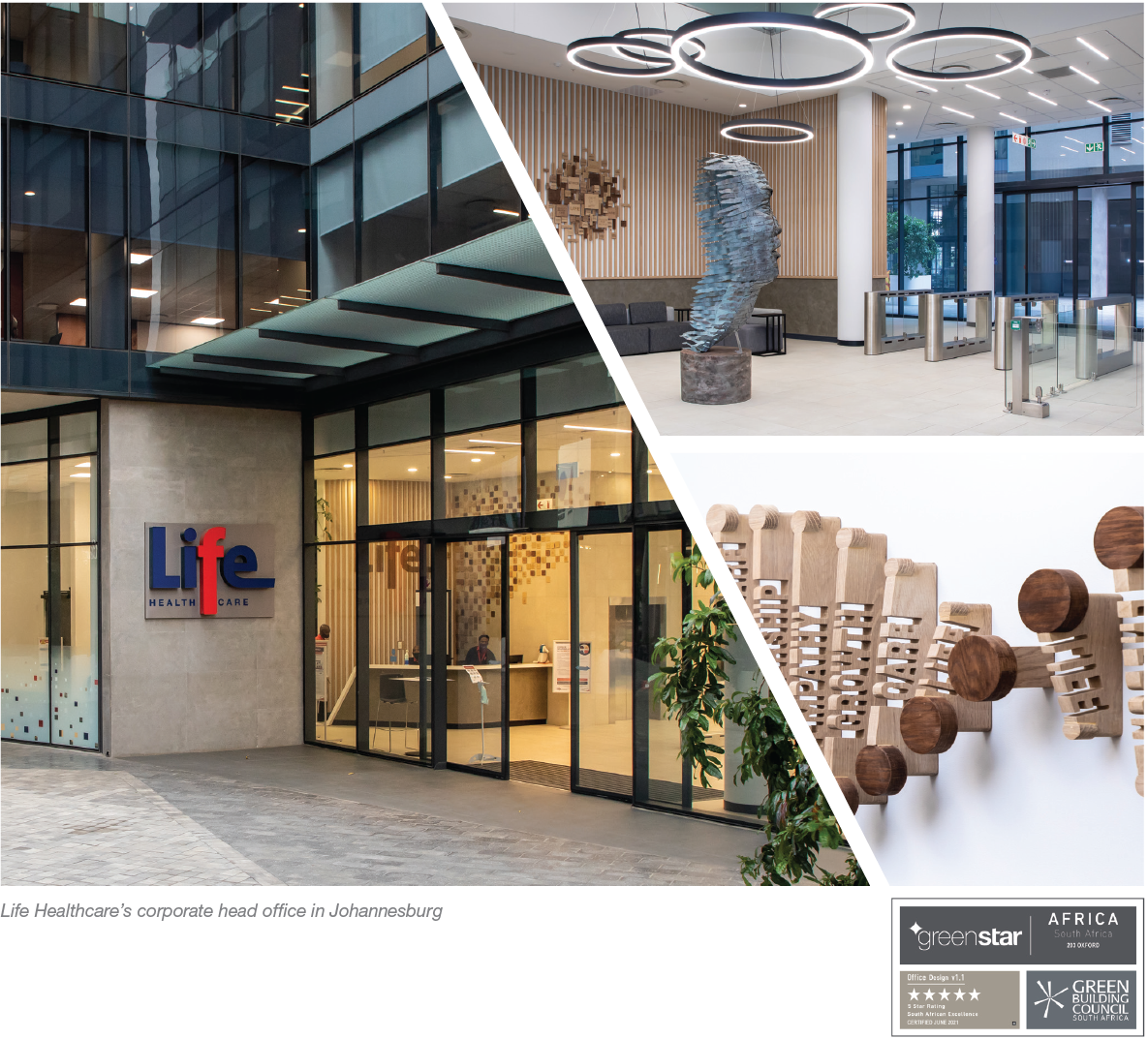
While as a Group we are in the early phase of our sustainability journey, we are delighted to have attained a significant milestone with the awarding of the 5-Star Green Star Office Design rating from the Green Building Council of South Africa for our new head office. This internationally recognised award is an indication of our commitment to protecting our people and our planet.
We also received an ‘AAA’ rating from MSCI ESG Research (2020: ‘A’) placing Life Healthcare in a best-in-class category within the global healthcare sector.
| 2021 | |
| FTSE/JSE Responsible investment index score | 3.3 |
|---|---|
| Sustainalytics ESG score (Risk rating = Low 10 – 20, Med 20 – 30, High 30 – 40) | 24.4 |
| MSCI ESG Research Inc. rating | AAA |
Our approach to sustainability as an international corporate citizen is guided by the United Nations Global Compact (UNGC) requirements and the United Nations – Sustainable Development Goals (SDGs), which are integrated within our own Global Code of Conduct.
Life Healthcare intends to set sustainability targets for the Group during 2022. The targets will be based on the material issues relevant to the nature of our business and our operating environment. The sustainability targets will become the driving tool for our business to attain strategic Group ESG goals.
ENVIRONMENTAL IMPACT
As part of understanding our impact on the environment, we have been measuring various environmental factors for a number of years. As we progress towards developing our environment goals and related targets in 2022, we will use 2021 as a baseline and as such are publishing some of the metrics below for the first time.
The diesel usage in our business relates to the requirement for us to have two back-up diesel generators at all of our hospital facilities so that we can continue to operate throughout the rolling electricity blackouts we experience regularly in South Africa. This is an imperative from a sustainability perspective, but the trade-off is that it has a negative environmental impact.
In our effort to become less reliant on grid-tied electricity, we have installed solar panels at 15 of our facilities over the last five years, and further installations are planned in the future. These solar installations have helped to reduce the Group’s dependence on grid-tied electricity by c.5%.
A total of 13 of the solar installations were developed by Fibon Energy, a renewable energy company based in Johannesburg. The appointment of Fibon Energy forms part of Life Healthcare’s empowerment strategy to harness corporate growth and inclusive development opportunities in a sustainable manner.
Our solar panel installations have:
Contributed
20%
SAVING TOWARDS ELECTRICITY CONSUMPTION
at installed sites
20%
SAVING TOWARDS ELECTRICITY CONSUMPTION
at installed sites
PRODUCED
ENOUGH
RENEWABLE
ENERGY ANNUALLY
to power
c.1 500
households
to power
c.1 500
households
PREVENTED the
equivalent of
c.7 800
TONS OF CO2 EMISSIONS
equivalent of
c.7 800
TONS OF CO2 EMISSIONS
SAVED the
equivalent of
33 000
TREES
equivalent of
33 000
TREES
Below is a summary of our key environmental data from our South African operations. For a more complete dataset, please refer to our separate Sustainability complementary data report which is available on our website.
| Life Healthcare emissions data* | UOM | 2021 |
| Scope 1 | tCO2e | 2 869 |
|---|---|---|
| Scope 2 | tCO2e | 142 922 |
| Scope 3 | tCO2e | 3 471 |
* This data refers to South Africa only.
ENERGY MANAGEMENT*
| KPI | Description | UOM | 2021 |
| Total non-renewable energy used | HFO | L | 415 472 |
|---|---|---|---|
| Petrol | L | 100 758 | |
| Diesel | L | 364 067 | |
| LPG | Kg | 108 773 | |
| Total renewable energy used | Solar PV | kWh | 7 821 437 |
| Electricity used | Purchased | kWh | 150 444 359 |
| Total electricity used | kWh | 158 265 796 | |
| Renewable energy consumption as a % of total energy consumption | % | 5.2 |
Water management*
| KPI | UOM | 2021 | 2020 | 2019 |
| Total water withdrawn | Kl | 1 274 035 | 997 867 | 913 090 |
|---|---|---|---|---|
| Total water withdrawn - municipal | Kl | 1 059 690 | 997 867 | 913 090 |
| Total water withdrawn - borehole | Kl | 214 345 | n/a | n/a |
WASTE MANAGEMENT*
| KPI | UOM | 2021 | 2020 | 2019 |
Total HCRW generated  |
Kg | 5 496 781 | 4 371 882 | 4 453 875 |
|---|---|---|---|---|
| HCRW - incinerated | Kg | 120 372 | n/a | n/a |
| HCRW - treated | Kg | 5 376 409 | n/a | n/a |
| Total HCRW generated per PPD |
Kg/PPD | 2.87 | 2.01 | 1.93 |
| HCRW - anatomical waste | Kg | 74 016 | n/a | n/a |
* This data refers to South Africa only.